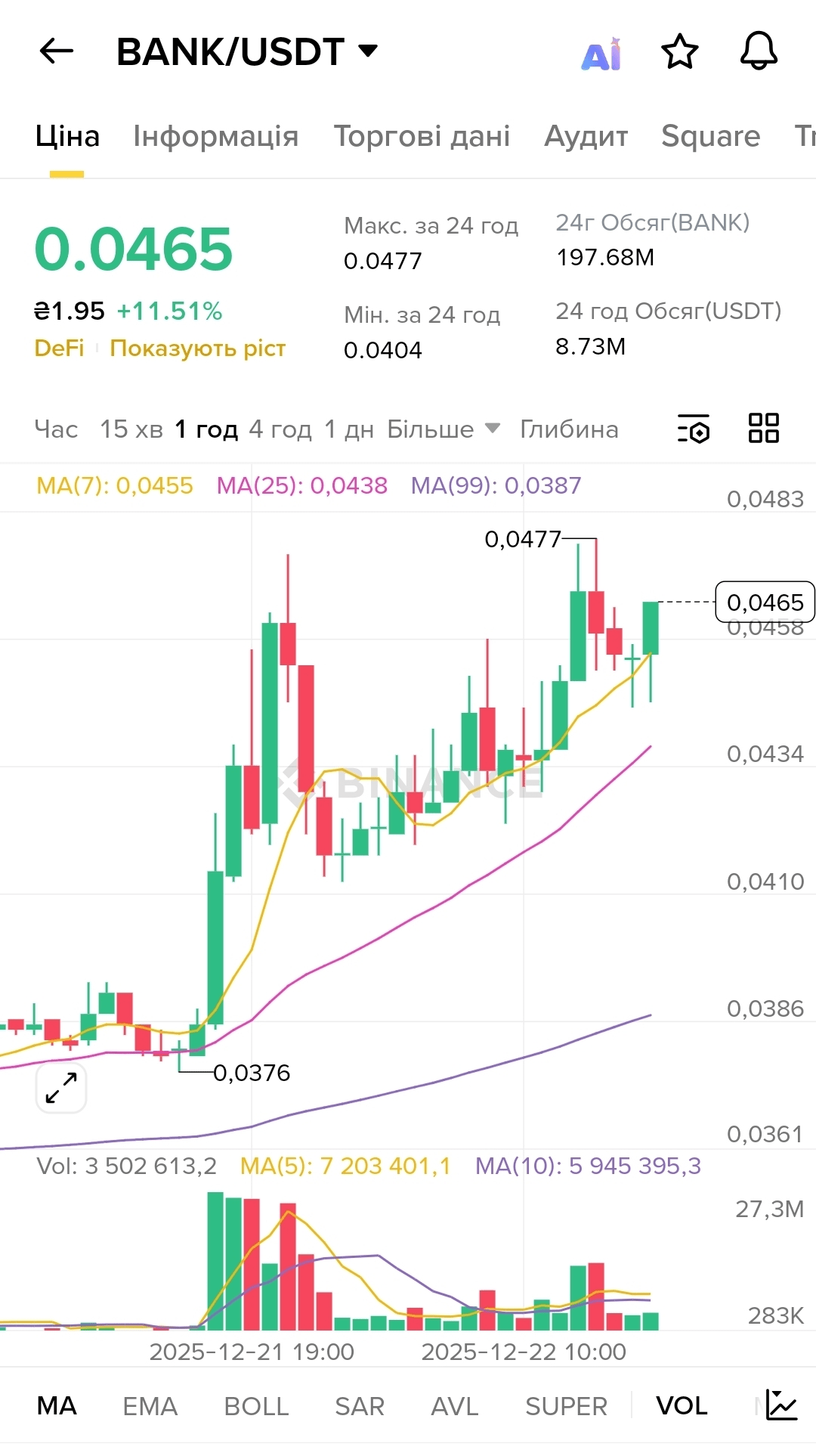
Do you see this graph $BANK ? Right now it shows +11.51%, and everyone is happy. But I look at it and think about something completely different — about how one small mistake somewhere in the fundamental strategy can turn this green graph into a red crash in just a few minutes. And this is not paranoia, it's the mathematics of complex systems, which @Lorenzo Protocol inherited along with its architecture of nested repositories.
I'll try to explain with an example that really worries me. Let's imagine there's a basic vault on Lorenzo that invests in a tokenized managed futures strategy — a classic CTA strategy in commodity markets. The manager of this fund trades contracts on oil, gold, wheat. Usually, he uses a leverage of 2-3x, which is normal for such strategies. Now, on top of this basic vault, someone creates a compositional vault — it takes tokens from five different underlying strategies, including our CTA, and creates a "diversified portfolio." Sounds reasonable, right? We reduce risk through diversification. But here's where the magic of non-linearity begins.
The compositional vault also has its own risk management parameters embedded in smart contracts. Let's say that if the volatility of the portfolio exceeds a certain threshold, it automatically reduces exposure to all underlying strategies. This seems logical — protection against excessive losses. Now, let’s see what happens if the manager of the CTA strategy makes a small mistake. Not catastrophic, just an ordinary human error — misjudging the position size or failing to close the hedge before important news. His fund loses 5% in a day. Unpleasant, but not critical for an experienced manager trading with volatility.
But this 5% loss triggers a chain reaction. The compositional vault sees a sharp drop in one of its components and recalculates the overall volatility of the portfolio. Volatility spikes, the trigger activates — the vault automatically reduces exposure by selling part of the tokens of all underlying strategies. Not just the problematic CTA, but all of them. This creates selling pressure in the market for these tokens. Prices fall not because something is wrong with the strategies, but because one smart contract executes automatic orders. And now imagine that there are not one but ten such compositional vaults holding the same CTA token. They all see the same volatility and trigger the same protection mechanisms at the same time. A cascade.
I once read about a similar situation in traditional finance — the Flash Crash of 2010, when algorithms started selling in response to other algorithms' selling, and in 36 minutes, the market lost a trillion dollars in capitalization. But at least there were circuit breakers — automatic trading halts. In #LorenzoProtocol there is no such mechanism because the blockchain does not stop. DeFi operates 24/7, smart contracts execute instantly, and there is no pause button.
It becomes even scarier when you think about the fact that compositional vaults can be nested within each other several levels deep. Vault A invests in underlying strategies. Vault B invests in Vault A plus other compositional vaults. Vault C invests in Vault B. And each level has its own risk management parameters, its own triggers, its own rebalancing logic. A small mistake at the lower level gets amplified at each subsequent level through these automatic mechanisms. Mathematicians call this non-linear dynamics — when small input changes lead to disproportionately large output changes. The butterfly effect: a butterfly flaps its wings in Brazil, and a month later, there's a tornado in Texas.
I specifically looked at the trading volumes $BANK over the last day — 8.73M USDT. That's not very much. And now imagine a panic selling situation when all compositional vaults are simultaneously trying to reduce exposure. There simply won't be enough liquidity to absorb this selling pressure without huge slippage. Token prices could fall far below their fair value (NAV of the underlying assets), creating a gap that arbitrageurs physically won't be able to close in time. And worst of all — this gap itself becomes a signal for the next wave of automatic sales.
Do you know what worries me the most? The fact that the architects of Lorenzo probably understood this risk when designing the system. They're not stupid; they know about the complexity of compositional structures. But they seem to have bet that the diversification and risk management of each individual vault would neutralize this risk. A classic mistake — thinking that systemic risk can be eliminated by distributing it among many participants. But in reality, you're just hiding it deeper, making it less obvious, and when it manifests — it manifests everywhere at once.
There’s another aspect that complicates the situation — delays in updating data. Oracles that supply prices of underlying assets for calculating the NAV of tokenized funds have certain latency. Let's say the price of the oil futures contract changed on the CME, but Lorenzo sees this change with a delay of a few minutes. During these minutes, compositional vaults make decisions based on outdated data. And when fresh data finally arrives, it turns out that the situation is completely different, and all decisions were wrong. This creates an additional layer of chaos — not just a cascade, but a cascade based on incorrect information.
I'm not saying that @Lorenzo Protocol will necessarily face such a crisis. Perhaps the protocol will exist for years without serious incidents, and everyone will be happy. But the probability of such a scenario is non-zero, and most importantly — it increases with the complexity of the system. The more compositional vaults, the more levels of nesting, the more automated risk management mechanisms — the higher the likelihood that all of this will converge at one point in time and create a perfect storm. And when that happens, it won't matter how good the intentions of the developers were or how professional the managers of the underlying strategies are. The mathematics of complex systems does not forgive design errors.
Looking at this chart with its MA(7) at 0.0455 and MA(25) at 0.0438, I think about how all these technical indicators, all these support and resistance lines — they work in a world of linear systems, where causes are proportional to effects. But Lorenzo is not a linear system. It is a complex network of interdependent components, where a small change in one place can lead to an avalanche effect elsewhere. And as long as the market is rising, as long as volatility is low, as long as all strategies are showing positive results — this complexity goes unnoticed. It only becomes apparent in times of stress. And at the moment of stress, it's already too late to change anything because smart contracts execute automatically, without human intervention. This is where the irony of decentralization lies — we have created a system that no one can stop, even when it becomes clear that it is heading toward a cliff.
#LorenzoProtocol @Lorenzo Protocol $BANK