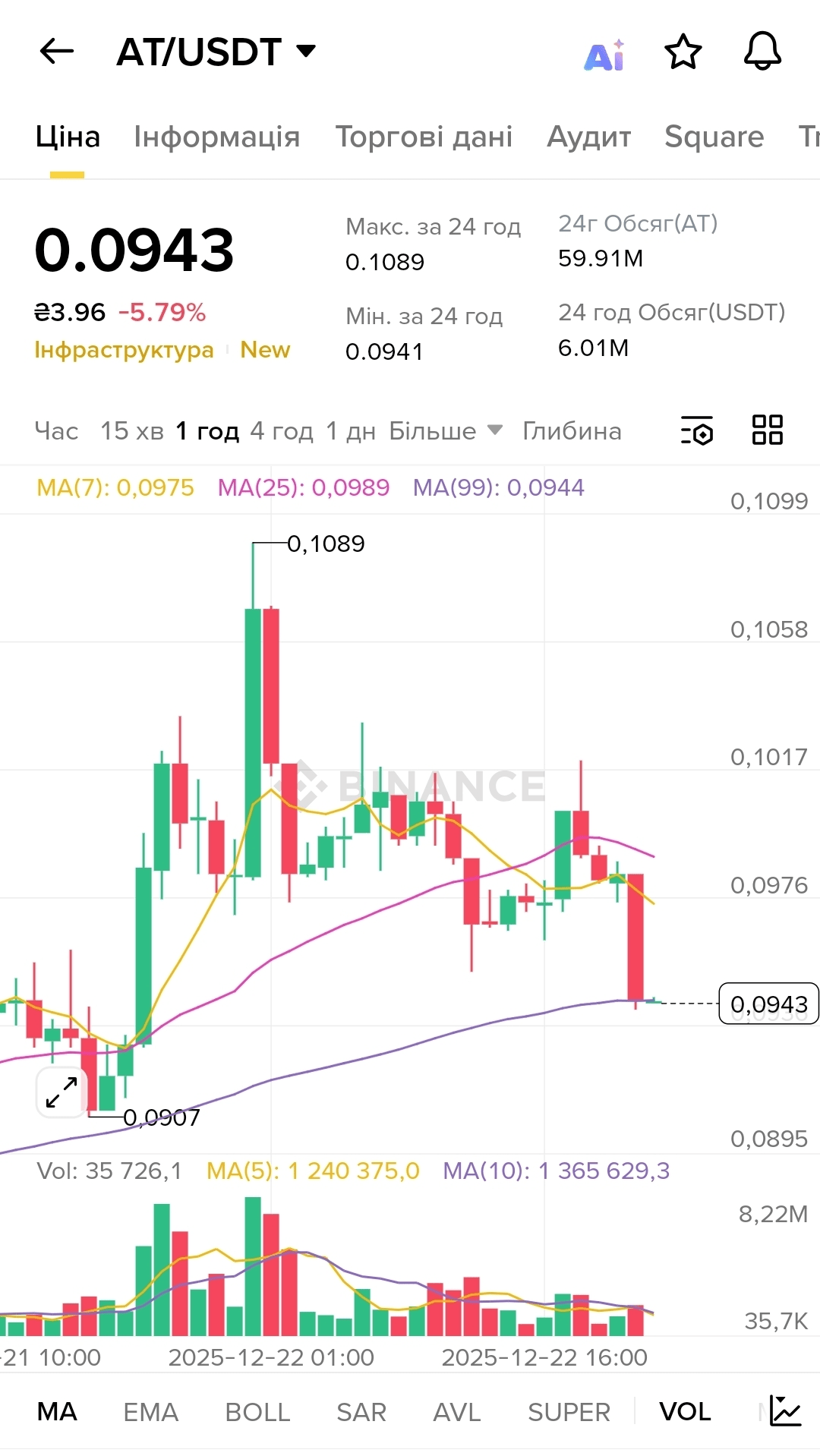
This morning I opened my wallet, looked at my tokens $AT — the price is 0.0943, down almost six percent in a day, a bit painful, I won't hide it. But do you know what worries me much more than the short-term drop? A strange philosophical thing that I accidentally thought about last week. Imagine the ship of Theseus — that same ancient Greek paradox. The ship sails, and over time each board in it is replaced with a new one. After ten years, not a single original part remains. The question is: is it still the same ship?
And suddenly I realized — @APRO Oracle is also the ship of Theseus. Only instead of boards, there are code, team, architecture, partners, even the philosophy of the project. And all of this is constantly changing. Update after update, fork after fork, new staff, new solutions. In a few years, not a single line of original code may remain. Will this still be the same #APRO that we trust now?
Honestly, this question truly worries me. Because when we invest in a project, we invest not just in a token — we invest in trust. Trust in the team, in the technology, in the approach, in the values. But what happens to that trust when everything gradually changes? At what point does APRO stop being APRO and become something else?
I look at the trading volume — six million per day — and wonder how many of these people even think about this? Most look at the price, at the market capitalization, at the roadmap. But no one asks — will what happens in three years have anything in common with what we invested in today?
Let's take a specific example. @APRO-Oracle is currently using a certain architecture for data verification. Suppose, a year from now, the team decides — the old architecture is inefficient, it needs to be completely rewritten. They do this gradually, module by module. After a year and a half, 80% of the code is new. Is it still the same oracle? Formally, yes — the name is the same, the token $AT is the same, the team may even be the same. But technologically, it’s already a completely different system.
And here arises the question of trust. I trusted the original architecture because it was tested, audited, had a track record. But the new architecture? It may theoretically be better, but it has not yet stood the test of time. Should I automatically trust it just because it bears the same name #APRO ?
Or take the team. The founders of the project have a certain vision, certain principles. But after a few years, some of them will leave — this is normal for any startup. New people will come with different ideas, different cultures, different priorities. They may be more commercially oriented, or more risky, or more conservative. The project gradually drifts in a different direction.
Is this still the same APRO? Legally, yes — the same company, the same token. But essentially? If the value orientations have changed, if the approach to development is different, if priorities have shifted — this is already a different project, just with the same name.
This worries me because in crypto we often invest for years. We hold tokens, hoping that the project will grow. But what exactly will grow? The same idea that was at the start? Or something completely different that just inherited the old name and token?
I look at the maximum for the day — 0.1089, minimum — 0.0941 — and think about another aspect. The community is also changing. Early followers of $AT had certain expectations, certain values. They believed in decentralization, in transparency, in a certain philosophy. But as the project grows, a mass of new people comes in who don't care about these things. They are only interested in profit.
And suddenly the community that determines the direction of development through voting becomes completely different. It makes decisions that the original community would never have supported. The governance of the token gives them the right to do so. But is this fair to those who were there from the beginning?
There is this thing in philosophy — the essentialist vs nominalist approach. Essentialists believe that things have a certain immutable essence. Nominalists say — essence does not exist, there is only the name we give to a set of characteristics. I lean towards nominalism. For me, @APRO Oracle is not some abstract essence, but a concrete combination of code, people, values, approaches. And when this combination changes, the project changes too, even if the name remains.
But then a practical question arises — how can an investor protect themselves? I invest in a certain project with certain characteristics. But there are no guarantees that in two years these characteristics will remain. The team may leave, the architecture may change, the community may become different. And I will be stuck with a token that is named the same but is essentially completely different.
Maybe there need to be some mechanisms of "constitutional protection" for projects? Like, certain fundamental principles are enshrined in governance and cannot be changed by a simple majority vote. So that even if everything else changes, the core of the project remains the same.
But who determines what the "core" is? And won't this become a brake on development? If #APRO cannot radically change, it may not keep up with the market. Competitors will be more flexible, faster, more innovative. And the project will die not because it changed, but because it refused to change.
This is the classic dilemma of identity and adaptation. To survive, you have to change. But if you change too much, you lose yourself. Where is the balance?
Honestly, I don’t know the answer. But I think the industry needs to start discussing this question. Right now, we behave as if projects are static objects with unchanging identities. But in fact, they are living, constantly evolving organisms. And this evolution can go so far that nothing will remain of the original.
Maybe there needs to be greater transparency of changes? When @APRO Oracle makes a significant update, should they somehow signal — "Attention, this is not just a technical improvement, this is a fundamental change in approach"? So that investors can consciously decide — whether to continue trusting, or if this is no longer the project they invested in?
Or maybe tokens should have versions? Like, when a radical change occurs, a new token AT2.0 is issued, and holders of the old one can choose — to exchange for the new one or to stay with the old version of the project if it continues to exist as a fork.
But this creates fragmentation, confusion, dilutes liquidity. Maybe worse than the problem we are trying to solve.
I look at this chart, at these candles — green, red, green again. Every day $AT a little different. Every day @APRO-Oracle is a slightly different project than it was yesterday. New transactions, new users, possibly new lines of code, new team solutions. It’s a continuous process of transformation.
And the question is not whether APRO will change — it will definitely change. The question is whether these changes will be an evolution of the same organism or at some point it will become a different organism that simply lives in the old shell.
For me personally, this means — you cannot "invest and forget". You need to constantly monitor not only the price but also the project itself. Does it still align with the reasons I invested money? Does the team still have the same vision? Is the technology developing in the direction I support? Is the community still made up of people whose values are close to mine?
If the answer to these questions changes — maybe it's time to review the investment. Not because #APRO has become a bad project. But because it has become a different project. And the one I invested in no longer exists, even if the name and token remain the same.
This is not pessimism — it is realism. The ship of Theseus will continue to sail, regardless of whether the original boards remain in it. But if I boarded through certain boards, I should know when they were replaced with others. Even if the new ship is technically better, it may not take me where I wanted to sail.
I sit, finishing my already cold coffee and think — maybe this is the deepest truth about crypto investments. We invest not in projects, but in moments in time. In a specific version of a project at a specific moment. And this version exists only now. Tomorrow there will be another version. Maybe better. Maybe worse. But definitely different.
And the only thing we can do is to be attentive, critical, ready to acknowledge that the ship we are sailing on is no longer the same ship that left the port. And to decide — to continue the journey on a new ship with the old name, or to disembark and look for something else.