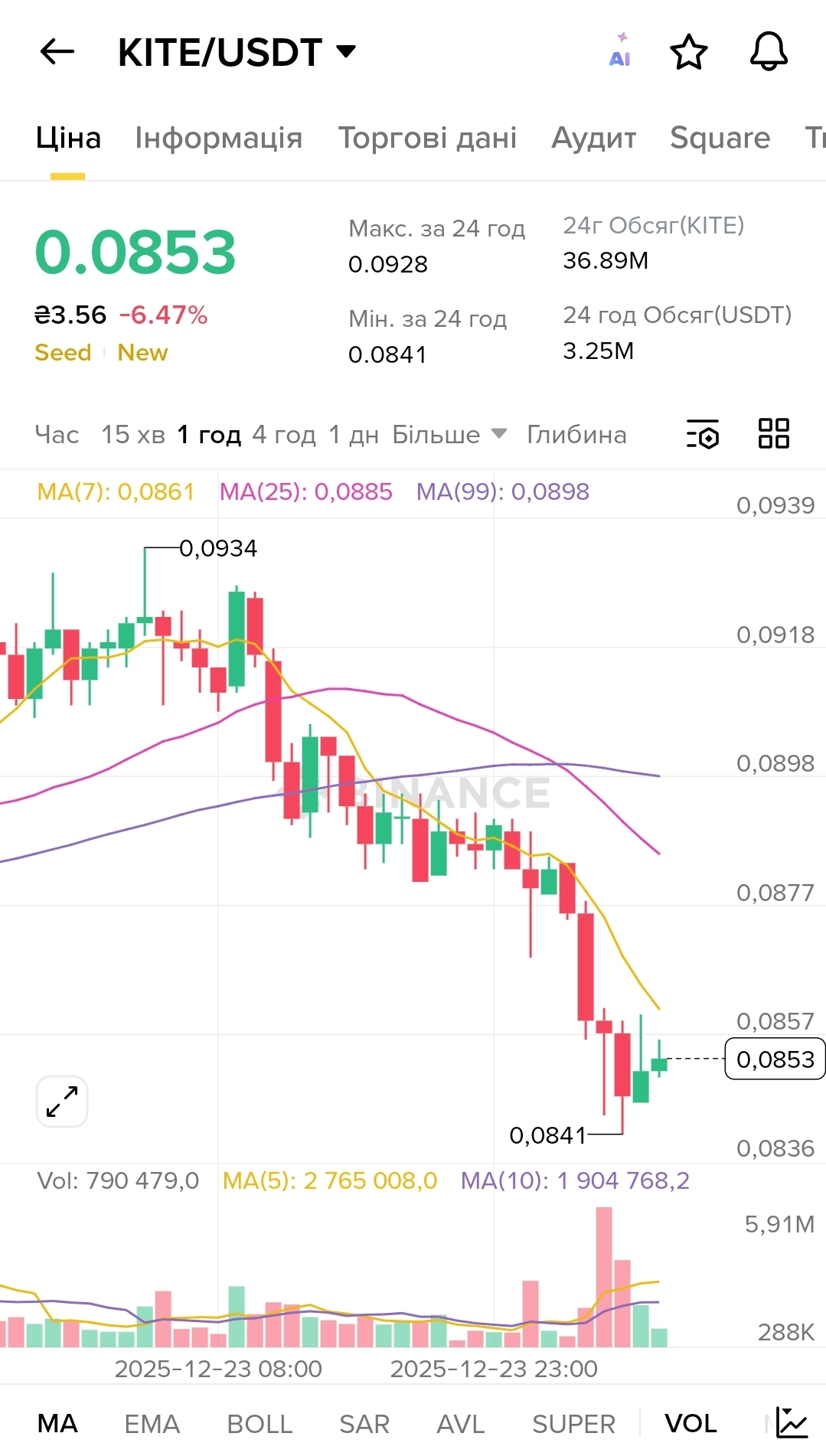
Price $KITE $0.0853, -6.47% — a big red day. The chart is flying down, the minimum touched $0.0841, and I am sitting and watching this. Do you know what I feel? Not panic. Curiosity. Because what is happening now is the best test for any project. When everything is falling, you see the real picture. Who panics. Who sells. Who holds. And most importantly — does what they are building work, regardless of the price.
Let's be honest: integration with Shopify and PayPal sounds cool in a presentation. But what does it actually mean? I spent the evening digging deeper because when the token drops by 6%, I want to know if there's a reason to hold or if it's a Trojan horse that looks like an opportunity.
Here's what I understood: @KITE AI is not just a "partner" with PayPal in the sense that they are taking selfies together at a conference. PayPal Ventures invested $18 million. This is not a PR move. This is a strategic bet. Now think: why would PayPal, a company with 400 million users and trillions of dollars in turnover, invest in an agency payment platform?
Because they see what most do not see. PayPal is not stupid. They know their traditional business model is under threat. Not from crypto. From agents. Imagine a world in five years: your AI assistant buys plane tickets for you, books hotels, orders food, pays subscriptions. It does this not through your PayPal account manually. It does this autonomously, through API, microtransactions, instantly. And PayPal either becomes part of this infrastructure or dies, like BlackBerry when smartphones came.
Integration with Shopify is not "agents can buy things on Shopify". It’s "agents become a new class of buyers". Shopify serves millions of merchants. These merchants sell to people. But what if tomorrow 30% of transactions come not from people but from agents? An agent buying office supplies for a company. An agent ordering ingredients for a restaurant based on demand forecasts. An agent buying gifts for clients based on their preferences. Shopify needs to be ready for this. And $KITE gives them that readiness.
But here’s what really struck me: this is not just integration. This is a Trojan horse in the Web2 economy. PayPal and Shopify are gigantic gateways to the traditional economy. Billions of transactions daily. Millions of merchants. Hundreds of millions of users. And @GoKiteAI is advancing through these gates unnoticed. Not as a "crypto-revolution that will destroy everything". But as "a new feature that makes payments faster and cheaper".
Merchants on Shopify will not know that the transaction went through the blockchain. PayPal users will not know that their agent is using PYUSD and state channels. They will just see: "Payment completed. Quickly. No fees". And under the hood, $KITE is working. It’s brilliant because it avoids the biggest problem of crypto — the adoption barrier.
Do you know why most people don’t use crypto? Not because they don’t understand the technology. But because they don’t see a reason to change what already works. "I have PayPal, why do I need Metamask?" But if PayPal itself integrates crypto internally — users don’t have to change anything. They just get better service. And cryptocurrency works in the background.
It’s like Uber. Most people who order Uber don’t think about it as a peer-to-peer platform that disrupts the traditional taxi industry. They just think: "It’s more convenient and cheaper than calling a regular taxi". And that’s why Uber won. Not because of revolutionary ideology. But because of better user experience.
$KITE does the same with payments. Agents on Shopify will not "use blockchain". They will just pay. Quickly. Cheaply. Without friction. And what works under the hood is #KITE with its state channels and sub-100ms latency — that's an implementation detail that doesn't bother the end user.
And here I understand the strategy. Most crypto projects try to pull people from Web2 to Web3. "Come to us! Here’s decentralization! Freedom! Revolution!" And people say: "I’m fine where I am, thank you". But Kite says: "Okay, we’ll come to you". Through PayPal. Through Shopify. Through existing merchant networks.
This is a Trojan horse in the best sense. Not an aggressive attack. But a quiet penetration through existing channels of trust. PayPal is trusted by millions. Shopify is trusted by millions of merchants. And when they say: "We’ve integrated new payment technology" — no one asks "Is this blockchain?" People just start using it. And then suddenly it turns out that half of their transactions are going through a decentralized network. And they don’t care because it just works.
I think about scale. PayPal processes $1.5 trillion in transactions per year. Shopify — over $200 billion from its merchants. Even if only 1% of these transactions go through agents on $KITE — that’s $17 billion in turnover. And what if 5%? 10%? Suddenly Kite becomes not a "niche solution for crypto geeks", but critical infrastructure for the global economy.
But here’s the question that worries me: can Kite pull this off? Because one thing is having partnerships on paper. Another is actually processing billions of transactions without failures, with minimal latency, with near-zero fees. Can state channels scale to that volume? Can L1 handle the load? I don't know. Nobody knows until they try.
And here I look at the chart -6.47% and think: maybe the market sees something I don’t see? Maybe there are technical limitations I don’t know about? Maybe the integration will be more complicated than it seems? I’m not an expert. I’m just a person trying to understand where the money is going.
But here’s what I know for sure: if Kite can become the rails for the agency economy within PayPal and Shopify — this is not just a "successful project". This is infrastructure that changes the game. Because suddenly crypto becomes not an alternative to the traditional economy but a part of it. Unnoticed. Invisible. But critical.
It’s like TCP/IP. No one thinks about TCP/IP when opening a website. But without it, the internet doesn’t work. Maybe $KITE will become TCP/IP for agency payments. Or maybe it won’t. But if there’s at least a 20% chance of that — it’s worth paying attention to. Even when the chart is red. Especially when the chart is red. Because it’s on days like this that it’s determined who believes in technology and who is just chasing the pump.