


VanEck analysts noted that Bitcoin's network hash rate declined by 4% over the month ending December 15, which could be a positive signal for Bitcoin prices in the coming months, as miner capitulation has historically been viewed as a bullish contrarian indicator.
The decline in hash rate indicates that a bottom is near.
VanEck Head of Crypto Research Matt Sigel and Senior Investment Analyst Patrick Bush stated in a report released on Monday:
When the state of hash rate compression persists for a longer period, the probability of Bitcoin subsequently showing positive returns and the magnitude of those returns tends to be higher.
They pointed out that since 2014, when Bitcoin's network hash rate has declined in the first 30 days, the rate of positive returns 90 days later has been positive 65% of the time; in contrast, under conditions of rising hash rate, the proportion of positive returns after 90 days is only 54%.
Even if the observation period is extended, this pattern still holds. When the hash rate shows negative growth in the first 90 days, the probability of Bitcoin rising in the following 180 days is as high as 77%, with an average increase of 72%, significantly better than the positive return performance of only 61% during the hash rate growth period.
This trend is also favorable for Bitcoin miners, as a price rebound would help expand the profit margins for some miners, and may even bring back online mining machines that were previously unprofitable. The current Bitcoin price is approximately $88,400, according to CoinGecko data, down nearly 30% from the historical high of $126,080 set on October 6.
The breakeven electricity price for Bitcoin miners has dropped significantly by over 35%
Sigel and Bush further pointed out that the currently most mainstream mining machine, Bitmain S19 XP, launched in 2022, has seen its breakeven electricity price drop from $0.12 per kWh in December 2024 to $0.077 in mid-December, a decline of nearly 36%, highlighting the severity of the current operating environment for miners.
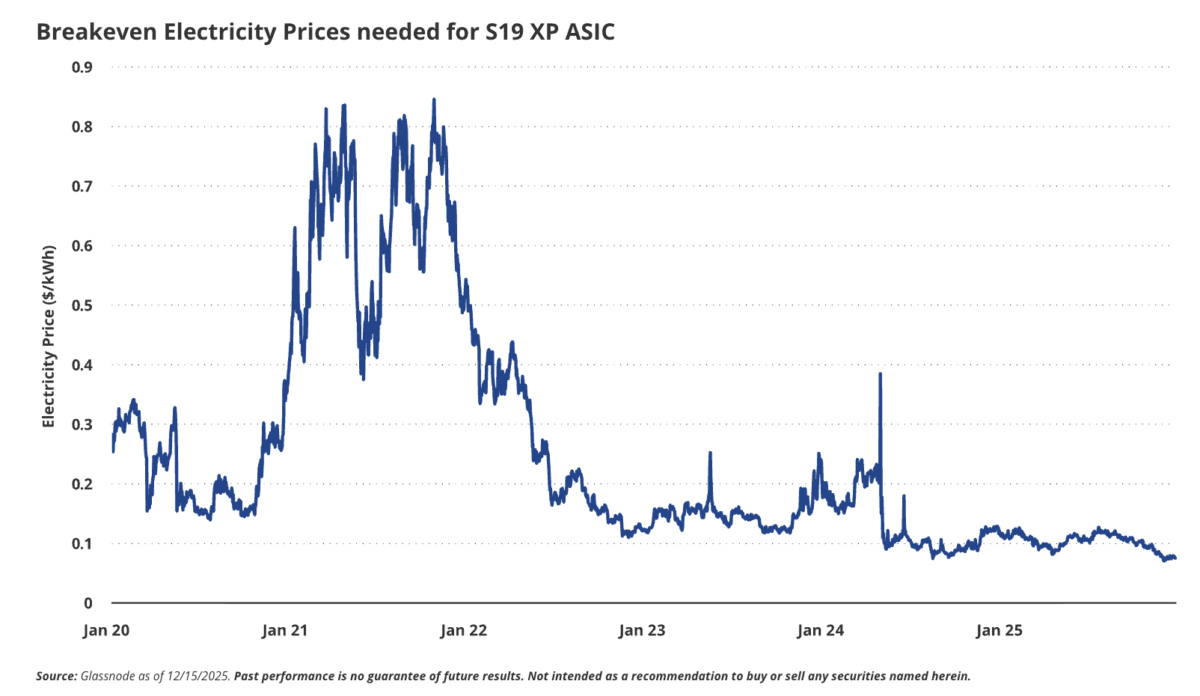
VanEck analysts believe that the 4% decline in hash rate is the largest drop since April 2024 and is likely related to the shutdown of approximately 1.3 GW of Bitcoin mining power in China recently. Analysts further noted that this portion of electricity may shift to support AI computing demands in the future, and under extreme conditions, this trend could further erode up to 10% of the Bitcoin network's hash rate.
Governments around the world continue to support Bitcoin mining
Despite some regions gradually exiting the Bitcoin mining industry, Sigel and Bush estimate that there are still up to 13 countries supporting Bitcoin mining activities to varying degrees. These countries include Russia, France, Bhutan, Iran, El Salvador, the UAE, Oman, Ethiopia, Argentina, Kenya, and Japan, which recently joined.
Reference
Source
