The article uses multiple case studies to illustrate the huge losses experienced by different individuals in the crypto market in 2025, including contract trading, spot investment, and hacking attacks, revealing the high risks and dark forest theory of the crypto market.
Article author and source: angelilu, Foresight News
The crypto market in 2025 is much like a high-speed express train running at full speed. Looking back from the platform, people can only see the survivors celebrating in the windows, but few notice the passengers who have been thrown off the tracks.
This year, we not only witnessed the madness of gamblers in the futures market, but also the brutal infiltration of the Web3 dark forest theory into the physical world. Stories of sudden wealth are largely similar, but the ways to lose everything are incredibly varied. We reconstructed the financial losses of several typical individuals in 2025—among them billionaires, tech geeks, legendary gamblers, and even ordinary people who simply wanted to save money.
Trading Section
Machi Big Brother becomes the "liquidation champion" on the blockchain.
Identity: Famous singer, entrepreneur, NFT whale
Losses: 71 liquidations in the first 19 days of November alone; single-day losses of $21.28 million.
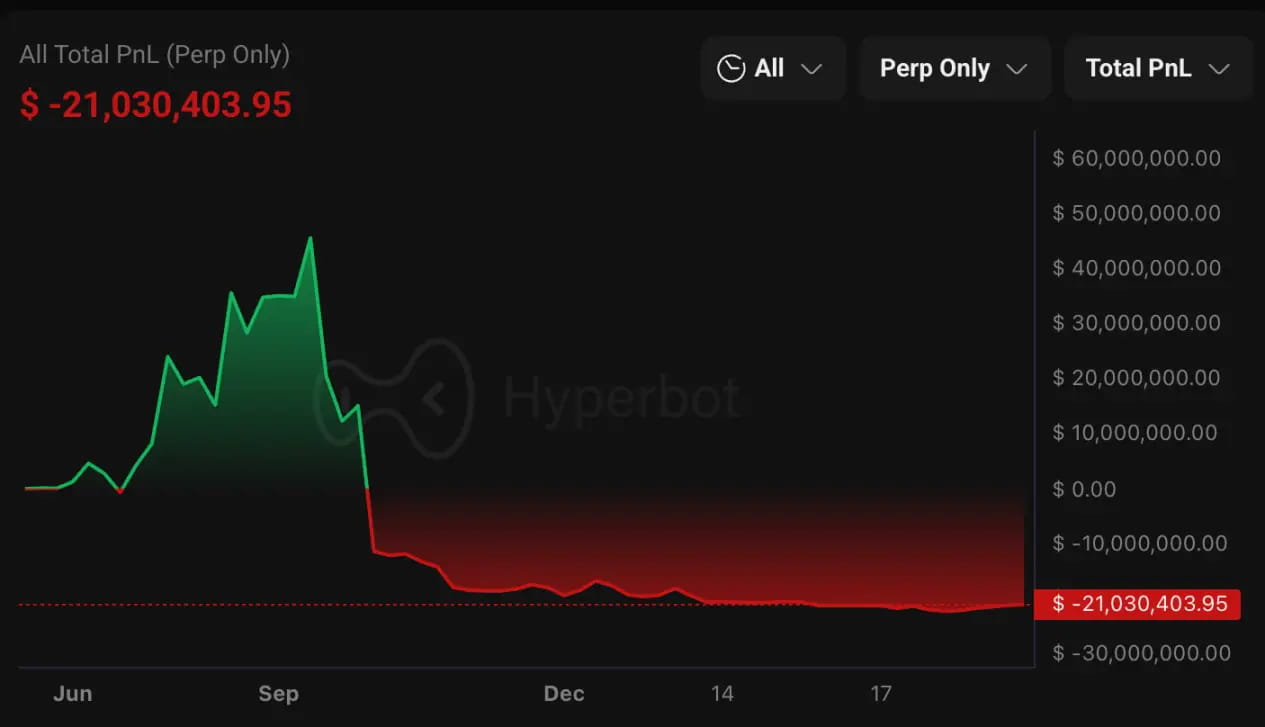
Huang Licheng's PnL profit and loss curve, source: Hyperbot
Rewind three months, and Brother Machi was a winner in the Hyperliquid ecosystem. His heavily invested HYPE, XPL, and ETH had yielded a paper profit exceeding $44 million. However, in late September and early October, the price of XPL crashed (with a maximum drawdown of 46%), and HYPE also experienced a significant pullback. His failure to take profits in time caused his paper losses in those single tokens to rapidly escalate to over $8.7 million.
Following the market crash on October 11th, Brother Machi officially turned to losses. However, turning to losses was not the end for Brother Machi, but rather the beginning of his endless opening of new positions. He attempted to recoup his losses by going long on ETH with high leverage. He held long positions in ETH ranging from approximately 7,000 to 30,000 coins (with leverage ratios often between 20x and 25x), but every time ETH experienced a sharp drop, it triggered his liquidation order.
In just 19 days, from November 1st to 19th, Brother Machi was forcibly liquidated 71 times. This means that for nearly three weeks, he experienced an average of nearly four liquidations per day, earning him the title of "liquidation champion" on the blockchain. He kept depositing, being liquidated, depositing again, and being liquidated again. As of this writing, his total losses on Hyperliquid perpetual contracts have reached $21.2 million. From a profit of $45.66 million to a loss of $21.2 million, he experienced a loss of over $66 million in less than three months. Despite a brief recovery, he remains in a state of deep losses and frequent margin calls.
Unlike ordinary people, Huang Licheng (aka Machi Big Brother) once enjoyed the spotlight of a superstar. In the 1990s, he was the soul of Taiwan's L.A. Boyz, a pioneering idol who brought authentic American hip-hop to the Chinese music scene. This isn't the first time Machi Big Brother has played the role of a "savior for retail investors." Everyone surely remembers the NFT battleground of 2023. To compete for BLUR airdrop tokens, he frantically boosted trading volume in this bottomless pit. The outcome was disastrous: he did receive airdrop tokens worth $1.9 million, but at the cost of losing 12,000 ETH (worth $25 million at the time).
James Wynn's billion-dollar gamble
Identity: James Wynn
Loss: $1.25 billion worth of Bitcoin long positions were opened, and $100 million was lost in one week.
If Machi is "a pastime for the rich," then James Wynn's story is like that of a mortal who flew too high and whose wings were eventually melted by the sun.
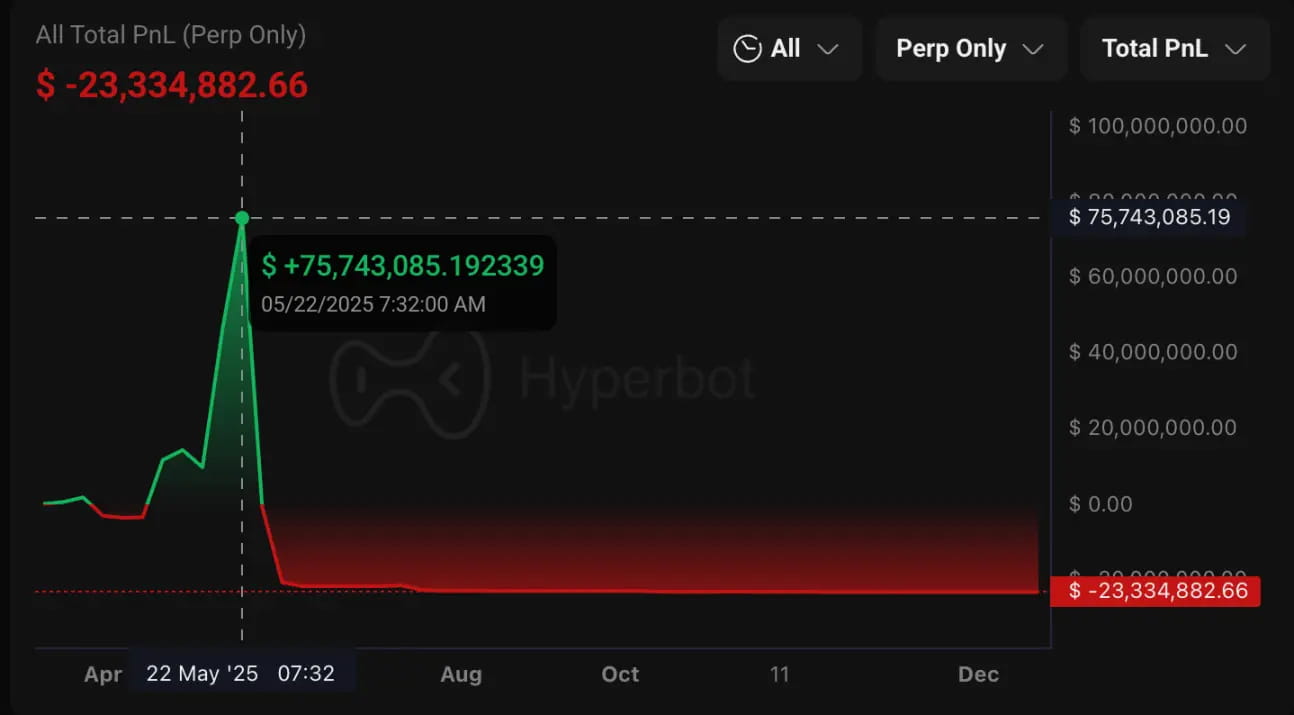
While both are contract trading, James Wynn's legend began with PEPE, but exploded on the Hyperliquid contract trading battlefield. In March 2025, James Wynn entered Hyperliquid with a massive $25 million he had earned from PEPE. This $25 million was earned from a mere $7,600 initial investment in PEPE, which he had heavily invested in in 2023. However, the gains in the spot market were not enough for him. Between March and April, he aggressively went long on PEPE and ETH, earning another $25 million, transforming himself into a super whale with $50 million in assets.
In May 2025, James Wynn set his sights on Bitcoin, which was then approaching its all-time high of $110,000. At that time, James Wynn did something significant on-chain: near Bitcoin's all-time high of approximately $108,000, he leveraged 40 times to open a massive long position with a notional value of $1.25 billion. To put this into perspective, his on-chain holdings alone exceeded the national reserves of many small countries. He attempted to use this $1.25 billion leverage to pry open the door to becoming the world's richest person.
But a subsequent sharp correction in Bitcoin, breaching the $105,000 mark, became James Wynn's nightmare. In just one week, his priceless contract melted away like an iceberg in the sunlight. Ultimately, he was forced to cut his losses and exit the market, losing nearly $100 million. Overnight, the astronomical sum he had earned through PEPE was almost entirely returned to the market. In his devastating collapse, he tweeted his famously nihilistic quote: "Money isn't real."
Unwilling to accept defeat, James Wynn attempted to recoup his losses in November, but he misjudged the situation—betting that Bitcoin would fall below $92,000 and shorting it with his remaining funds. Data documents his final frenzy: within just two months, he was liquidated 45 times; on his worst day, he suffered 12 consecutive liquidations within 12 hours. The once-renowned "Memecoin prophet" has become a gambler screaming at candlestick charts. He vowed on social media: "I'm going to sell all my stablecoins and short them. Either I'll make hundreds of millions, or I'll go completely bankrupt."
A major spot whale suffered a loss of $125 million and "cut its losses" to exit the market.
Identity: A whale who borrowed cryptocurrency to short 66,000 ETH
Losses: Single position unrealized loss of $125 million; $140 million transferred to Binance within 8 hours for market manipulation.
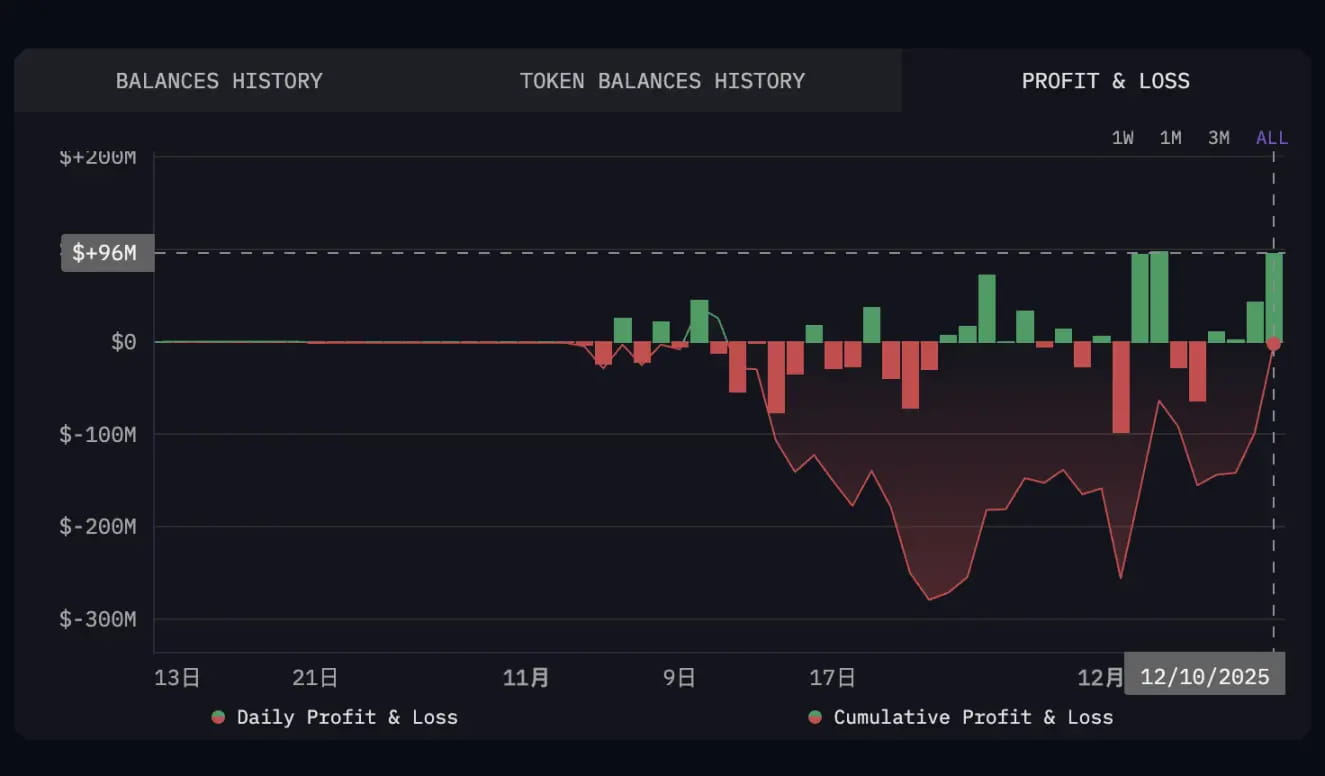
Besides contracts, whales holding spot assets can also suffer huge losses. The whale that "borrowed to short 66,000 ETH" was once a market hunter, skilled at using lending protocols for large-scale short arbitrage. But this time, the hunter became the prey.
Making $24 million by shorting cryptocurrency wasn't enough for him; he wanted more—he wanted to profit from both long and short positions. On November 5th, after closing his short positions, he immediately switched gears and began a frenzied buying spree. In just nine days, up to November 14th, he seemed possessed, transferring a total of $1.187 billion to Binance and withdrawing 422,000 ETH, driving his average holding price up to $3,413. For this high-stakes gamble, he even used a staggering $485 million in on-chain leveraged lending.
The market delivered a brutal slap to this greedy individual. As the price of ETH plummeted, breaking below the $3,000 mark, his "bottom-fishing" turned into a deep loss. On-chain data recorded his most desperate moment: at the worst point in November, his massive long positions suffered a floating loss of up to $133 million. The $24.48 million profit he had painstakingly earned from shorting was instantly swallowed up by this huge loss, and he even lost his principal of $100 million. The former "short-selling god" became a "leveraged gambler" burdened with $480 million in debt, thanks to borrowed money.
On November 16, the whale began its massive retreat, redeeming 177,000 ETH from Aave and starting to deposit 44,000 ETH (worth $140 million) into Binance in batches, resulting in an actual loss of $125 million.
The giant whale that collapsed in the "Chinese Meme"
Identity: Whale heavily invested in Chinese memes at high points
Loss: Cumulative loss of US$3,598,000 (US$2,490,000 loss per currency)
Besides stubbornly holding onto ETH, many others have also suffered losses by stubbornly holding onto Meme.
In October 2025, while market focus shifted between AI and mainstream cryptocurrencies, this whale became entangled in a narrative maze of "Chinese memes".
Like a dedicated stamp collector, he invested $4.49 million to aggressively build a portfolio of Chinese meme tokens on the BSC blockchain: "Binance Life," "Customer Service Xiao He," and "Hakimi." He heavily invested in "Binance Life" at an average price of $0.3485, continuously increasing his holdings until he reached $4.08 million, becoming the 7th largest individual holder of the token. The market gave him countless opportunities to exit, but he chose to be a "diamond hand" (meaning he held onto his position until the market closed).
After holding his position for eight days, his Meme holdings shrank by 56.5%, resulting in a paper loss of over $3 million. Except for "Hakimi," all Meme tokens collapsed, but he didn't liquidate his holdings, continuing to chase the rising prices. Finally, in early November, his faith crumbled under the weight of the zero-price trend, and he liquidated all his tokens within 50 minutes. The outcome was disastrous: a total loss of $3.598 million. Of this, "Binance Life" alone cost him $2.49 million.
This whale learned a lesson with $3.6 million: in the world of Meme, what's more terrifying than contracts is a liquidity crunch. Once the trend turns bad, every second is a window of opportunity to escape; holding on will only lead to nothing.
The "instant karma" of an "unknown hacker"
Identity: Blockchain hacker / Top "reverse indicator"
Losses: Trading losses in October alone reached $8.88 million.
This might be the most "satisfying" loss story of 2025. We usually think of hackers as ruthless, rational predators, but this "unknown hacker" proved with his actions that he only understands code and not candlestick charts.
In March and August of this year, he stole a huge sum of money using technical means and should have disappeared to enjoy his wealth. However, he made a fatal mistake—he tried to use the stolen money to speculate in cryptocurrency. It turns out that the market manipulators in the crypto market are even more ruthless than the hackers.
He mastered the art of "buying high and selling low" on Ethereum. In early October, he heavily invested in 8,637 ETH (worth approximately $38.01 million) at an average price of $4,400. After holding them for only 10 days, he was caught in the "10/11" flash crash. In the panic, he not only failed to hold on but also liquidated his entire position at the rock-bottom price of $3,778, incurring a loss of $5.37 million in a single trade.
In mid-October, he panicked and sold at a loss during the market downturn, losing $3.24 million. The most ridiculous moment occurred an hour after he sold at a loss—seeing the market rebound, he couldn't resist buying back more than 2,000 ETH at a higher price. As a result, the market fell again, and he had to sell at a loss once more. As of October 18, in just half a month, he had accumulated losses of $8.88 million due to frequent buying and selling at high and low prices.
This hacker's experience tells us that stealing money requires skill, but preserving it requires character. Faced with fluctuating stock charts, even a hacker is just a tender green leek to be harvested.
Attack Chapter
User Babur: Invalid "multi-signature" and expensive "double-click"
Identity: On-chain whale
Loss: Approximately $27 million (some funds have been transferred to Tornado Cash)
If some losses were due to overly complex technology, then Babur's $27 million loss was due to "bad habits."
In late December 2025, SlowMist founders Yu Xian and CertiK disclosed the case. The Solana and Ethereum addresses of whale Babur were hacked, resulting in losses of up to $27 million. Regrettably, Babur actually possessed a certain level of security awareness—he used the industry-leading Safe Multisignature wallet (Multisig) to safeguard his assets.
In theory, multisignature wallets require multiple private key signatures for transfers, making them extremely secure. However, the investigation uncovered a fatal, basic error: Babur had stored the two signing private keys required for multisignature on the same computer. This is akin to buying the world's most secure safe (multisignature) that requires two keys to open, but then leaving both keys on the safe's door handle.
When he double-clicked to run a malicious file ("poisoning") on his computer, the virus easily stole all the private keys. Yu Xian commented on this: "A real poisoning attack is probably very simple, without any advanced techniques, and many threats are old news."
CertiK subsequently detected that the hackers had transferred 4,250 ETH (approximately $14 million) to Tornado Cash for mixing. Babur paid $27 million for a very basic lesson: without physical isolation of private keys, even the most advanced multi-signature schemes are just a thin veil.
Suji Yan, the "Missing 11 Minutes" at her birthday party
Identity: Founder of Mask Network
Loss: $4 million (a nightmare on my 29th birthday)
February 27, 2025, should have been a joyous 29th birthday celebration for Mask Network founder Suji Yan, but it turned into a Rashomon-like nightmare. This wasn't a sophisticated code attack from the dark web, but a chilling crisis involving someone close to him. According to Suji's account, he was celebrating his birthday at a private party with a dozen friends. Simply by going to the restroom and leaving his phone out of his sight for a few minutes, the wheels of fate began to turn.
On-chain data shows that in the following 11 minutes, the hacker calmly and manually transferred over $4 million from his publicly disclosed wallet. SlowMist founder Yu Xian confirmed that these funds were quickly converted into ETH and distributed to seven addresses.
"The operation was manual and lasted for over 11 minutes." This means that behind the laughter and chatter, someone (or lurking malware) took advantage of this brief lull to loot right under his nose. Suji admitted, "I trusted my friends, but this is a nightmare for anyone." This incident became one of the chilling lessons of Web3 in 2025: never store the private keys to hot wallets containing large sums of money on your phone, which you carry with you for social media and taking photos.
Sam Altman's ex-boyfriend's terrifying night
Identity: Well-known tech investor, Sam Altman's ex-boyfriend
Losses: $11 million + personal injury
If being hacked on the blockchain is considered "paying to avoid further trouble," then Lachy Groom's experience completely shattered the illusion that "decentralized assets are safer." On a Saturday in November, a robber posing as a deliveryman tricked him into opening the door to his San Francisco mansion. Lachy was not only held at gunpoint but also bound with duct tape and beaten. For 90 minutes, the robber forced him to hand over his passwords and emptied his account of $11 million worth of crypto assets. This case represents a further "dimensional reduction" in Web3 crime: hackers no longer need to break into code; they only need to break into your home.
Recommended reading: (Leaving aside "Altman's ex," just how crazy is Lachy Groom's extraordinary life?)
Furthermore, "wrench attacks" targeting cryptocurrency holders have surged over the past three years. According to a database maintained by Jameson Lopp, co-founder of cryptocurrency security company Casa, approximately 60 such attacks have been recorded globally this year, resulting in tens of millions of dollars in losses.
TikTok buyers' cold wallets "poisoned" by the supply chain
Identity: Ordinary investor
Loss: 50 million RMB (approximately 7.08 million USD)
This is a classic case of "cognitive exploitation." An investor, seeking so-called absolute security, decided to use a hardware cold wallet to store his assets. But he made a fatal mistake: he bought a "discounted" cold wallet on TikTok.
Unbeknownst to him, the wallet had been tampered with before leaving the factory, and its private key had already been compromised. When he confidently deposited 50 million RMB, he was essentially transferring the money directly to the hackers. Hours later, his assets were completely laundered through Huione. This costly lesson teaches us that the biggest security vulnerability often stems from the human tendency to seek easy gains.
A whale that lost $91.4 million after trusting "official customer service"
Identity: A "compliant" whale with $300 million in Bitcoin
Loss: 783 bitcoins (worth approximately $91.4 million at the time)
On August 19, 2025, a whale (a Bitcoin whale) fell victim to a social engineering attack. He didn't click on any links or download any viruses; he simply answered a phone call. The caller, a seemingly professional-sounding "senior engineer from the official hardware wallet," informed him that his device had a critical vulnerability and required an immediate "firmware upgrade." Under an hour-long "guided" phone call, the whale completely lowered his guard and handed over 783 bitcoins, worth approximately $91.4 million. After the malicious transfer, the funds began a typical money laundering process, being deposited multiple times into Wasabi Wallet (a privacy tool commonly used to obfuscate tracking).
A similar case occurred in 2024, involving an even larger sum of money, with the victim losing approximately $300 million worth of Bitcoin.
Survivor bias
These 10 names, costing hundreds of millions of dollars in tuition, reveal the full picture of the Web3 dark forest: there are no absolute winners here; hackers can steal code but lose to market manipulators in the secondary market; there is no absolute security here; Babur's technical defenses cannot withstand the "poisoning" of the physical world; and there are no absolute fortresses here; Lachy's mansion could not stop robbers' guns, and whales that listened to "official customer service" could not stop the blind obedience deep in human nature.
Everyone on this list was once a top performer or a lucky one in their respective fields. If there's one survival rule to remember in 2025, it might not be "how to get rich quick," but rather "how to survive."
In the crypto market, survival is far more important than how much money you make. After all, only those who survive have the right to tell the story of next year.