Last night I was reading another optimistic article about @Lorenzo Protocol — how cool it all is, how tokenization democratizes finance, how $BANK will give everyone access to complex strategies. And you know what struck me? The author never once asked the question: what do we really know about Lorenzo? Not about his promises, not about the whitepaper, but about whether it actually works as claimed. And here I look at this chart — price 0.0476, growth +6.01% — and I realize that we are all celebrating something about which we have a very superficial understanding. This is not skepticism for the sake of skepticism, it's a fundamental problem: we cannot know whether Lorenzo is successful, even when he shows profits.
I'll start with the simplest question that for some reason no one asks: when you see that your OTF token on Lorenzo has increased by 15% over a month, where does that profit come from? There are three possible sources, and none of them can be reliably measured separately from the others. First — the underlying investment strategy really made money through skilled asset management. Second — the overall market has risen, and anyone who just held assets would have achieved the same result. Third — the token has appreciated due to speculative demand in DeFi, which has nothing to do with the real value of the underlying positions. Now tell me: how do you separate these three components? The protocol shows you a number — the NAV of your token. But this NAV is calculated based on the prices of the underlying assets, which themselves depend on the evaluations of the oracles, market conditions, and speculation. It's a closed loop.
There is such a thing in epistemology — the problem of the underdetermination of theory by empirical data. It sounds complicated, but the essence is simple: the same observations can support many different explanations, and we cannot reliably select the correct one. Lorenzo is a perfect illustration of this problem. Let's say someone got lucky — their tokenized managed futures fund showed 30% annualized. Fantastic! But why exactly? Maybe the fund manager is a genius who found inefficiencies in the commodity markets. Perhaps, they just got lucky in guessing the direction of oil prices during a geopolitical crisis. Maybe the underlying futures markets were in backtesting mode — that is, showing results that look good historically but will not repeat in the future. Or, even more interestingly, perhaps the composite structure of the repositories created a temporary arbitrage between the tokenized and real prices of assets, which will soon disappear.
I tried to understand this through the traditional lens of hedge fund valuation. In TradFi, there are statistical methods for separating alpha (the true skill of the manager) from beta (overall market drift). You look at the Sharpe ratio, Sortino ratio, maximum drawdown, correlation with market indices. But all these metrics require two things: a long history of data and stability of underlying conditions. Lorenzo has neither. The protocol is young, and there is not enough history for statistically significant conclusions. And crypto markets are so volatile and change so quickly that any historical performance says practically nothing about the future. Add to this the fact that #LorenzoProtocol operates at the intersection of DeFi and TradFi — two worlds with fundamentally different market regimes — and it becomes clear: traditional valuation methods do not work here.
An even more fundamental problem is that we cannot separate the success of the protocol from the success of the underlying strategies. For example, the token shows stable profits. Does this mean that Lorenzo as a platform is well-designed? Or does it mean that specific asset managers trading through Lorenzo are talented? Or does it mean that we are in a favorable macroeconomic cycle? Most likely — some combination of all three, but which one? And most importantly: will this success persist when at least one of these factors changes?
Let's imagine a specific scenario. There is a volatility strategy on Lorenzo — it profits from selling options during low volatility and buying them during high. For 2024, it showed a 40% profit. Investors are happy. But what really happened? Perhaps 2024 was a year of abnormally low volatility in the cryptocurrency markets, and the strategy simply collected premiums on sold options without any serious stress tests. Maybe the manager used leverage, which amplified profits in calm conditions but will kill the fund during the next volatile period. Perhaps the composite structure of the repositories at Lorenzo created an additional layer of risk compensation that happened to work in these conditions but will collapse in others. We just don't know. And the scariest part — we can't find out until something extreme happens.
There is a concept in the philosophy of science — Hume's problem of induction. The essence is that no amount of past observations can guarantee that the future will be the same. A classic example: a turkey sees that the farmer feeds it every day for a year and concludes that the farmer cares for it. And then Thanksgiving comes. Lorenzo is that same turkey. The protocol can work flawlessly for a year, two, three. All strategies are profitable, no technical failures, the community grows. And then comes a moment of stress — a sharp market downturn, regulatory blow, technical vulnerability in smart contracts — and it turns out that all the previous 'success' guaranteed nothing. Moreover, it created a false sense of security, causing people to invest far more than they should have.
Looking at trading volumes — 3.42M USDT per day — I think: what if this money suddenly tried to exit all at once? Will the protocol hold up? Can it maintain liquidity? Do the redemption mechanisms really work as described in the documentation? We don't know, because there hasn't been a stress test. And the worst part — when it happens, it will already be too late. This is not a bug, it is a feature of epistemic uncertainty: we only learn about the real resilience of the system at the moment of its collapse. Until that moment, we live in a state of collective illusion, interpreting profits as proof that everything is working correctly.
Another layer of complexity — Lorenzo operates with tokenized versions of traditional funds. This means that between your money and the real assets, there are at least three levels of abstraction: Lorenzo smart contracts, OTF structure, and underlying traditional financial instruments. At each level, something can go wrong, and you will never know where exactly the problem was. Let's say the fund shows a loss. Is it because the strategy is bad? Or because the manager made a mistake? Or because there was a technical problem during tokenization? Or because the oracles provided incorrect data? Or because someone exploited a vulnerability at the DeFi level? Untangling this knot of causal relationships is practically impossible.
And you know, the saddest part of all this is that the market does not punish epistemic uncertainty. On the contrary, it rewards confidence. Projects that honestly say 'we do not know if this works long-term' lose to those who shout 'we are revolutionizing finance'. Lorenzo is no exception. Marketing is built on confident claims about democratizing access, efficiency, innovation. But behind these words lies a huge zone of uncertainty that is simply not discussed. Because if you start talking, investors will go where they are promised simplicity and guarantees, even if those guarantees are an illusion.
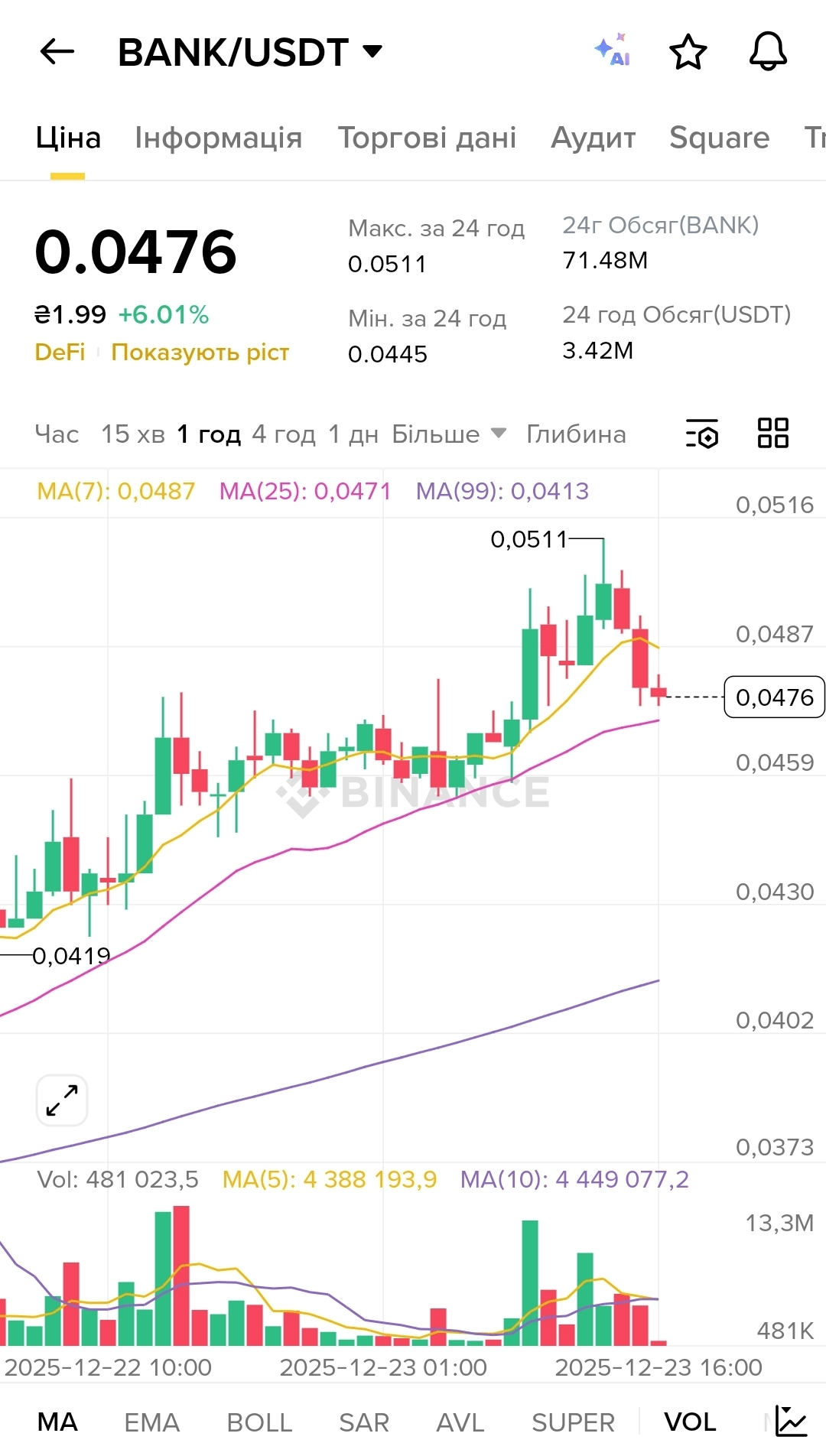
The chart shows MA(7) at 0.0487 above MA(25) at 0.0471 — a technically bullish signal. But what does it really mean for a protocol with such a complex architecture? Absolutely nothing. It is just a reflection of the sentiments of speculators in recent weeks, who themselves do not understand what exactly they are evaluating. We are all playing a game called 'pretending to know how to value tokenized composite repositories of traditional financial strategies on the blockchain', even though such a methodology simply does not exist. And while everyone is making money — everyone is comfortable in this uncertainty. The problem will only manifest when losses begin, and it turns out that no one can explain why. And until that moment, we continue to celebrate +6% as proof that everything works, even though the only thing it proves is that people are willing to pay more today than yesterday. And nothing more.
#LorenzoProtocol @Lorenzo Protocol $BANK