

@Falcon Finance There’s a specific kind of silence that falls over a room when someone finally asks, “Okay, but what are the risk limits?” It usually comes after a strong run. People have been talking about upside, speed, access. Then a wick hits, funding flips, a liquidation cascade starts somewhere else, and suddenly the conversation turns from dreams to guardrails.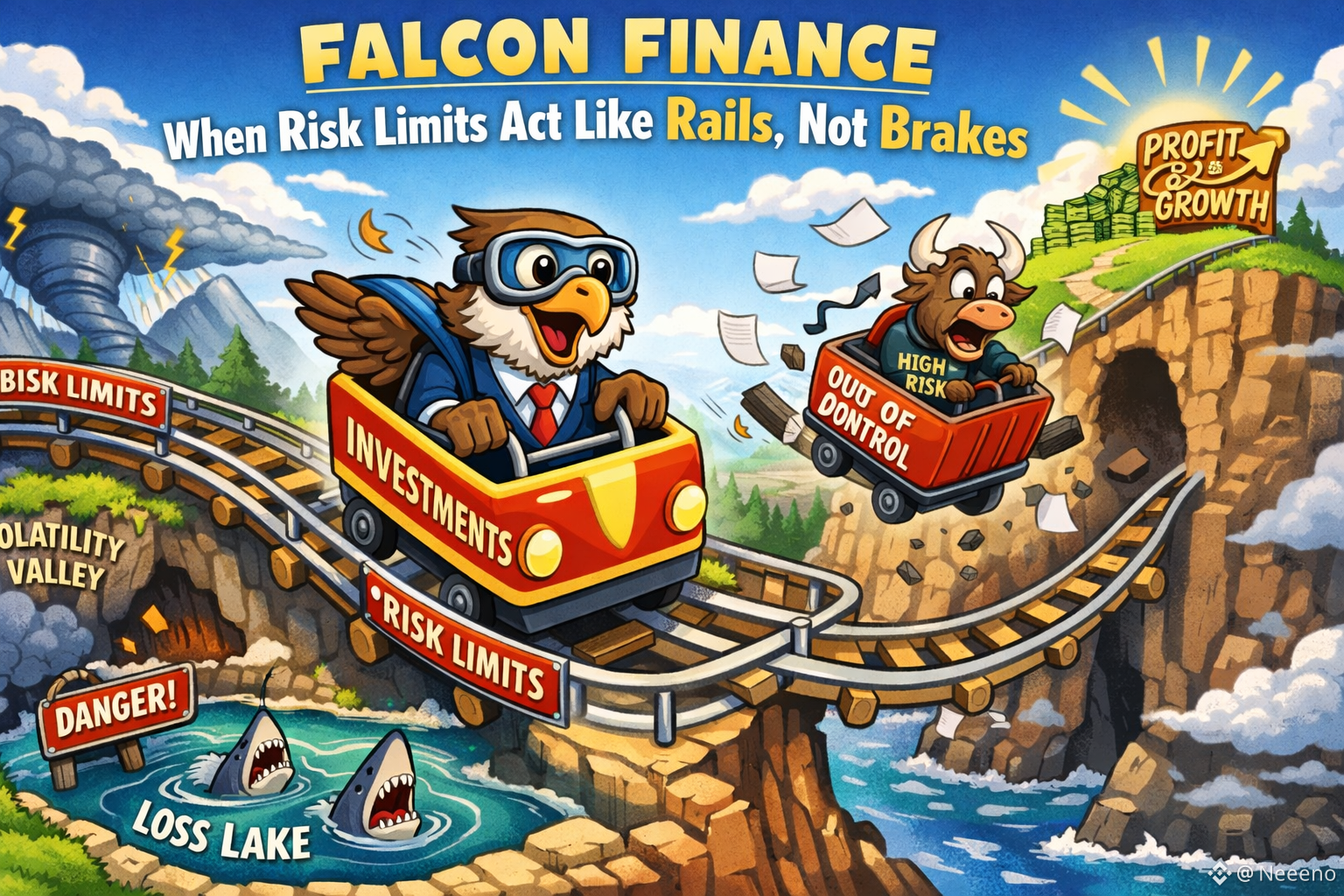
For a long time, crypto treated risk limits like emergency brakes. You didn’t notice them until they slammed on. Sometimes that was fine; sometimes it felt like the system waited for the worst possible moment to enforce discipline. After a few cycles of that plus some public failures of pegs, lenders, and over-levered trades the mood has shifted. The new question isn’t “How much risk can we take?” so much as “How do we keep risk from sneaking in through the back door?”
That’s why a protocol like @Falcon Finance is getting attention right now. Falcon frames itself as a synthetic dollar system, issuing a token called USDf against liquid collateral and aiming to earn yield through strategies designed to stay largely hedged. You can debate the mechanics people always do but the more interesting story is how openly Falcon talks about limits as part of the product, not an annoying constraint bolted on later.
In its materials, Falcon emphasizes a dual-layer approach: automated monitoring paired with human oversight, plus stricter rules around what kinds of collateral it will accept when liquidity is thin. That might sound like standard practice in traditional finance, but in DeFi it’s still a statement of values. Code looks neutral even when the incentives around it are not. Saying, plainly, “We watch this, we cap that, we step back when volatility spikes” is a form of trust-building.
The “rails, not brakes” idea helps explain what this feels like in practice. Brakes are reactive; they assume you’ll get into trouble and then try to stop you in time. Rails shape the path before you start moving. A good set of rails doesn’t kill momentum. It just narrows the range of ways momentum can become catastrophic.
Falcon has published a risk note that gets specific about extreme conditions: rapid price moves, liquidation risk, and safeguards meant to reduce exposure when volatility jumps. Whether every mechanism performs perfectly in a real stress event is a separate question, but the posture matters. It’s the difference between “trust the model” and “assume the model will be wrong sometimes, and build for that.”
This topic is trending now instead of five years ago for a simple reason: stablecoins stopped being a niche tool for traders.So it gets checked more closely by regulators, large investors, and regular people. No one wants a stablecoin that only works in calm markets and falls apart under pressure. They want something that behaves predictably when everyone is anxious.
You can also see a broader shift toward transparent buffers. In September 2025, Falcon Finance announced a $10 million on-chain insurance fund, positioning it as a transparency and risk backstop. An insurance fund isn’t a spell you cast to make risk disappear. It’s an admission that risk is real, measurable, and worth budgeting for. In crypto, that kind of honesty is progress.
Another angle showing up more often lately is the way protocols talk about collateral. The old habit was to lock it up and pretend it was inert. The newer habit is to treat it as something that can work earn, circulate, stay useful without turning into a daisy chain of hidden leverage. Falcon’s recent messaging leans into “collateral as a living resource.” It’s a compelling idea, and it’s exactly where good rails matter most. If collateral is productive, the boundaries have to be obvious where leverage can’t hide, and how losses are contained
None of this guarantees safety. Delta-neutral strategies can break when correlations shift. Liquidity can evaporate precisely when you want to rebalance. Smart contracts can be audited and still fail. A synthetic dollar can hold its peg for months and then get tested in a single afternoon. The point isn’t to pretend those risks don’t exist. The point is to make the system behave like it expects to be tested. And that expectation matters.
In many conversations about risk limits now, what stands out is how personal it has become for users. The industry used to treat blowups as abstract lessons. Now more users have stories: money stuck, positions wiped, nights spent refreshing a block explorer. That changes the tone. It makes “boring” sound attractive. It makes “consistent” feel like a feature, not a lack of imagination.
If Falcon Finance succeeds, it won’t be because it promised the world. It will be because it made its limits legible, enforced them when it was inconvenient, and built rails that let people keep moving without constantly fearing the cliff.
@Falcon Finance #FalconFinance $FF


