
The Christmas Rally refers to the phenomenon in financial markets where prices tend to rise or show a strong trend during the period around Christmas and the end of the year. The reasons for the Christmas Rally are numerous, with the mainstream view being that lower trading volumes during the holidays mean that smaller buying can push prices higher.
Stock Market | Higher Probability of Increase
There is no definitive definition for the days of the Christmas Rally. For statistical convenience, we take the last 5 trading days of December and the first 2 trading days of January as data samples to explore whether the Christmas Rally truly exists over the past 5 years.
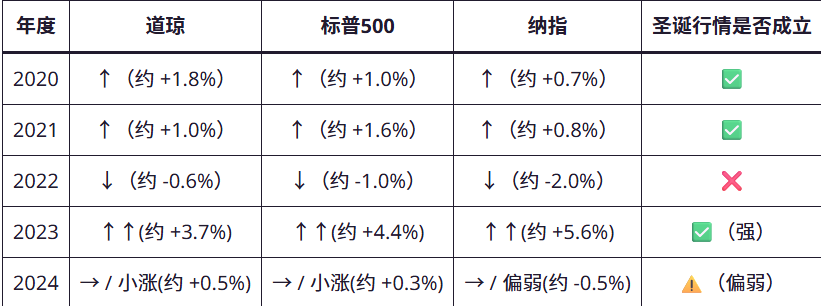
In the five years from 2020 to 2024, 3 years were clearly successful, 1 year was a failure, and 1 year was weak.
Failure year (2022) corresponds consistently to the 'strong contraction cycle'
Crypto market | Only two years can be considered successful
Since the cryptocurrency market does not have a closing period, we have consolidated data from December 24th (Eastern Time close) of each year to January 2nd of the following year (Eastern Time close) for comparison, using Bitcoin, Ethereum, and SOL to reflect the mainstream market, and Dogecoin to reflect the altcoin market.
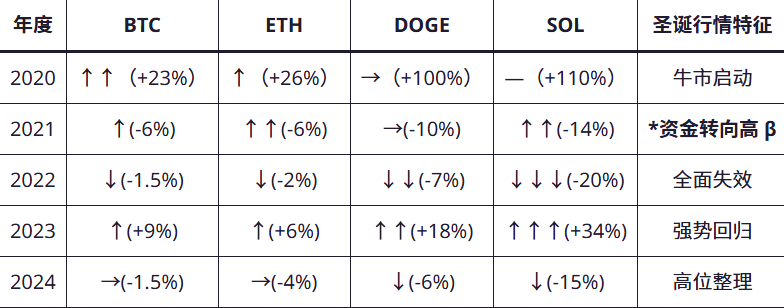
*Funds shifting to high β (High Beta) refers to market funds moving from relatively stable, low-volatility assets to assets with greater price fluctuations and sensitivity to market conditions in pursuit of higher potential returns.
Summary | The stock market's success rate during the Christmas period is higher
Comparing the 'Christmas effect' of the cryptocurrency market from 2020 to 2024 with the three major U.S. stock indices reveals that while both are influenced by year-end liquidity and sentiment, the differences in stability and structure are quite pronounced. In the past five years, U.S. stocks have generally maintained moderate gains, showing higher consistency and predictability, except for 2022, which saw a 'counter-Christmas effect' due to aggressive rate hikes; in contrast, the success rate of the cryptocurrency market's Christmas effect is lower, but the volatility is significantly greater.
Specifically, the U.S. stock market Christmas effect resembles a seasonal phenomenon characterized by low volatility and a probabilistic advantage, reflecting institutional year-end portfolio adjustments, reduced selling pressure, and a slight rebound in risk appetite; whereas the cryptocurrency market is more akin to an amplifier of liquidity and sentiment.


