
Bitcoin has taken quite some time to frustrate both bulls and bears, oscillating between $85,000 and $90,000 without a clear breakout. The culprit is not a lack of buying interest or macroeconomic headwinds, but the options market. Derivatives data shows that market makers' gamma exposure is currently suppressing spot price volatility through mechanical hedging. This structure keeps Bitcoin's price fixed within a narrow range, but the forces maintaining price stability will expire on December 26.
Gamma Flip Level
The core of this dynamic is the 'Gamma Flip' level mentioned by traders, currently located around $88,000.
Above this threshold, market makers holding short gamma positions are forced to sell on the way up and buy on the way down to maintain delta neutrality. This behavior suppresses volatility and pulls prices back to the middle of the range.
Below the flip level, the mechanism reverses. Selling pressure will self-reinforce, as the hedging direction of market makers aligns with price movements, amplifying volatility rather than suppressing it.
$90,000 is repeatedly rejected, while $85,000 continues to provide support
The $90,000 level repeatedly acts as a ceiling due to concentrated call option positions.$BTC
Market makers hold a large short call option position at the $90,000 strike price. As the spot price approaches this level, they must sell Bitcoin to hedge their exposure. This creates what appears to be organic selling pressure, but in reality, it is forced supply from derivatives hedging.
Every attempt to rise to $90,000 triggers this hedging flow, explaining why breakout attempts repeatedly fail.
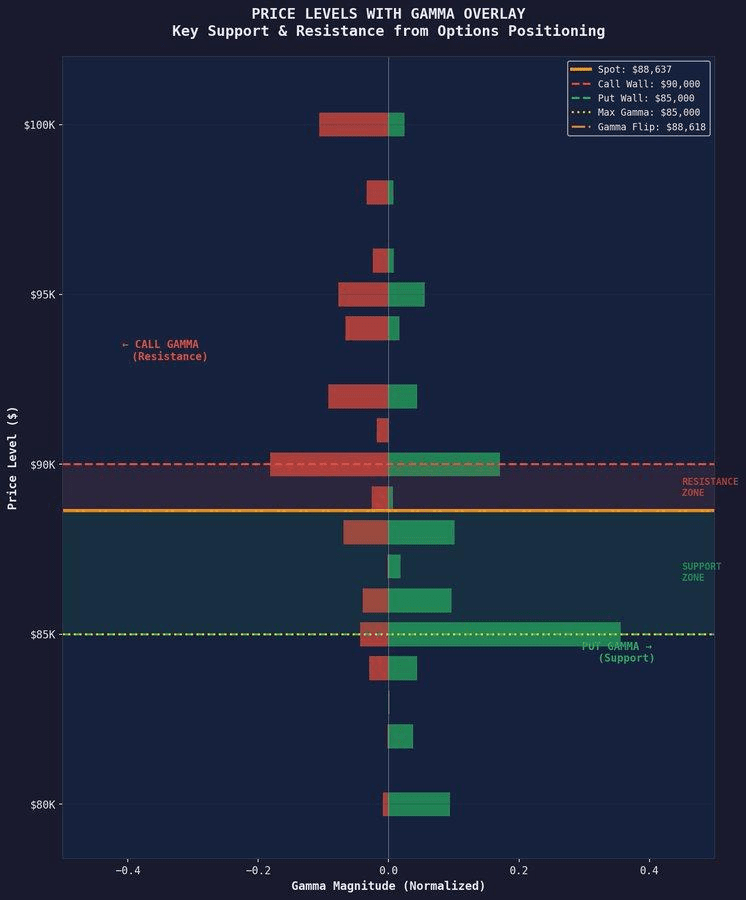
On the downside, $85,000 serves as a reliable support through a completely opposite mechanism.
The large number of put option positions at this strike price means that market makers must buy spot Bitcoin when the price approaches this level.
This forced demand absorbs selling pressure and prevents sustained breakdowns. The result is a market that appears stable on the surface but is actually maintained in an artificial equilibrium by opposing hedging flows.
Futures liquidation further strengthens the range options
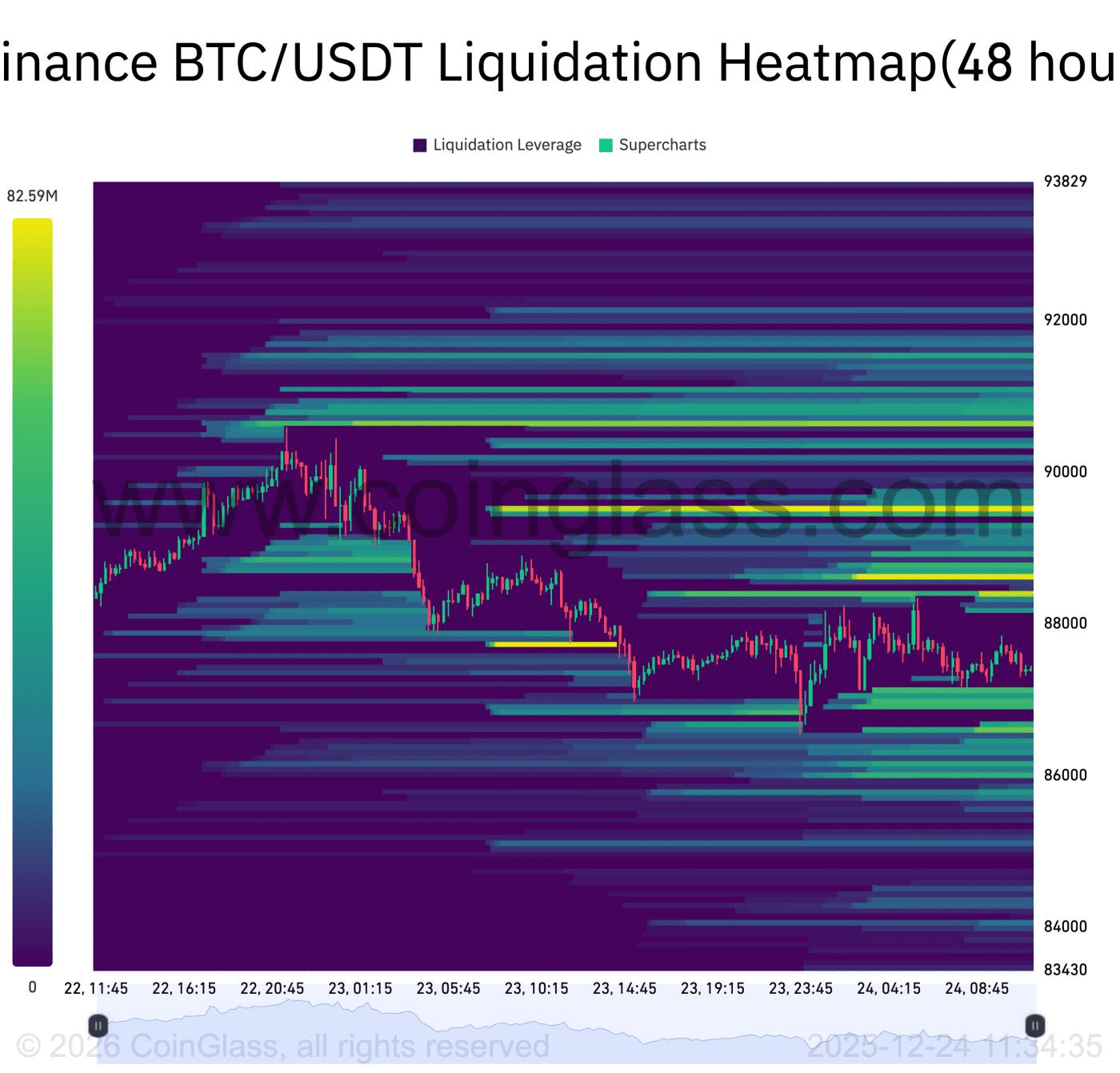
The driven range does not operate in isolation. The liquidation heat map from Coinglass shows that leveraged futures positions have gathered around the same price level, creating additional magnetism that further strengthens the $85,000 to $90,000 corridor.
Above $90,000, a large number of short liquidation levels have accumulated. If the price breaks through this upper limit, forced short liquidations will trigger a chain of buy orders. Conversely, long liquidation levels are concentrated below $86,000, meaning that once a break occurs, leveraged longs being stopped out will accelerate the decline.
Currently, the hedging mechanism of options market makers is fully aligned with the futures liquidation mechanism, doubling the structural pressure that keeps Bitcoin trapped in its current range.
An options trap is coming
The options expiration on December 26 is set to become the largest in Bitcoin's history, with a nominal value of approximately $23.8 billion.
In contrast, the total annual expiration in 2021 was approximately $6.1 billion, $11 billion in 2023, and $19.8 billion in 2024. This rapid growth reflects the increasing participation of institutions in the Bitcoin derivatives market.
According to analyst NoLimitGains, approximately 75% of the gamma distribution will disappear after this expiration. The mechanical forces that fixed the price in the range of $85,000 to $90,000 will essentially no longer exist.$BTC
Market makers dominate ETF inflows with gamma
The scale of current market maker hedging activity far exceeds spot market demand. The data cited by analysts shows that market makers have gamma exposure of approximately $507 million, while daily ETF activity is only $38 million—a ratio of about 13:1.
This imbalance explains why Bitcoin has ignored seemingly favorable catalysts. Before the outstanding issues in derivatives are cleared, the mathematical logic of market makers' hedging is more important than the narratives adopted by institutions.
What will happen next
Once the expiration on December 26 passes, the price suppression mechanism will end. This does not guarantee a specific direction—it merely means Bitcoin will gain space for free movement.
If the bulls successfully hold the $85,000 support level before expiration, a breakout to $100,000 will structurally become possible. Conversely, a breakdown below $85,000 in a low gamma environment may accelerate the downside.
Traders should expect volatility to increase as they enter early 2026, as new positions will gradually be established. The recent price movements in a range are likely a temporary phenomenon driven by derivatives mechanisms rather than a reflection of underlying market confidence.
【Trading Reminder: Don't treat this as investment advice! The market is unpredictable.】
Disclaimer: The above content only represents the author's viewpoint and does not constitute any investment advice.
