
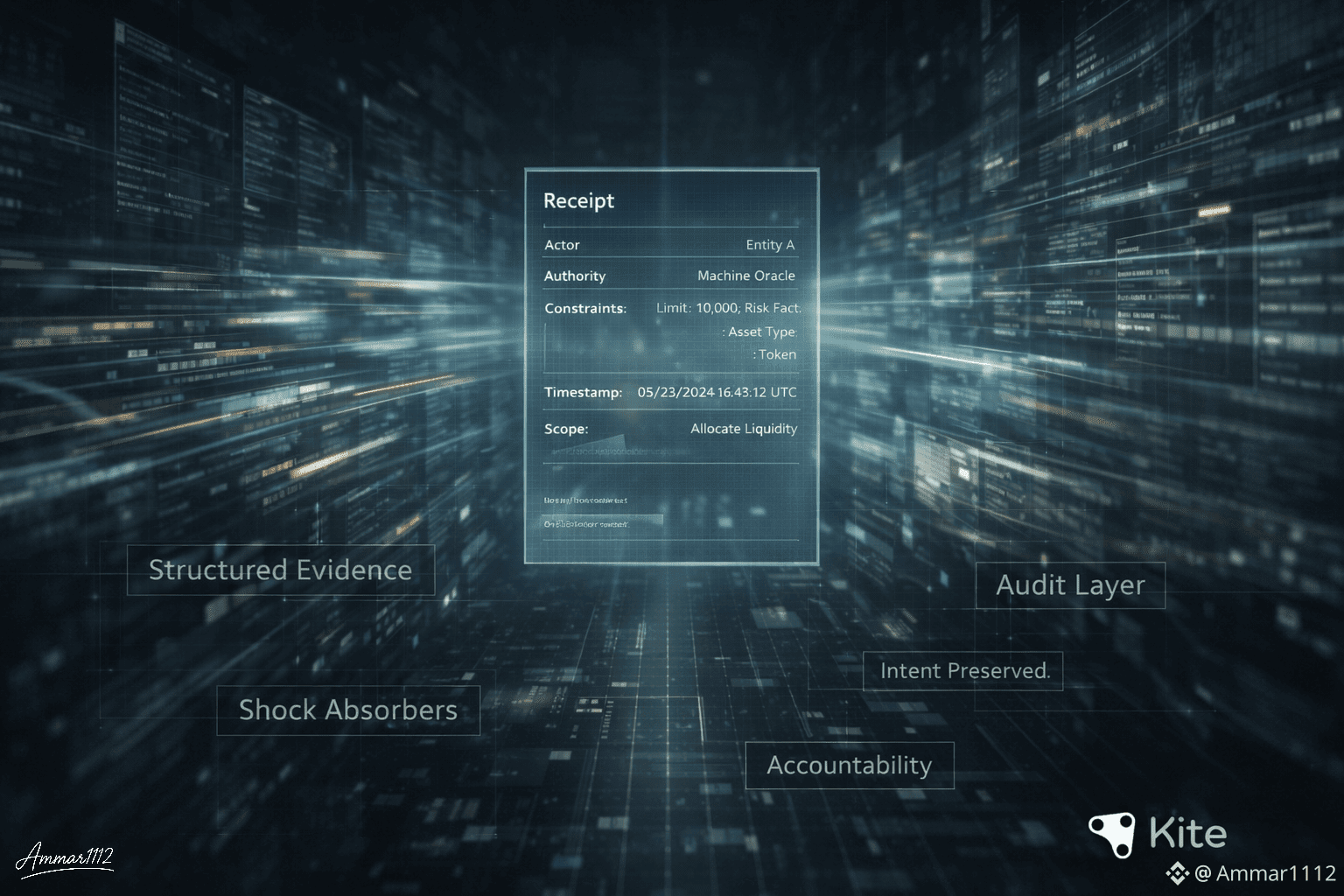
Most people think receipts are boring.
A confirmation.
A record.
Something you download and forget.
That view makes sense in human systems.
It breaks in machine economies.
The common assumption is that receipts exist to prove payment.
Money sent.
Service delivered.
Transaction complete.
That’s only the surface.
In autonomous systems, receipts don’t just confirm outcomes.
They preserve context.
Who acted.
Under which authority.
Within what constraints.
At what moment.
This isn’t accounting.
It’s memory.
When machines transact without receipts that carry intent and scope,
everything becomes unverifiable after the fact.
Not illegal.
Just unknowable.
This is where things usually break. Not loudly. Quietly.
Audits don’t fail because data is missing.
They fail because meaning is.
A raw transaction hash can tell you what happened.
It can’t tell you why it was allowed to happen.
Machine economies don’t need more transparency.
They need structured evidence.
Receipts become the audit layer because they sit between execution and trust.
They translate action into accountability.
Without slowing systems down.
I’ve been thinking about this more than expected.
Once machines act faster than humans can observe,
receipts stop being optional artifacts and start becoming pillars.
KITE treats receipts this way.
Not as logs.
But as economic proof that survives speed.
Maybe the real role of receipts isn’t to reassure users.
Maybe it’s to make autonomous systems governable at all.
And maybe we misunderstood them because we were still thinking like humans.


