


When Survival Becomes the New Success Story
Let me be completely honest with you – if your crypto portfolio made it through 2025 intact, you didn't just win. You survived one of the most devastating years in digital asset history. While everyone was chasing moon shots and dreaming of financial freedom, the harsh reality was playing out behind the scenes: hackers, exploits, and catastrophic failures that left billions in ruins.
The Shocking Numbers That Tell the Real Story
Here's what really happened while most people were busy checking price charts: A staggering $3.4 billion disappeared from the crypto ecosystem in 2025. Yes, you read that right – billion with a "B". And here's the part that should make your blood run cold: approximately $2 billion of those stolen funds have been traced back to North Korean hacking operations.
Think about that for a second. While we were all arguing about which Layer 2 solution was superior or debating the next big meme coin, sophisticated state-sponsored attackers were systematically draining the industry.
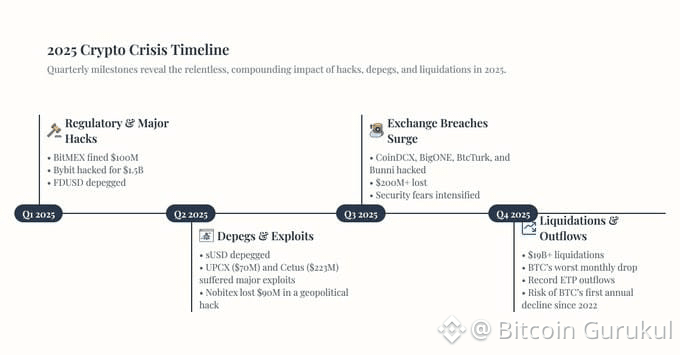
January: The Year Started with a Warning Shot
The crypto world barely had time to recover from New Year's celebrations when BitMEX got slapped with a crushing $100 million fine for Bank Secrecy Act and Anti-Money Laundering violations. This wasn't just pocket change – it was a clear message that regulatory pressure wasn't going away.
Most traders shrugged it off. "Just another exchange getting fined," they said. Little did anyone know this was just the opening act.
February: The Hack That Changed Everything
Then came the moment that made everyone's stomach drop. Bybit suffered the largest single crypto hack in recorded history – North Korean hackers successfully drained $1.5 billion.
Let me put that in perspective: that's more than the GDP of some small countries. Gone. In one coordinated attack.
The crypto Twitter timeline went silent for hours. This wasn't just another bridge exploit or small-time rug pull. This was a wake-up call that nobody wanted to answer.
March Through May: When Stability Became a Joke
Remember when stablecoins were supposed to be, well, stable?
March brought the FDUSD depeg, with prices plummeting to around $0.76. Traders who thought they were safely parked in a stablecoin watched in horror as their "stable" assets lost nearly a quarter of their value.
April wasn't any better. The sUSD stablecoin crashed to approximately $0.68, while the UPCX platform suffered a devastating exploit that saw 18.4 million UPC tokens stolen, valued at roughly $70 million at the time.
By May, even the newer ecosystems weren't safe. The Cetus protocol on Sui network was completely drained of $223 million. The pattern was becoming undeniable – nowhere was safe.
The Summer of Discontent: June Through August
June delivered something different – a geopolitical cyber attack. Nobitex, Iran's largest crypto exchange, lost $90 million in what experts believe was a targeted attack with funds reportedly destroyed rather than stolen. This wasn't about profit anymore; it was about warfare.
July and August became a blur of exchange breaches:
CoinDCX lost approximately $44 million
BigONE was hit for around $27 million
BtcTurk reported about $48 million missing from what appeared to be a hot wallet compromise
Industry reports documented $163 million lost across 16 separate exploits in August alone
Security wasn't just a concern anymore – it was a full-blown crisis.
September and October: When the Bottom Fell Out
September saw the Bunni protocol (built on Uniswap v4) lose approximately $8.4 million to hackers. At this point, the crypto community was becoming numb to the constant barrage of bad news.
Then came October 10-11 – two days that will live in crypto infamy. A massive liquidation cascade wiped out over $19 billion in leveraged positions. Traders who were certain of their bullish bets watched their entire accounts evaporate in hours.
Ethena's USDe stablecoin, which was supposed to offer stability and yield, briefly traded down to $0.65 on Binance. Another "algorithmic stablecoin" failing under pressure. Have we learned nothing?
November: The Month Hope Died
If October was brutal, November was soul-crushing. Bitcoin experienced its worst monthly decline since mid-2021, dropping approximately 17-18%. The market capitalization wiped out most of the gains that had been built throughout 2025.
Institutional money that everyone thought would save the market? They ran for the exits. Crypto Exchange-Traded Products saw nearly $2 billion in weekly outflows – the highest since February and a clear vote of no confidence.
December: Staring Into the Abyss
As the year limped toward its conclusion, Bitcoin faced the very real possibility of recording its first annual decline since 2022. The asset that was supposed to be "digital gold" and a "store of value" was failing to live up to its promises once again.
What This Really Means for All of Us
Look, I'm not here to sugarcoat things or sell you hopium. The data speaks for itself. 2025 wasn't just a bad year – it was a systematic dismantling of the narrative that crypto was ready for mainstream adoption.
Here's what we learned the hard way:
Security is still broken. Despite years of "lessons learned," billions continue to disappear. If major exchanges with massive security budgets can't protect funds, what chance do smaller platforms have?
Stablecoins aren't stable. When multiple stablecoins can lose 20-35% of their value overnight, we need to stop calling them "stable" and start calling them what they are: slightly-less-volatile coins.
State-sponsored attacks are real. This isn't conspiracy theory territory anymore. North Korea and other nation-states are actively targeting crypto infrastructure, and they're winning.
Leverage kills. That $19 billion liquidation event in October? Those were real people with real money, wiped out because they bet too big on borrowed money.
Institutional interest is fickle. The moment things get uncomfortable, the "smart money" heads for the door, leaving retail investors holding the bag.
The Uncomfortable Truth Nobody Wants to Say
If you made it through 2025 without getting hacked, liquidated, or rugged, you genuinely outperformed 99% of participants in this space. That's not an exaggeration – it's simple math based on the carnage we witnessed.
But here's what bothers me most: we're already seeing people trying to spin this as "just another cycle" or "healthy market correction." This wasn't healthy. This was catastrophic failure across multiple fronts.
Looking Forward (With Eyes Wide Open)
So where does this leave us heading into 2026? Honestly, I don't have all the answers, and anyone who claims they do is probably trying to sell you something.
What I do know is this: the crypto industry needs to fundamentally rethink security, stability mechanisms, and risk management. We can't keep having billion-dollar hacks and act like it's just the cost of doing business.
For those still in the game, here's my unfiltered advice:
Assume every platform can be hacked. Never keep more on an exchange than you're willing to lose completely. Not "probably won't lose" – willing to lose entirely.
Question everything about stablecoins. If it can depeg by 30%, it's not fulfilling its primary function. Diversify your stablecoin holdings and understand the mechanisms behind each one.
Leverage is a trap. I know the potential gains are tempting, but October 10-11 should be required viewing for anyone considering margin trading.
Do your own research – and I mean really do it. Don't just read the marketing materials. Dig into the smart contracts, understand the team, look at the track record.
Keep a significant portion in cold storage. If state-sponsored hackers are targeting exchanges, your funds aren't safe there, period.
Final Thoughts From Someone Who's Seen Too Much
I've been through multiple crypto cycles now, and 2025 hit different. This wasn't just about prices going down – it was about fundamental failures of security, trust, and infrastructure.
The believers will say I'm being too negative. The skeptics will say I'm not being negative enough. But I'm just trying to give you the unvarnished truth based on what actually happened.
Crypto isn't dead, but it's badly wounded. The question for 2026 and beyond is whether the industry will learn from these painful lessons or continue making the same catastrophic mistakes.
What do you think? Did you survive 2025? What were your biggest lessons? Drop your thoughts below – and be honest. We need more real talk and less hopium in this space.
Stay safe out there.

