
@Falcon Finance If you build in DeFi, you start to notice how often people reach for the word “dollars” when they really mean “a calm place to stand.” Prices need a unit. Treasuries need a unit. Payroll and accounting need a unit. Stablecoins made that easier, but they also imported a different kind of dependence: issuers, custodians, and the legal scaffolding behind them. Synthetic dollars keep resurfacing because they offer another path, one where stability is expressed through collateral and rules, not a promise on a bank balance sheet.

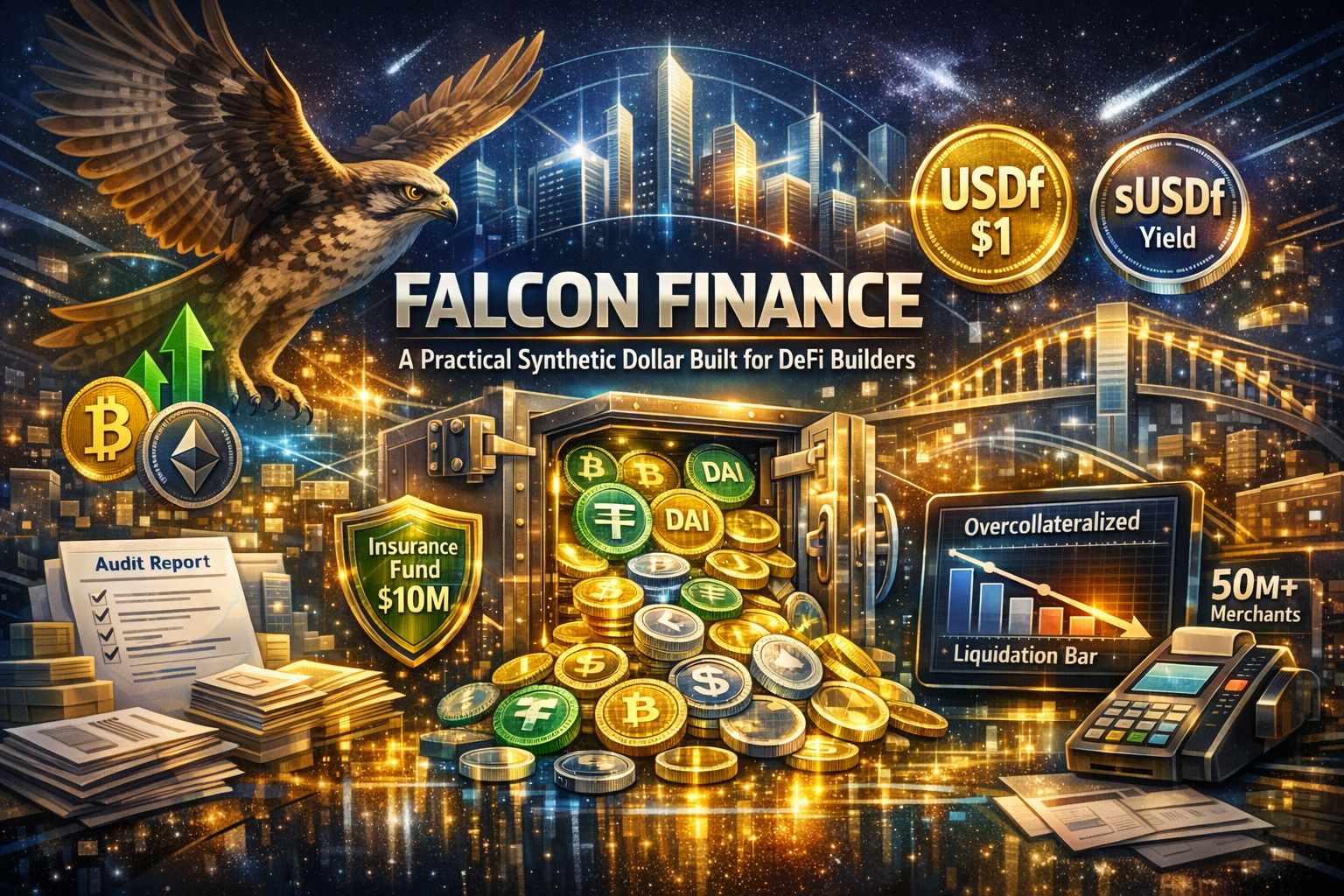
Falcon Finance sits squarely in that resurgence. Its synthetic dollar, USDf, is overcollateralized and minted when users deposit eligible collateral. The protocol’s documentation is direct: collateral can include stablecoins like USDT, USDC, and DAI, and it can also include non-stable assets like BTC and ETH, with an overcollateralization buffer designed so collateral value stays above the value of issued USDf. For builders, that matters because it reads like infrastructure. You are not buying a brand; you are integrating a mechanism whose failure modes you need to model.
The timing is not accidental. In 2025, “dollars that do nothing” feel increasingly out of step with what users expect from onchain money. Research on onchain yield describes a market splitting into reserve-backed tokens, treasury-yield wrappers, and synthetic models that bake returns in through different strategies. Regulation has also become a live variable rather than a foggy risk. Mainstream coverage around stablecoin launches has pointed to U.S. legislation such as the GENIUS Act as a reason more traditional firms are willing to engage. Even if you disagree with the politics, the product implication is real: builders can plan when the rules are clearer.
Falcon’s progress is concrete enough to evaluate. Recent reporting around its Base deployment describes USDf at roughly $2.1 billion in supply and frames the move as bringing that liquidity to the Coinbase-backed Layer 2 ecosystem. Independent tracking puts USDf’s market cap above $2.2 billion with a price designed to hold around $1.00. Numbers like that do not prove safety, but they do change the integration conversation from “interesting concept” to “live liquidity you can route.”
A design choice that’s easy to overlook, but matters in product work, is Falcon’s dual-token setup. USDf is meant to behave like the stable unit, while sUSDf is positioned as the yield-bearing version that appreciates as strategies feed rewards into a vault-like structure. I like separating “spendable” from “yielding.” It is a small act of honesty in a space that often tries to make one token do ten jobs at once, and it helps builders set expectations for users who want stability.
Yield, though, is where the synthetic-dollar category earns both fans and skeptics. Yield never arrives for free; it shows up because someone is taking risk, providing liquidity, or capturing a market spread. Falcon’s own explainer describes boosted yield options tied to fixed lockups, a familiar trade: more return in exchange for less flexibility. If you are building an app for end users, the hard part is not adding a “stake” button. The hard part is deciding how much of your product can tolerate variable return, and how you will explain that risk when yields compress or liquidity gets thin.
One trend I genuinely welcome is the move toward visible buffers instead of vibes. Falcon has announced an onchain insurance fund with an initial $10 million contribution, described as a structural safeguard for USDf stability and sUSDf yields. The word “insurance” is loaded, and it is worth staying skeptical about what is and is not covered. Still, a dedicated backstop that is onchain and trackable is a concrete object a risk model can reference, and that is progress compared with the older habit of hiding risk in a spreadsheet and praying markets stay calm.
There’s also an infrastructure story forming around the project’s operations. Falcon has publicly described a $10 million strategic investment from M2 Capital, framed around expanding its collateralization infrastructure. Funding does not guarantee resilience, but it often correlates with the boring work that resilience requires: audits, monitoring, integration support, and clear documentation that survives contact with edge cases. When you are building on top of a synthetic dollar, boring is a compliment.
For DeFi builders, the most compelling use case is not speculation; it is treasury and liquidity management. Falcon positions USDf and sUSDf as tools for projects and founders to preserve reserves, maintain liquidity, and earn yield. The push for distribution is real too: an announcement tied to AEON Pay framed Falcon assets as reaching over 50 million merchants through payment rails. Whether that becomes everyday usage or stays mostly inside crypto wallets will depend on reliability, fees, and the unsexy details of settlement.
My practical takeaway is simple. Treat USDf like a plainly collateral-backed instrument with liquidation mechanics you must understand, not like cash. Use sUSDf only where variable yield will not break your app’s commitments. Watch liquidity per chain, because bridges and pools are where stable assumptions go to die. Synthetic dollars can make DeFi feel more usable and less like a casino, but only if builders keep asking the quiet questions: what backs it, what stresses it, and who absorbs the shock when the market turns.


