

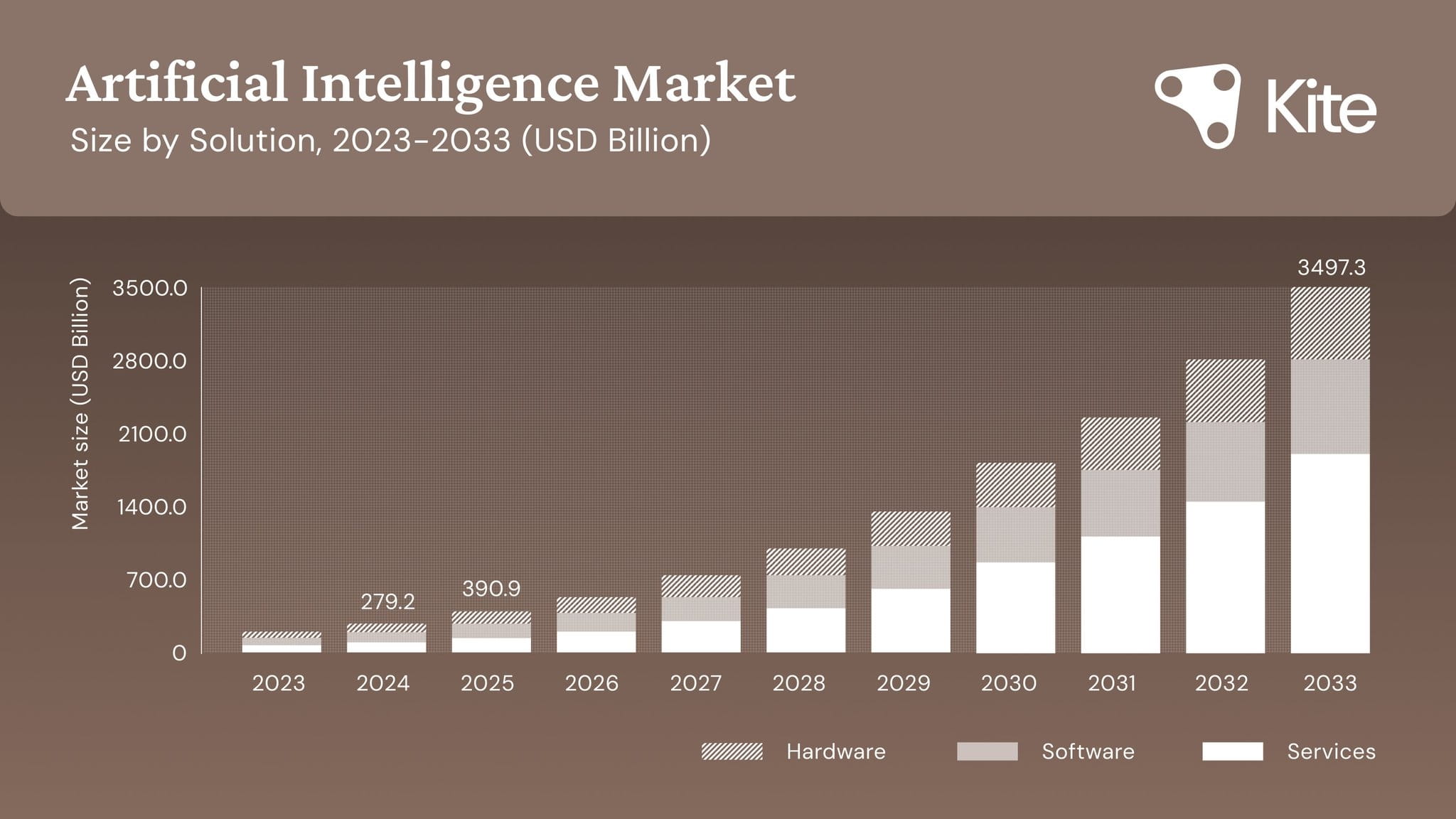
I took another look at Kite during this time, not because of emotional excitement, but because the AI line has reached an unavoidable stage.
Models are not scarce, agents are also not scarce; what is truly scarce is: who dares to hand over authority and money to a non-human executor.
Many AI projects like to start with capabilities, but Kite is one of the few that focuses on responsibility and empowerment from the beginning.
If I had to summarize what Kite is doing in one sentence, it's not about teaching AI to be smarter, but about trying to allow, restrict, and hold AI accountable on the chain.
This matter is not sexy, but the further you go, the more unavoidable it becomes.
First, let's lay out the facts from the market perspective.
Currently, the circulation of $KITE is around 1.8 billion pieces, with a total of 10 billion pieces, and the price range is roughly between 0.08 and 0.1 USD. The corresponding circulating market value is already of medium size. This at least shows one thing: it is no longer in the stage where it can be pushed up casually based on emotions; the market has begun to price it using real liquidity and chip structure, rather than just listening to narratives.
But what truly keeps me following Kite is not the price.
There is only one core question:
If AI Agents really want to run on-chain, who will decide what they can do, how much they can spend, and under what circumstances they must stop?
Now many so-called AI chains are essentially just people plus wallets plus automated scripts. When problems arise, either blame the model, blame the contract, or blame oneself for not seeing clearly; the responsibility is vague.
Kite is taking a more difficult but more realistic path; it attempts to directly compress identity, authorization, and settlement into the protocol layer, rather than leaving it to the application layer to patch with scripts and rules.
To put it more bluntly, Kite wants an Agent on-chain to be more like a hired executor rather than a program with no one responsible for it.
Who created it, who gave it permission, what is the upper limit of permissions, what are the triggering conditions, and whether each call is verifiable, these do not rely on agreements, but on the semantics of the protocol itself to constrain.
Of course, this road is not pleasing to everyone.
The clearer the permissions are defined, the more it resembles traditional systems; the more it resembles traditional systems, the easier it is to be questioned as not being sufficiently 'decentralized'.
However, from the long-term perspective of infrastructure, this step will eventually have someone to take it. Otherwise, once AI Agents truly scale, the destructive power of accidents will definitely be more exaggerated than in the early days of DeFi.
Another point that is often overlooked but personally important to me is the runway issue.
Identity, authorization, and settlement are underlying capabilities that have never been short-cycle businesses. Without sufficient funds and resources, it is easy to fail in the ecological cold start phase.
The financing scale disclosed by Kite is at the level of 30 million USD, and the background of the investors is relatively solid. This does not equal success, but at least indicates that it is not the kind of light project that goes live and then disappears after a wave. The ability of such projects to survive is, in itself, a threshold.
Recent discussions around Kite have focused more on Binance-related exposures and liquidity nodes. Such events will certainly bring short-term trading opportunities, but if you only pay attention to the K-line in those few days after the launch, it is easy to miss the point.
The real stress test is yet to come.
Will there be applications on-chain that must rely on the Kite authorization model to operate, can protocol fees shift from subsidy-driven to real-use driven, and will Agent behavior begin to form patterns that can be statistically analyzed and audited?
If these cannot be realized, then no matter how complete the narrative is, it will gradually be falsified by the market.
My attitude towards Kite is very clear now: it is neither a faith warehouse nor purely short-term; it is more like an infrastructure observation target that needs continuous verification.
It is not solving whether it will rise today, but a question that must eventually be answered head-on: When the execution power is given to AI, who will take responsibility?
If the Agent economy really exists, then permissions and responsibilities will definitely become the core layer.
Kite is at least moving forward on this most difficult and ungracious road.
The rest will be left to time and on-chain data.


