
The cryptocurrency industry is entering its third and most critical phase: the Global Privacy Era, according to Balaji Srinivasan, the former CTO of Coinbase. He recently argued that the next decade of Web3 will be defined not by scalability or speed, but by protecting user data and financial sovereignty through robust encryption.
We couldn’t agree more with this visionary assessment. The shift from public, transparent ledgers to confidential, programmable computation is not merely an upgrade; it is the prerequisite for the multi-trillion market opportunity Balaji predicts, enabling everything from compliant tokenization of real-world assets to the formation of sovereign ‘Network States’, outlined in his influential book The Network State.
Yet, while we share the destination, we see a different pathway to get there. Balaji champions Zero-Knowledge (ZK) proofs as the foundational technology for this new era, predicting the rise of “ZK-everything,” including ZKYC and ZK DEX. While ZK is a powerful cryptographic tool, particularly for single-prover privacy, we believe a different technology is needed to be able to handle composable, multi-party, and real-time Web3: Garbled Circuits (GC).
The Millionaire’s Problem and the Need for Multi-Party Privacy
The core challenge of the Global Privacy Era is not just proving a single fact privately, but enabling multiple parties to compute a result together without revealing their individual inputs. This is the essence of Yao’s Millionaires’ Problem, the decades-old challenge that laid the foundation for Secure Multi-Party Computation (MPC).
ZK-proofs excel at verifying the integrity of a computation, but they can face significant challenges when applied to complex, multi-party scenarios, often requiring intricate setup and high computational overhead for generic functions. This is where Garbled Circuits offer a superior, more pragmatic solution. GC is inherently designed for MPC, transforming a computation into an encrypted logic circuit that parties can cooperatively evaluate without exposing sensitive data.
The distinction is critical for the real-world applications that will define the next decade:
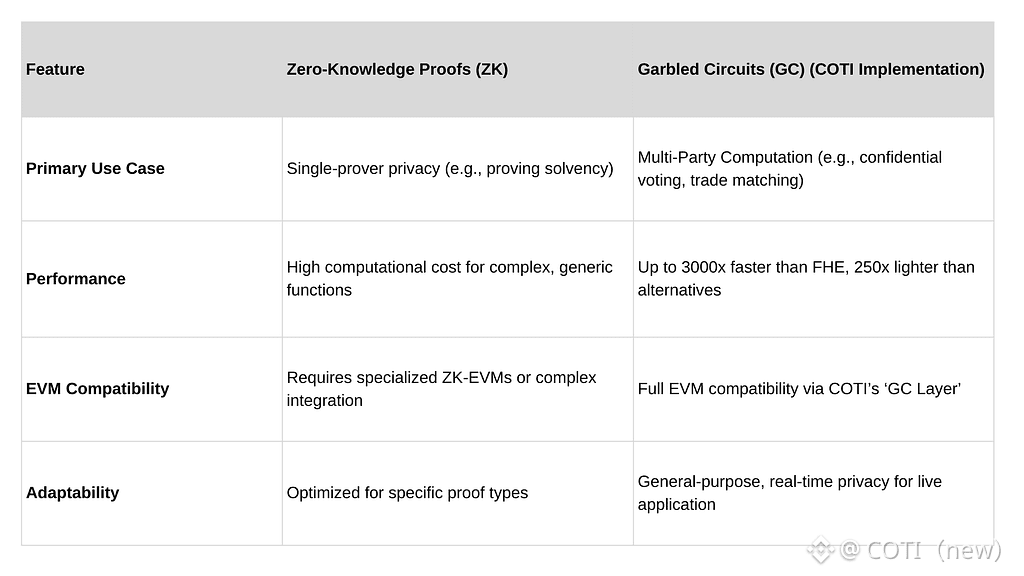 COTI compared to ZK Proof
COTI: The Programmable Privacy Layer for a Composable Web3
COTI’s implementation of optimized Garbled Circuits is the first-ever on a blockchain, achieving a performance profile that eliminates the historical trade-off between security and speed. This breakthrough is what makes Balaji’s vision of a private, composable Web3 technically feasible at scale.
As a privacy-first Ethereum Layer 2, COTI’s ‘GC Layer’ allows developers to build privacy-preserving applications, adding confidentiality parameters directly to smart contracts. This approach addresses a critical gap in the Web3 ecosystem: enabling compliant, enterprise-grade privacy that combines transparency with confidentiality, rather than just anonymity.
For the tokenization of real-world assets, COTI supports confidential pricing and transaction details while maintaining regulatory compliance. For decentralized identity, it allows selective disclosure and privacy-preserving verification. And for the “Network States” that require a high level of informational privacy and secure governance, Garbled Circuits provide the lightweight, high-performance foundation needed for real-time, multi-party operations.
The Future is Private, Programmable, and Practical
Balaji Srinivasan is correct: the Global Privacy Era is upon us. Privacy is no longer an optional feature but the essential infrastructure of the future internet. However, the future of Web3 demands a privacy solution that is not only cryptographically sound but also fast, flexible, and inherently designed for multi-party collaboration.
While ZK-proofs have their place, Garbled Circuits, as pioneered by COTI, offer the most practical and scalable path forward. By providing a programmable privacy layer that is orders of magnitude faster and lighter, COTI is building the foundation that will empower builders, communities, and founders to realize the full potential of the decentralized, private, and composable internet of the future.
Summary
Balaji Srinivasan identifies the Global Privacy Era as the next phase of Web3 and points to Zero-Knowledge (ZK) proofs as the path forward. However, we argue that ZK is insufficient for the task and discuss why Garbled Circuits (GC) are a superior infrastructure that are inherently designed for Multi-Party Computation (MPC), offering performance up to 3000x faster than alternatives, forming a practical foundation for the composable, private internet Balaji envisions.
About COTI
COTI is the programmable privacy layer for Web3. Powered by high-performance Garbled Circuits, COTI brings fast, low cost, flexible, and compliant privacy to any blockchain. With privacy that’s programmable by design, COTI enables the next generation of DeFi, payments, identity, governance, and AI.
For COTI updates and to join the conversation, be sure to check out our channels:
Website: https://coti.io/
X: https://twitter.com/COTInetwork
YouTube: https://www.youtube.com/channel/UCl-2YzhaPnouvBtotKuM4DA
Telegram: https://t.me/COTInetwork
Discord: https://discord.gg/9tq6CP6XrT
GitHub: https://github.com/coti-io