
What is Walrus?
Walrus is a decentralized storage solution on the Sui network. Its purpose is to enable users and businesses to permanently store images, PDF files, etc., on Sui without impacting the network’s performance or security.
How Walrus Operates
Walrus’s operating model is relatively simple, consisting of only 6 main components, as follows:
• End User — Users of Walrus who want to store data (blobs) such as images, audio, etc., on Sui. These blobs are collections of data that users can access and retrieve.
• Publisher — The component responsible for recording blobs into the network.
• Client — The component that connects End Users and Publishers, handling the reception and reading of blobs from users. It then sends this data to the Publisher.
• Storage Node — The core component of Walrus, responsible for storing data and handling End User requests. According to the project team, to become a Walrus node, users need to stake WAL—the native token of Walrus.
• Aggregator — An entity that aggregates data from Storage Nodes and forwards it to other systems or end users when data retrieval is needed. The Aggregator’s goal is to optimize the storage and retrieval process for users.
• CDN/Cache — A temporary storage system to provide data with the lowest possible latency to End Users.
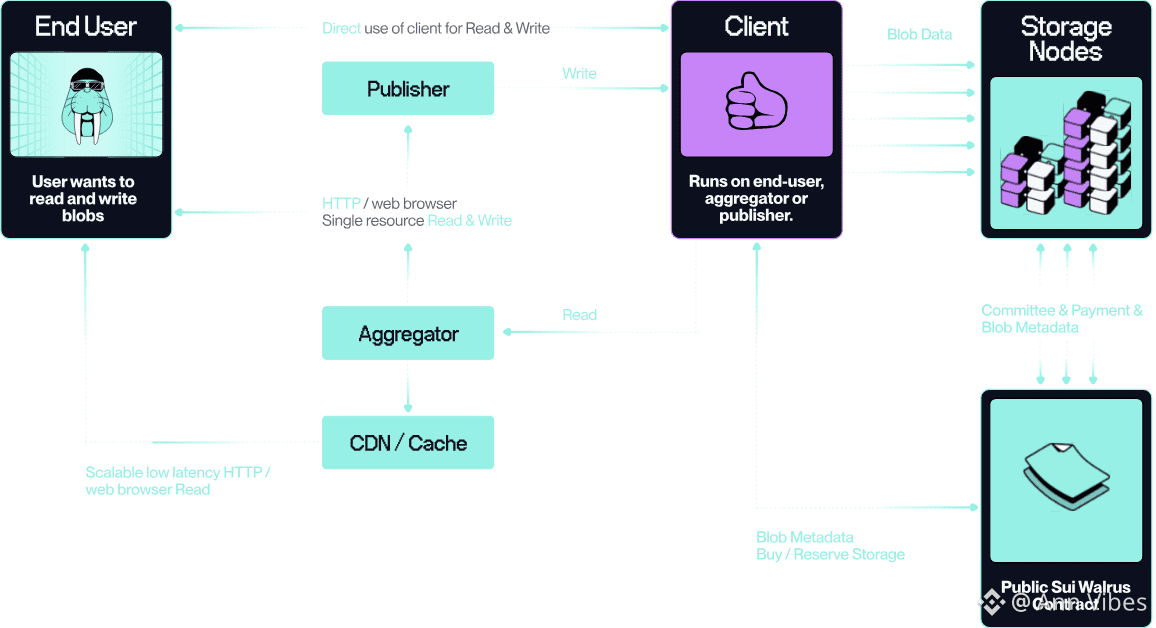
Overall, Walrus’s structure ensures that the Sui network avoids performance issues, thanks to entities like the Aggregator and CDN/Cache. Additionally, using multiple Storage Nodes enhances data security, as it does not rely on a single storage location.
Applications of Walrus
Although on-chain storage solutions are not yet widely popular, Walrus believes this technology can be applied to tasks such as:
• Storing NFT metadata — Walrus can permanently store metadata (images, audio, etc.) for NFTs. This differs from many NFT projects that rely on centralized servers, where data can be altered or lost.
• AI applications — The platform can store data and train AI models, thereby reducing storage-related costs for AI development businesses.
• Supporting data availability for Layer 2 — Although Walrus is currently only on the Sui network, its technology can help Layer 2 solutions save on data availability costs. Walrus’s model allows everyone to access data and verify its correctness.
• Copyright registration applications — Walrus enables creators to store content and grant access only via decryption keys to those who have paid for subscriptions or purchased the content.
What is the Walrus Token?
WAL Token Information
• Token Name: Walrus
• Ticker: WAL
• Token Type: Utility & Governance
• Total Supply: 5,000,000,000 WAL
WAL Token Allocation Ratio
The WAL token allocation is as follows:
• Community Reserve: 43%
• Early Contributors: 20%
• Other: 17%
• Mysten Labs: 10%
• Subsidies: 10%
WAL Token Release Schedule
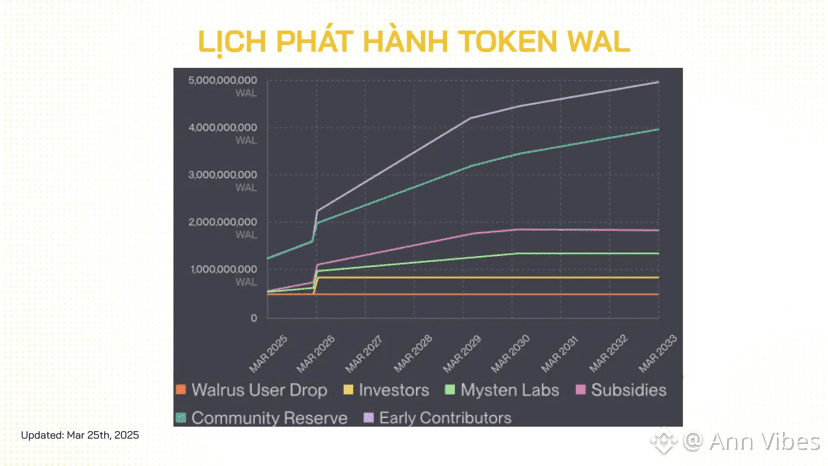
Use Cases for WAL Token
The WAL token is used in the following cases:
• Payments for activities on the platform
• Staking to enhance protocol security and earn rewards
• Governance for protocol changes
Team, Investors, and Partners of the Walrus Project
Project Team
The team behind Walrus currently comes from Mysten Labs—the company that founded the Sui network. They include:
• Evan Cheng — Co-Founder and CEO at Mysten Labs. Before founding Mysten Labs, he was an engineer at Apple and Meta.
• Sam Blackshear — Co-Founder and CTO at Mysten Labs. He was also an engineer at Meta and Microsoft.
• Adeniyi Abiodun — Co-Founder and CPO at Mysten Labs. He has worked as an engineer for companies like PeerNova, Oracle, Meta, etc.
• Kostas Chalkias — Co-Founder and Chief Cryptographer at Mysten Labs. Previously, he was CTO at Safemarket, Erybo, etc.
• George Danezis — Co-Founder and Chief Scientist at Mysten Labs. He previously worked at Privitar and The Alan Turing Institute.
Team behind Walrus. (Image description: Photos of the Walrus development team.)
Investors and Partners
Walrus has not yet disclosed information about investors or funding amounts. Regarding strategic partners, Walrus has collaborated with notable projects such as The Defiant, Sui, etc.

