


CryptoQuant's 2025 Exchange Annual Report is out, and Binance has evolved into a global black hole for cryptocurrency liquidity. It's a clear market leader in terms of liquidity on exchanges.
I've created several visual charts that clearly show market share and comparisons with other exchanges.
1. Spot Trading: A clear market leader.
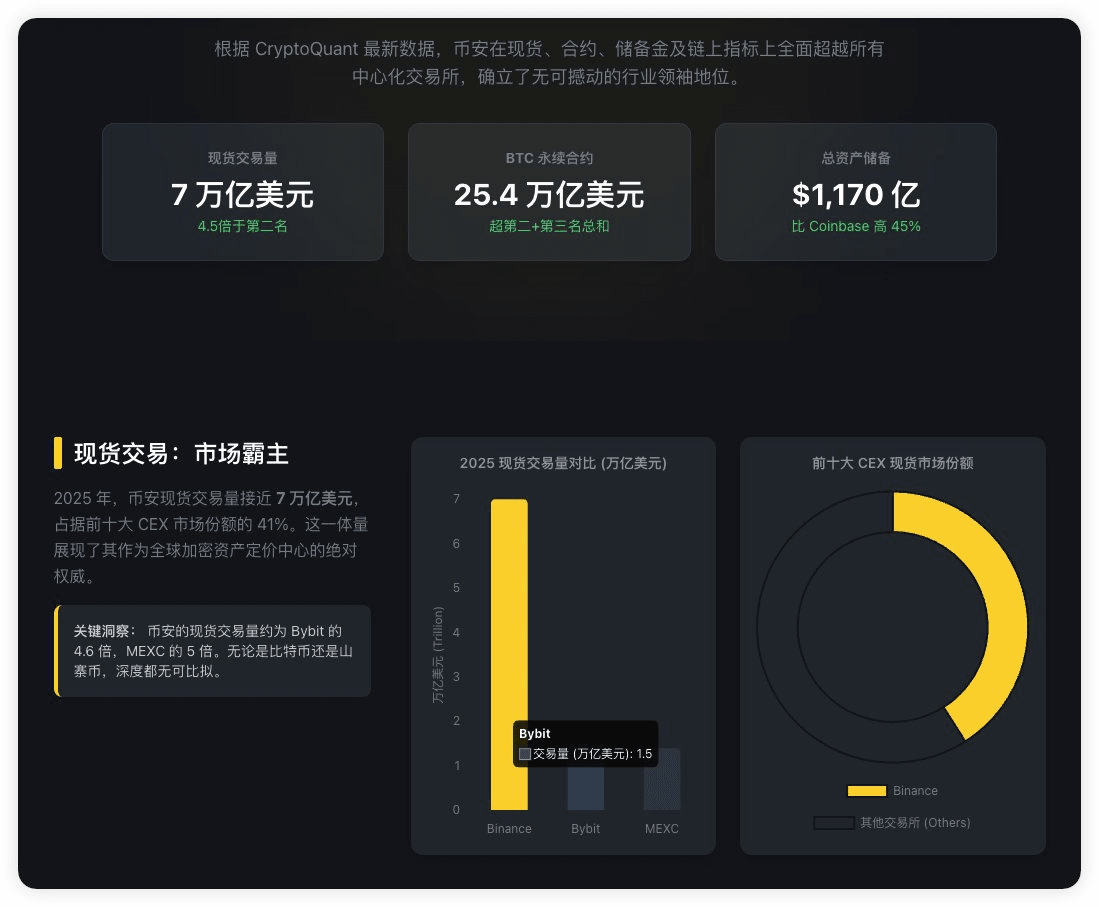
- Binance's spot trading volume approached $7 trillion in 2025
- Market share: Binance holds 41% of the top ten exchanges
- Compared to competitors: It's 4.6 times larger than the second-place Bybit ($1.5 trillion) and 5 times larger than MEXC ($1.4 trillion).
This means whether you want to buy or sell, Binance can offer the lowest slippage across the entire network. Especially in the altcoin sector, Binance’s depth is nearly equivalent to the total of all other platforms combined. The significant widening of the gap between Binance and other platforms in 2025 is largely due to Binance Alpha.
2. Derivatives Trading: Has become the absolute core of Bitcoin trading
What do contract traders value most? Extreme liquidity. Especially in the core battleground of Bitcoin perpetual contracts, Binance has demonstrated terrifying dominance.
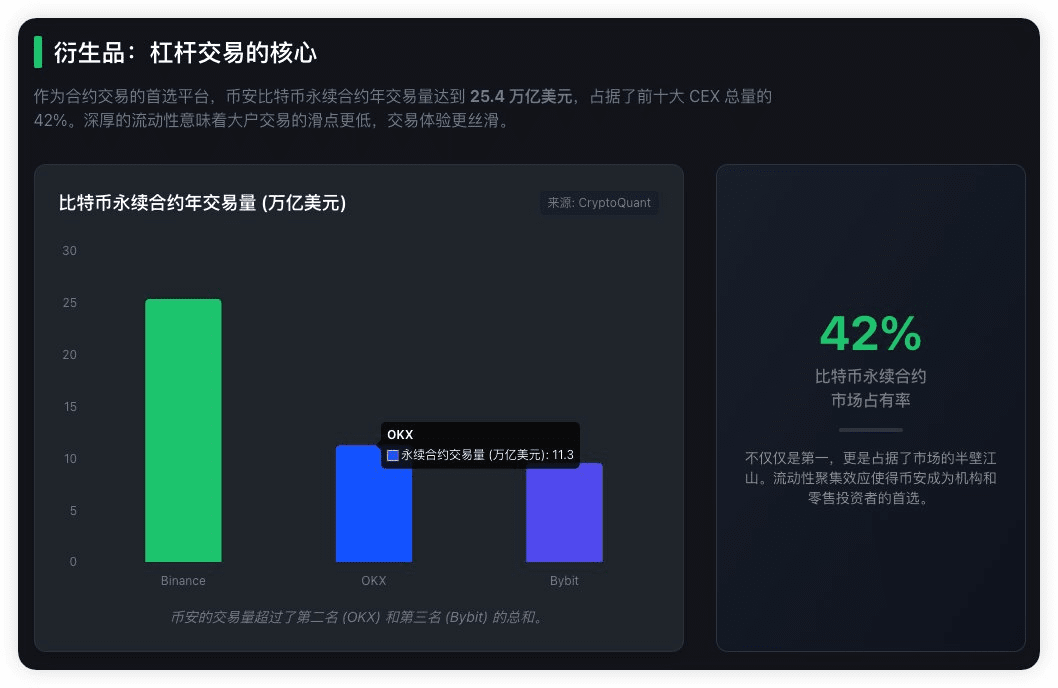
- Trading Volume: $25.4 trillion
- Dominance Level: This figure exceeds the combined total of OKX ($11.3 trillion) and Bybit ($9.6 trillion)
- Market Share: 42%
For large funds and institutional traders, extreme liquidity means cost savings and reduced risk.
3. Capital Reserve: First in stablecoin reserves, total capital exceeds Coinbase
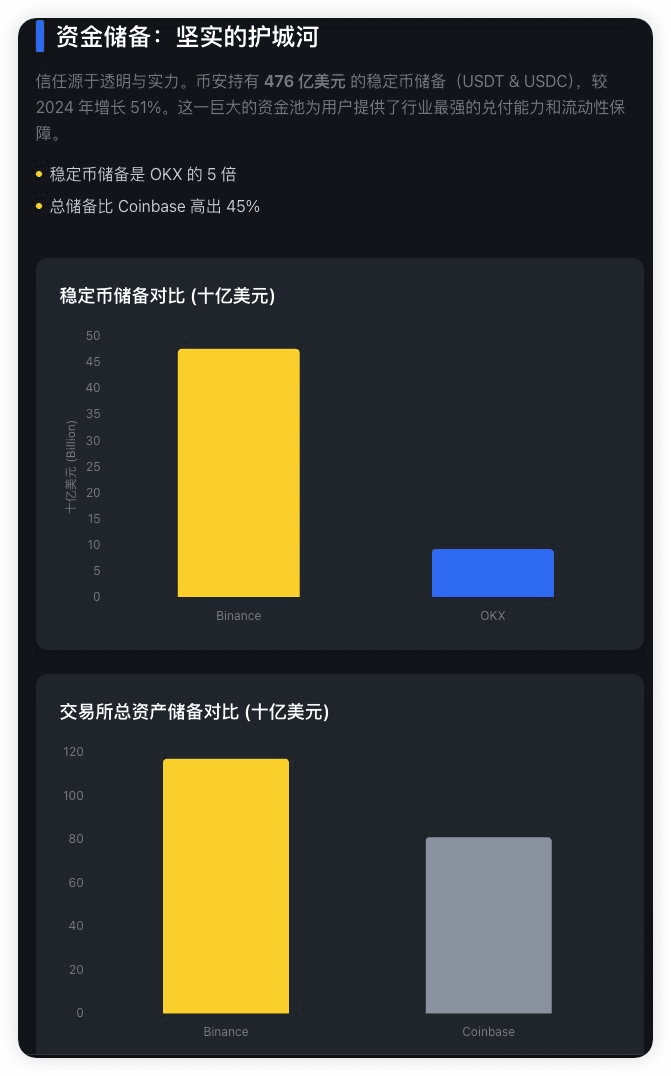
Stablecoin Reserve: Binance holds $47.6 billion in USDT and USDC. For comparison, second-place OKX has only $9.3 billion. Binance's stablecoin depth is 5 times that of OKX.
Total Asset Scale: Total reserves reach $117 billion, 45% higher than traditional veteran exchange Coinbase ($81 billion). For a long time, Coinbase led Binance in exchange reserves, but the gap has now widened significantly.
4. Objective Comparison: What Are Competitors Doing?
Although Binance has dominated in data, competitors in 2025 each have unique strengths and are not without achievements.
- OKX ranks second to Binance in derivatives, but its Web3 wallet ecosystem remains competitive. Stablecoin reserves are about 20% of Binance’s, spot liquidity is relatively weak, but by integrating the wallet’s spot advantages into the exchange, users can trade on-chain assets directly within the exchange, significantly improving the spot trading experience.
- Bybit’s spot trading has grown rapidly ($1.5 trillion), with strong focus on institutional services. Trading volume is approximately one-fourth of Binance’s.
- Coinbase holds an advantage in the U.S. compliant market and institutional custody (BTC ETF). On-chain activity is 33% lower than Binance’s, and asset turnover efficiency is slightly inferior. However, it has the public blockchain BASE and acquired Deribit’s derivatives business in 2025, making it a powerful cash cow.
- MEXC continues to attract aggressive users with rapid coin listings and a vast number of cryptocurrencies. However, trading depth and trust in security are weaker. Originally a haven for altcoins, its dominance has been somewhat reduced by Binance Alpha’s rise, but it remains the most active exchange for altcoin trading.
CryptoQuant’s report conclusion is straightforward: Binance has built a comprehensive closed-loop ecosystem spanning depth, security, and user activity. In the crypto world, liquidity breeds more liquidity.
Binance’s scale effect in 2025 owes much to Alpha. If Binance’s spot and futures trading are its main highways, then Binance Alpha is the high-pressure turbine continuously delivering traffic and capital to these highways.

