

1. Stocks = all-time high
2. Gold = all-time high
3. Silver = all-time high
4. Copper prices = all-time high
5. Money market funds = all-time high
Everything reaches new highs at the same time.
Global markets continue to strengthen, everyone is shouting about the second half of the bull market, as if gold is everywhere.
The more excited the market becomes, the more cautious we should be; today let's take a look at how Newton went bankrupt.
He's the man who discovered gravity, the father of physics, and the greatest scientist in human history—no contest.
This genius whose intelligence overshadowed everyone else ended up being a 'sucker' in the stock market, and lost badly.
The story goes back to Britain in 1720.
At the time, there was a company called the South Sea Company, which had been granted a special charter by the British government to conduct trade with South America.
Think about it—South America, full of gold and silver? What enormous imagination space that must have been!
Plus, the company had government backing and was responsible for handling national debt—just like today’s 'state-owned enterprises' combined with 'AI leaders'.
The entire country went mad.
From nobles to commoners, everyone was investing in stocks, united by one belief: buy South Sea stock, and get rich quick!
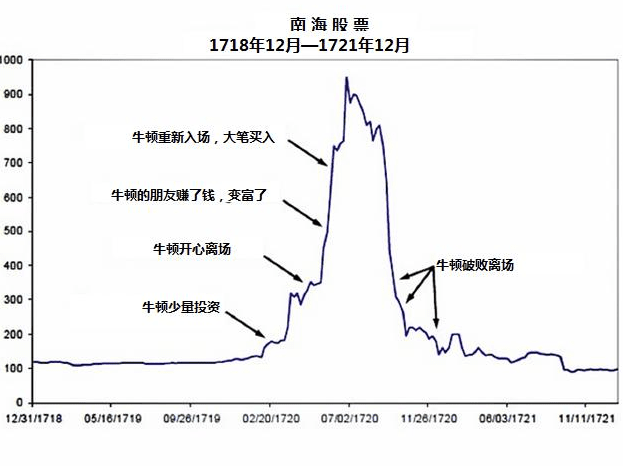
The stock of the South Sea Company soared like a rocket. From 128 pounds at the beginning of the year, it surged through summer, breaking through 1,000 pounds! A gain of nearly 8 times in just half a year!
Our Sir Newton was already 77 years old at the time, serving as the Warden of the Royal Mint—undoubtedly a high-net-worth individual.
He was swept up in this frenzy too.
At first, Newton's moves were flawless.
When the market was still relatively calm, he invested 7,000 pounds. After the stock doubled, he sensed a hint of risk and promptly sold, netting 7,000 pounds in profit—100% return.
You see, geniuses are geniuses—they not only understand science but also know when to take profits.
If the story ended here, it would be a beautiful tale of a scientist effortlessly profiting in the stock market through wisdom.
But human nature is the devil.
What happened after Newton sold?
The stock of the South Sea Company didn't stop—it kept soaring even more wildly!
His friends and colleagues who didn't sell were getting richer by the day. One bought a mansion today, another acquired a manor tomorrow.
Every day, people told him: 'You sold too early! It’s already at 800!' 'It’s about to hit 1,000—how much money did you miss out on!'
Does this feeling sound familiar?
It's that feeling when you sell a stock and the next day it shoots up, and keeps rising. The pain is like a knife in your heart, making you feel like a fool.
The anxiety of missing out is more tormenting than loss.
Even the genius Newton couldn't resist.
At the peak of the market frenzy, when the stock broke through 1,000 pounds, he came back in!
And this time, he almost bet his entire fortune—about 20,000 pounds.
What was 20,000 pounds worth back then?
That was an astronomical sum at the time—equivalent to all his salary as Mint Warden over ten years, without spending a penny.
What happened afterward, everyone knows.
Bubbles, after all, are just bubbles.
Shortly after Newton heavily invested, the British Parliament passed the (Bubble Act) aimed at cracking down on speculative companies. Panic spread instantly, and the stock of the South Sea Company plummeted, falling back to below 100 pounds by year-end.
Countless people lost everything, while Newton lost all his previous gains and also suffered massive principal losses.
After this ordeal, Newton left behind a famous quote:
I can calculate the movements of the heavenly bodies, but not the madness of people.
There's nothing new under the sun.
Compared to Newton's era, today's markets are vastly more advanced in technology, tools, and speed of information transmission.
But the underlying code driving market sentiment has never changed: greed and fear.
Especially the fear of missing out.
Just like now, aren’t many people starting to feel restless again, eager to go all-in and quickly make up for the money they missed out on in recent months?
Before you press the 'buy' button, think of Newton.
Even a mind as brilliant as his couldn't predict the short-term market peaks and bottoms, nor maintain absolute rationality in the midst of frenzy. How could ordinary people think they can?
What I want to say is, the better the market seems, the more you should prioritize risk management.
For ordinary investors, the simplest and most effective way to control risk is to manage your position size!
Position size is your chip stack at the poker table—never go all-in in one move.
When market sentiment runs high and everyone is talking about stocks, what you should do is not rush in—but check whether your position size is too heavy, and consider reducing it slightly to lock in some profits.
No matter how optimistic you are about a direction or how certain you are about an opportunity, always keep some cash in your account.
This money is your strength—the ammunition that lets you add to your position when the market drops, and the guarantee that you can sleep soundly at night.