


Two months ago, when Alibaba decided to allocate all its resources to Qwen, people thought it was just a model upgrade. But today, with the Qwen app deeply integrated into the underlying interfaces of Alibaba's ecosystem, a highly ambitious business vision is emerging: Alibaba is attempting to leverage its vast ecological commercial moat to deliver a game-changing blow to the fragmented era of mobile internet apps in the AI age.
Qwen's goal is no longer just a chatbot; it aims to become the super entry point of the AI era — a reimagined digital overseer surpassing Alipay and Mobile Taobao.
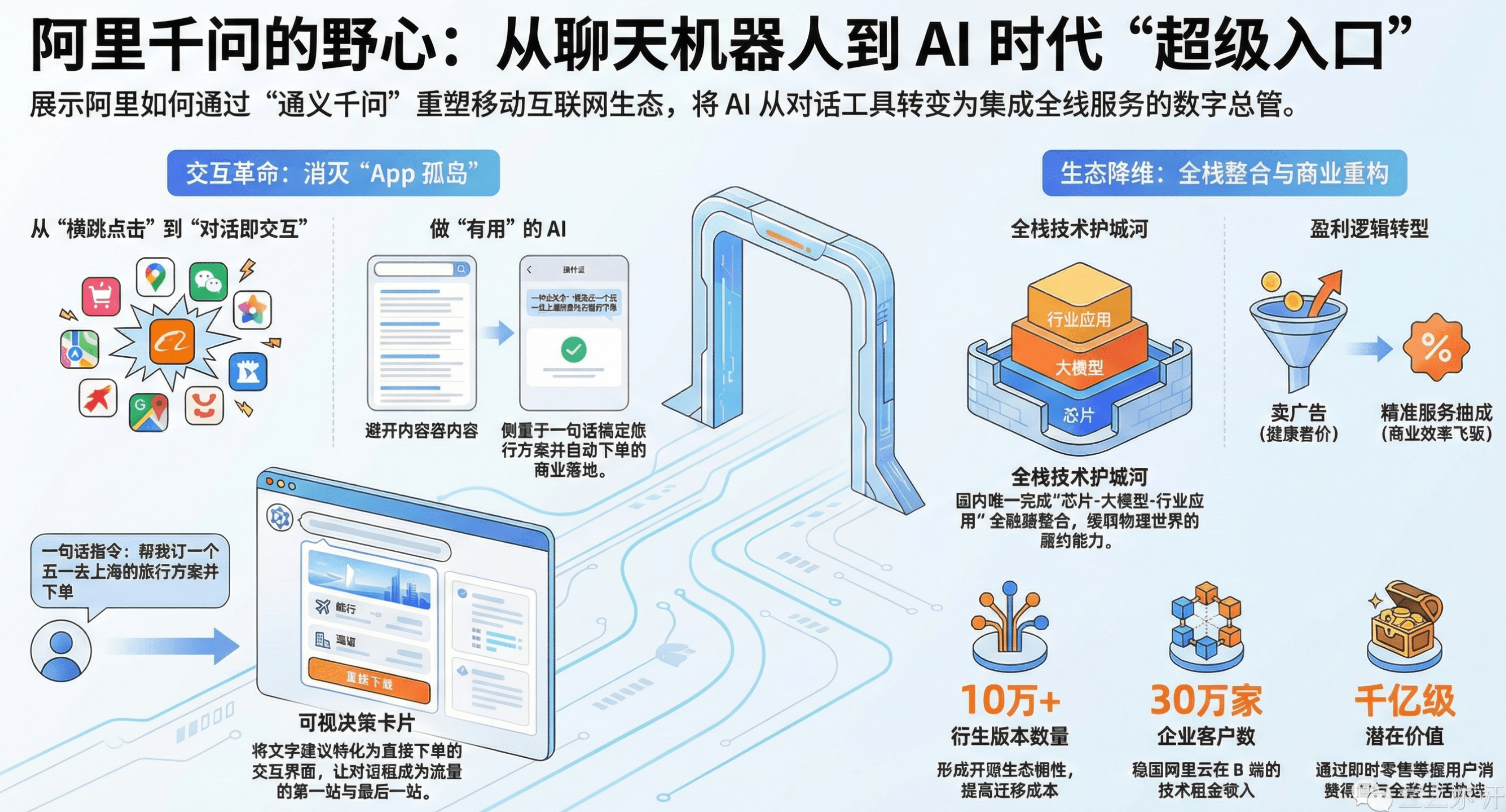
1. The funeral of apps: from island hopping to dialogue as interaction.
Looking back at the past decade of mobile internet life, it's actually quite exhausting. We are trapped in hundreds of app islands.
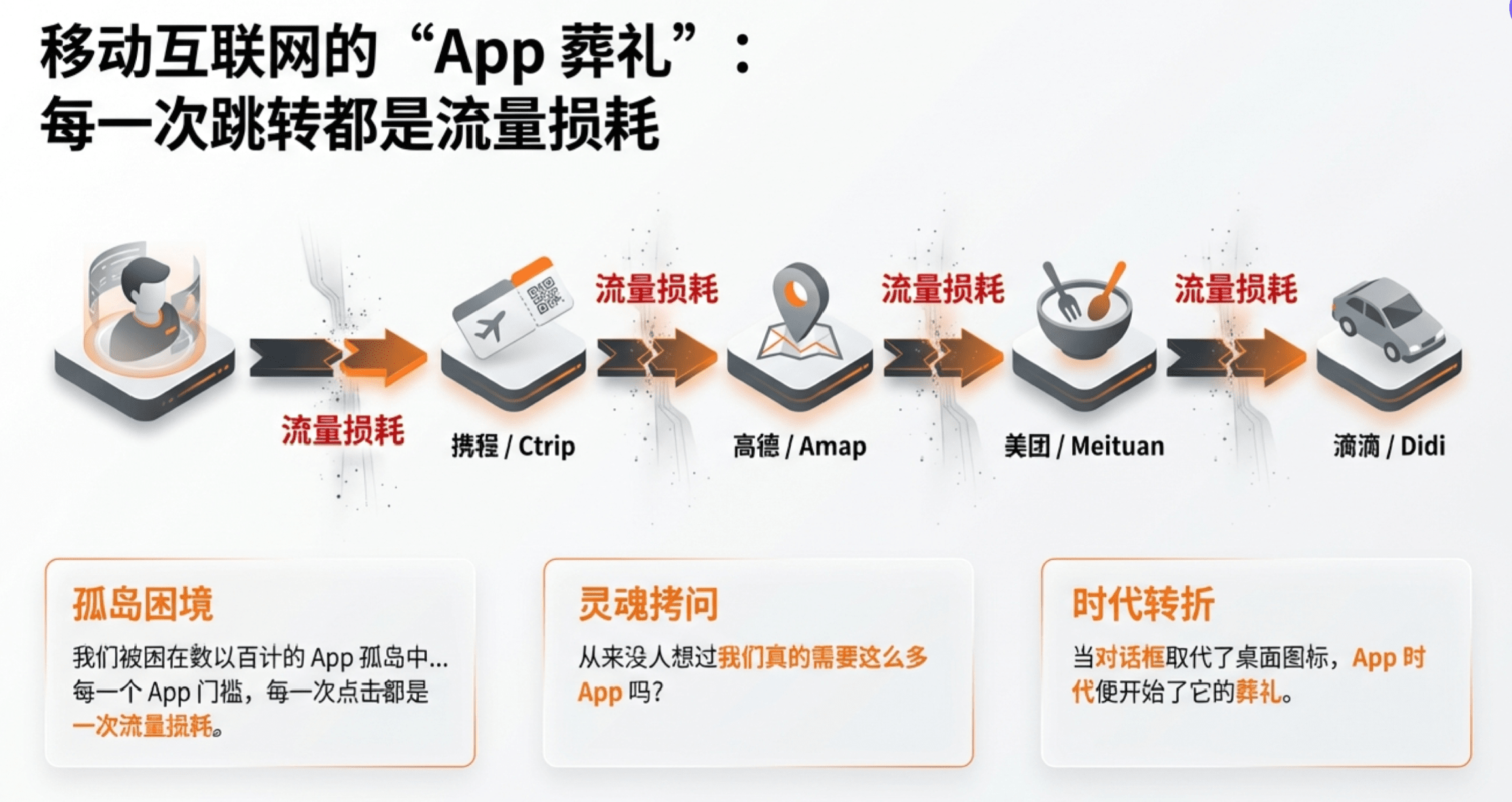
If you want to book a business trip, you first need to go to Ctrip to book a ticket, then open Amap to see where the hotel is, then search for restaurants on Meituan, and finally hop to Didi to call a ride. Each app is like an independent island; you keep jumping back and forth, and every app's threshold, every click is a loss of traffic. Has anyone ever thought about whether we really need so many apps?
Qianwen now wants to do something big: eliminate these click actions.
After this upgrade, Qianwen is no longer just a talker giving you suggestions; it can actually get things done. Because it has connected to the underlying interfaces of Taobao, Alipay, Amap, and Fliggy. Qianwen has introduced 'visual decision cards.' This means that the originally lengthy text suggestions have turned into an interactive interface for direct ordering.
Think about it, when the dialogue box becomes the only entry point for the phone, users no longer need to learn how to use different apps; they just need to issue a command in one sentence. When the dialogue box replaces desktop icons, the app era begins its funeral. Whoever can make decisions for users and directly execute payments will be the first and the last station for traffic.
2. Ecological dimensionality reduction strike: AI that can run errands is truly powerful.
The current AI circle is busy competing in scoring and reasoning, but honestly, everyone is slowly getting tired of it.
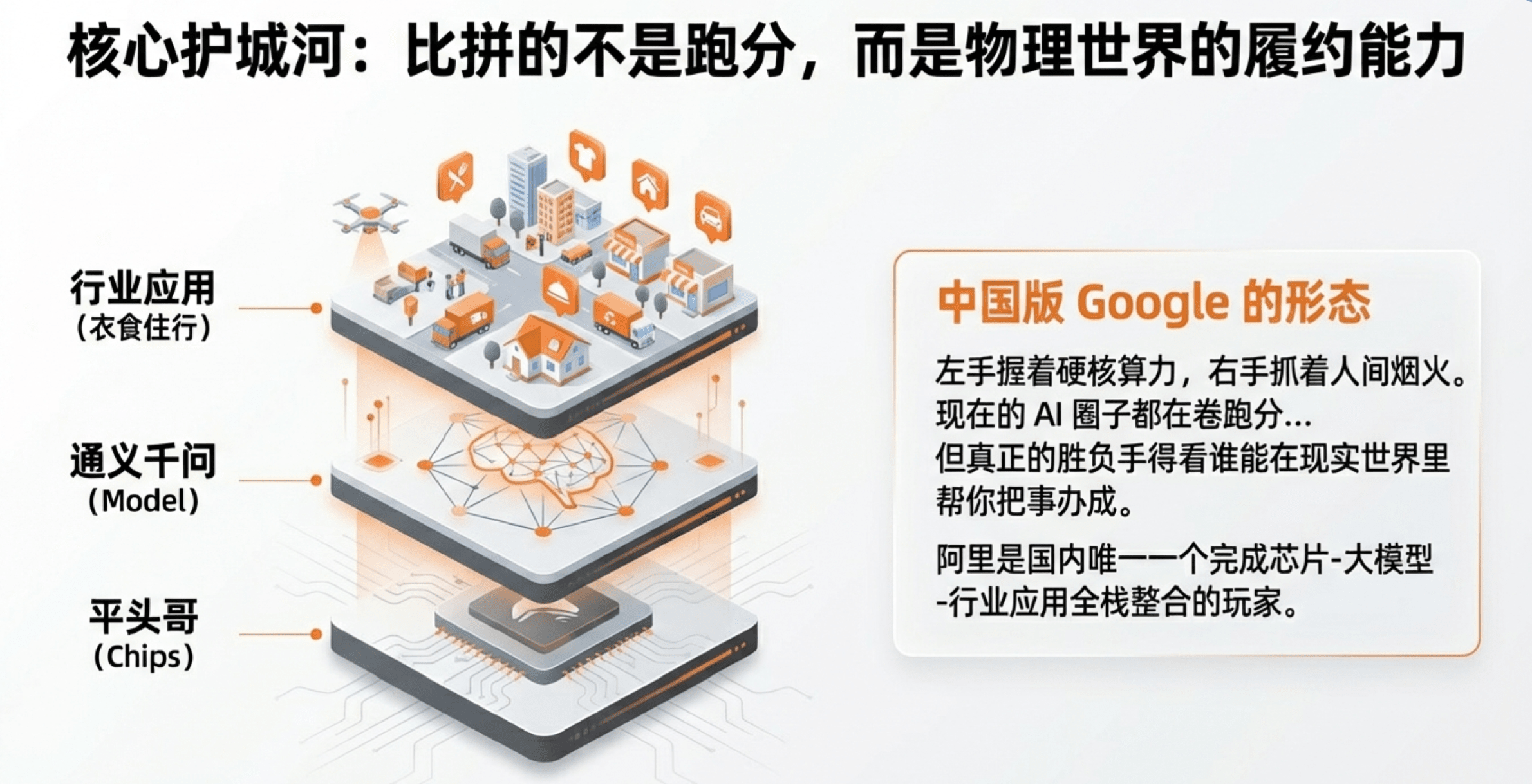
Where is the real key to victory or defeat? It depends on who can help you get things done in the real world. The competition is about the fulfillment capacity in the physical world. This is Alibaba's biggest moat.
Alibaba is the only player in the country that has completed the full-stack integration of chips (Pingtouge) - large models (Qianwen) - industry applications (covering all aspects of life). While others are still testing data in laboratories, Qianwen can already help you order takeout, book flights, and even handle troublesome visa applications.
Even more brilliant is that Alibaba has deeply integrated government functions into Qianwen. The rigid demands and free traffic brought by government services will ultimately settle in Qianwen's account system, forming a credibility endorsement similar to that of Alipay when it started.
This is simply the Chinese version of AI Google: with hardcore computing power in one hand and the mundane world in the other.
3. Business reconstruction: from selling ads to collecting rents.
The success or failure of Qianwen is not only related to daily active users on the C-end but also to the life and death of Alibaba Cloud.
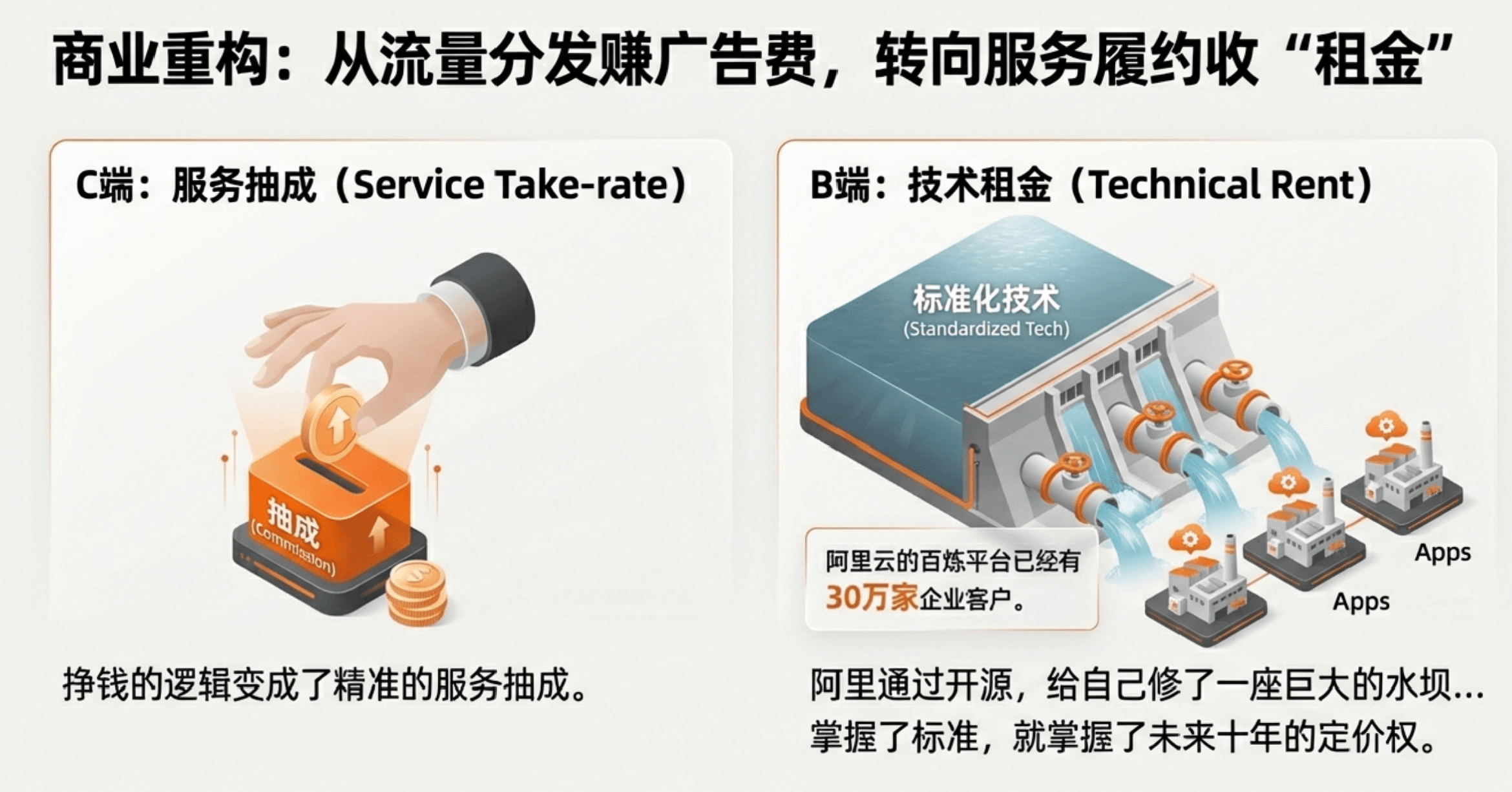
1. Transformation from traffic distribution to service commission.
In the past, the internet made money by selling ads and doing search rankings. But in the AI era, when this assistant can directly help you make decisions and pay, commercial efficiency will undergo a fundamental leap, and the logic of making money will transform into precise service commissions.
2. Ecological inertia of the open source bottom layer.
Currently, the derivative versions developed based on Qianwen have exceeded 100,000. There are hundreds of thousands of technical teams around the world using Qianwen's foundation to develop software, which has a huge destructive power. Just like everyone is accustomed to using the Windows operating system, once medical, legal, and coding professional models are built on Qianwen's foundation, the cost of replacing it will be exorbitant.
Alibaba Cloud's Bai Lian platform already has 300,000 enterprise customers. Through open-source, Alibaba has built a huge dam for itself. The more C-end users use it, the smarter the model becomes, and Alibaba Cloud's technical rent in the B-end becomes more solid. Mastering the standards means mastering the pricing power for the next decade.
4. Key battle: Why must we secure instant retail?
Many people ask why Alibaba is willing to sacrifice beautiful financial report data recently, spending heavily to secure the top market share. The logic has been unified in Qianwen; the value of this entry point is worth at least hundreds of billions.
Instant retail (takeout, ride-hailing, fresh produce) has three core characteristics: high monthly activity, strong repurchase, and business continuity. In the AI's computational logic, a single instant retail user may only be worth 10 yuan on the surface, but behind that is their entire lifestyle trajectory and consumption credit. In other words, you are not just acquiring a takeout user; you are accounting for almost all of a person's spending on the internet.
If Alibaba loses instant retail, Qianwen will lose the most real commercial nutrients. Therefore, this territory must be maintained; otherwise, in the future, users will place orders through other people's AI, and Alibaba will completely become a backend worker.
5. Endgame: Can Qianwen break out in the fiercely competitive C-end market?
The current AI circle is roughly a three-way standoff. Each party has a distinctly different foundation:
ByteDance (Doubao):
Strong in content and dopamine, it is the most fun and fully functional AI.
Tencent (Yuanbao):
Strong in social relationship chains, it is an AI that understands you.
Alibaba (Qianwen):
It must be strong in getting things done and creating useful AI.
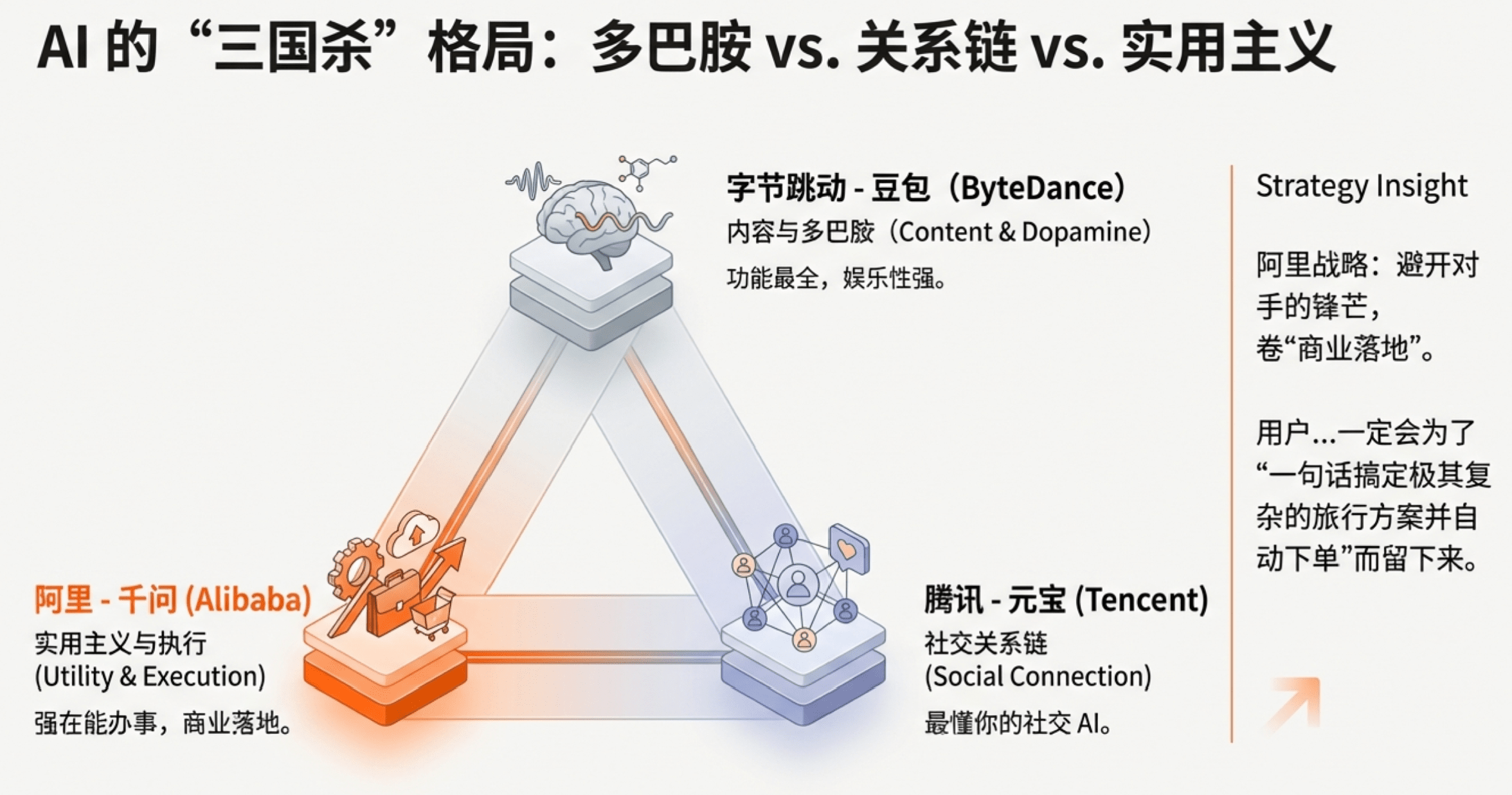
Alibaba's shortcoming lies in its C-end product experience and content ecology. But this time, Alibaba has figured it out, not competing in short videos with you all. It competes in commercial implementation. You may not browse videos in Qianwen, but you will definitely stay to simplify extremely complex travel plans and automatically place orders.
Qianwen currently demonstrates strong endogenous integration capabilities, but its true test lies in openness, connecting more third-party external ecosystems and raising the business ceiling of the platform.
The key to future success or failure lies in whether Qianwen can break the limitations of the Alibaba system and connect to interfaces of Meituan, JD.com, or even Pinduoduo. If Qianwen can only mobilize Alibaba's own resources, it is just a super shopping guide; if it can command services across the internet, AI will not just be a search box, but the operating system of the AI era, as well as your brain and wallet.