


On January 15, 2026, social media giant X (formerly Twitter) suddenly tightened its API policies, explicitly prohibiting the 'Post-to-Earn' model, leading to a collapse of the core business logic of Web3 search and data platform Kaito. However, even more chilling for the market than the business meltdown was the suspicion of 'insider trading' revealed by on-chain data — while retail investors were still vigorously promoting the so-called 'last meal' (final airdrop points), the project team may have already completed a high-level exit of up to $2.7 million.
1. Core Event: The centralized iron curtain falls, and the InfoFi track faces a 'dimensionality reduction attack'
As a leader in the 'InfoFi' (Information Finance) track, Kaito's business model heavily relies on X platform's data interface (API). Through the 'Yaps' points system, Kaito incentivizes users to publish content with specific tags on X in exchange for the expectation of future token airdrops.
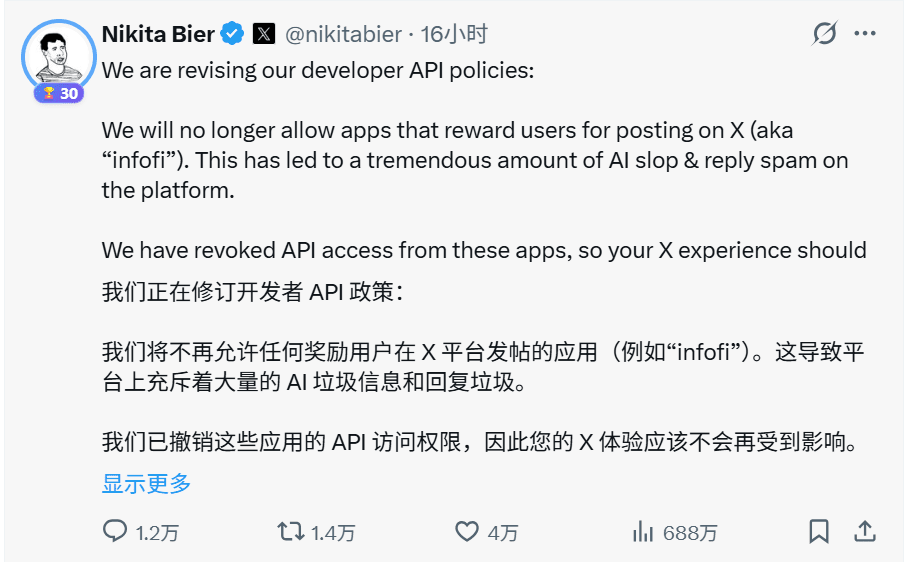
However, this model suffered a devastating blow from X officials on January 15, 2026. X product head Nikita Bier publicly announced that due to such applications flooding the platform with 'AI-generated junk information and replies (AI slop & reply spam)', X decided to revoke API access for related applications.
Immediate impact:
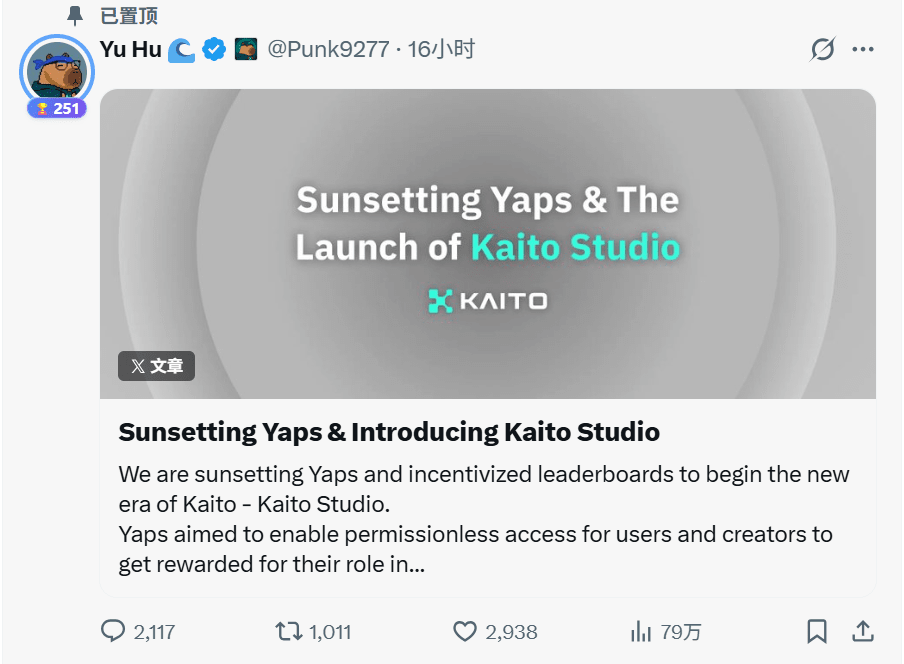
Business level: Kaito founder Yu Hu was forced to announce the termination of the Yaps business and transition to a traditional marketing platform, Kaito Studio.
Market level: $KAITO Tokens plummeted, with a decline exceeding 20% in a short time, not only breaking technical support levels but also shattering the community's trust baseline.
II. On-chain forensic: The missing 5 million tokens and 'running ahead' suspicion
If the API ban is an irresistible 'natural disaster', then the massive funds transfer that occurred before the announcement was widely questioned by the community as a 'man-made disaster'.
According to on-chain analysts like EmberCN and public browser data, the Kaito team or related parties exhibited an astonishing 'precognitive ability' before the crisis broke out:
Event process sorting
- On January 4, 2026, a key transfer occurred where Kaito's multi-signature wallet (Multi-sig) distributed tokens to an intermediary address. Among them, a sum of 5 million $KAITO tokens was quickly transferred.
- On the same day (T-11), the suspected transfer of the aforementioned 5 million tokens (then worth about 2.7 - 2.82 million dollars) was directly transferred to the Binance recharge address. Generally, transfers into exchanges are a very strong signal for monetization.
- From January 5 to 14, 2026, during the information vacuum period, community retail investors were completely unaware and continued to interact frequently on X ('earning points'), contributing traffic and data to the project.
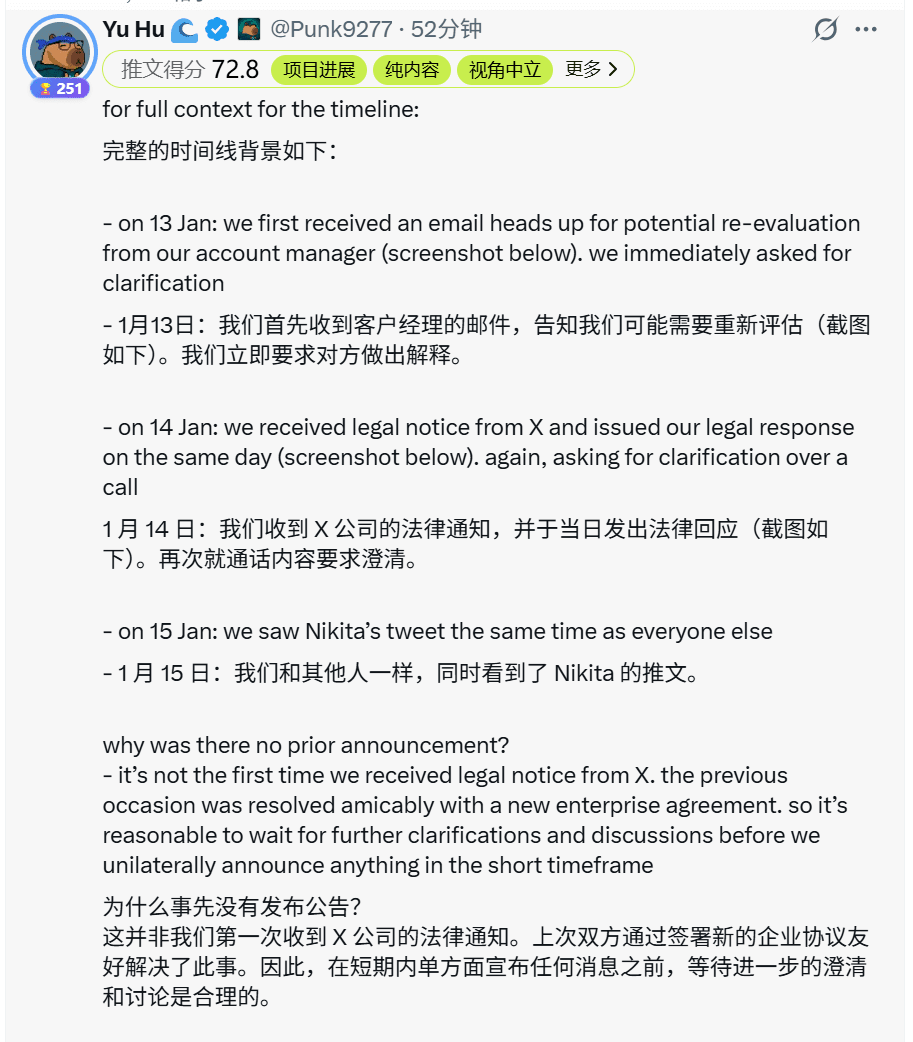
- On January 15, 2026, the official announcement X announced the ban on APIs, Kaito admitted that its business was hindered. Founder Yu Hu subsequently admitted to having 'communicated with X'.
From the capital transfer on January 4 to the announcement on January 15, there was a long information time difference of 11 days. The transfer time of these 5 million tokens was precisely timed at the price peak before bad news was announced. This means that while retail investors were staying up all night tweeting for a 'headless meal' (final point settlement), the funds with insider information might have cashed out up to 2.7 million dollars by 'running ahead'.
III. The vulnerability of being 'in someone else's backyard'
The collapse of Kaito is not just a project failure; it reveals the structural ailments that are common in current Web3 applications: the pseudo-decentralized parasitic model.
Single Point of Failure (SPOF):
The so-called 'decentralized search' or 'Web3 social layer' relies entirely on the API authorization of centralized entities (X) for underlying data acquisition. 'Building in someone else's backyard, when the fence will be torn down depends entirely on the owner's mood.' Once X cuts off the supply (API), the valuation logic of projects like Kaito that depend on it will instantly drop to zero.
The curse of traffic:
The essence of the InfoFi model is to create 'artificial traffic' using token incentives. For X, early on, it may have needed this activity, but when AI bots and junk replies seriously disrupt the real user experience, this type of traffic becomes a liability for the platform. X's ban is a necessary return to commercial rationality, while Kaito gambled its survival on the hope that the giants would always be 'tolerant'.
Lack of transparency in governance:
Although it claims to be a DAO and Web3, in terms of core decisions (such as negotiation progress with X) and fund management (such as the movement of 5 million tokens), the project party still maintains extreme centralization and opacity. The founder admitted to 'having communicated with X', indirectly confirming that the team was aware of risks far earlier than the community.
IV. Conclusion: An expensive 'headless meal'
The most ironic scene of the entire event is that Kaito's loyal users were still trying to earn the last points by brushing 'Yaps' on January 14. They thought they were participating in the future construction of Web3, but in reality, they were paying the 'farewell banquet' bill for the already departed traders.
The warning that the Kaito incident left for the industry is bloody: any Web3 business model built on the permission of centralized platforms has a foundation as fragile as quicksand. And for investors, when on-chain data (large amounts transferred into exchanges) diverges from the project's fundamentals, never hold onto any illusions—because in the crypto market, bad news always reaches retail investors last.
Musk sent Kaito to the guillotine, and Kaito could still think about having a delicious bowl of headless meal, but the meal money is on you.
The most ironic part of the entire event is that Kaito was still thinking about having this 'headless meal' before leaving. The night before the API permissions were revoked, on-chain data showed that as early as 11 days before the announcement (January 4), the team's associated multi-signature wallet had transferred 5 million $KAITO tokens (about 2.7 million dollars) to a suspected Binance address.
After the news was announced, founder Yu Hu also admitted to having communicated with X. This means that while you were tweeting all night to earn points, the team was already well aware and had completed high-level reductions in advance.
Building in someone else's backyard, when the fence will be torn down depends entirely on the owner's mood. When X decided to no longer tolerate these projects that depend on its traffic to benefit, the so-called vision of decentralization became as fragile as a blank sheet of paper in front of the centralized platform's API, but perhaps now X can be quieter.
After InfoFi was sanctioned, which groups will be differentiated as beneficial or detrimental?
Beneficial: Outstanding content creators, Binance Square, OKX Orbit, highly engaged Discord users, beacons, (some) project ecosystem users, X users who do not like AI content
Detrimental: The income of Nigerian uncles, accounts that survive on 'words', token prices, AI reply plugin income, InfoFi platform's discourse power, projects that look good but are useless
Differentiation: Small and medium accounts without project capabilities lose InfoFi, struggling to promote for 20U—top KOLs with discourse rights further increase advertising fees, accounts without creative and analytical abilities lose attention and interaction—seriously creative (small) accounts with long research reports and in-depth technical analysis regain traffic
————————————
Human insight is irreplaceable; in the future, comment sections and timelines will become cleaner and neater, without a variety of AI standard symbols and tags. Creating a memorable personal IP and good personal reputation is the most important.
InfoFi undeniably drove many quality content users and some small accounts to seriously participate in creation, leading to life-changing financial gains, but AI content and replies also made timelines and content messy. After all, in 2024 and before, the first thing I did after waking up every day was to scroll through Twitter, which was fascinating and could last a long time. I hope that in a few days the timeline can return to its original state.
Seriously output effective content, insist on originality, the door of Crypto is still open for everyone, keep it up!
Everything is interconnected, digital is king | More airdrop activities follow #welinkBTC
Focusing on Web3, blockchain games, AI, Airdrop investment opportunities 🫙 Monitoring 100 crypto influencers across the network 🔥 Let's traverse bull and bear markets $BNB
