
From the traffic wars to value symbiosis, the breakthrough path of a public chain
Twitter has once again sparked a narrative debate about the 'crypto gateway' with news of the integration of trading features. While all players scramble for the first user touchpoint, the BNB Chain has chosen a completely different path—not to be the 'gatekeeper' of traffic, but to become the 'overpass' of value flow. By 2025, this chain delivered an unexpected report card: 700 million independent addresses, 4 million daily active users, 14 billion USD stablecoin market value, and the collective entry of TradFi giants like BlackRock and China Merchants International. This is not just a victory of data, but a crypto story about 'coexistence.'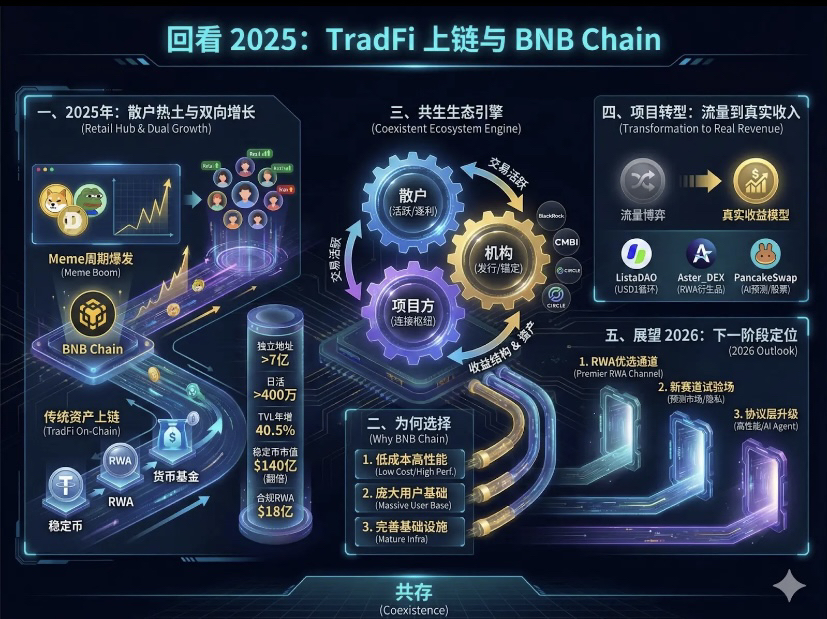
I. 2025: The dual personality and institutional transformation of BNB Chain
If BNB Chain in 2024 was a playground for meme coin festivities, then in 2025 it made a thrilling leap from "retail paradise" to "institutional springboard." This transformation is not merely a user structure upgrade but has formed a unique "dual personality": on one side are Degens chasing $BROCCOLI and $Cheems on Four.meme, while on the other side are institutional investors subscribing to BlackRock's BUIDL fund through Securitize.
Data shows that this seemingly fragmented coexistence is exceptionally harmonious. In 2025, BNB Chain's daily average transaction volume peaked at 31 million, with TVL growing 40.5% year-over-year, and the RWA asset scale breaking through $1.8 billion. More critically, the network experienced zero downtime throughout the year during the peak of the meme market and when BNB price hit an all-time high (at one point approaching $1300), proving its ability to handle real high-load environments. This resilience of "withstanding retail FOMO and receiving institutional funds" is precisely the characteristic that traditional financial giants value the most.
The explosion of stablecoins is another highlight. The total market capitalization of mainstream stablecoins like USDC and USDT has doubled to $14 billion, and Circle's yield-generating stablecoin USYC has over $1.4 billion in single-chain deployment. While other public chains are still worrying about "killer applications," BNB Chain has constructed the most scarce "cash layer" in the crypto world through the genuine demand for stablecoin payments, lending, and yield products.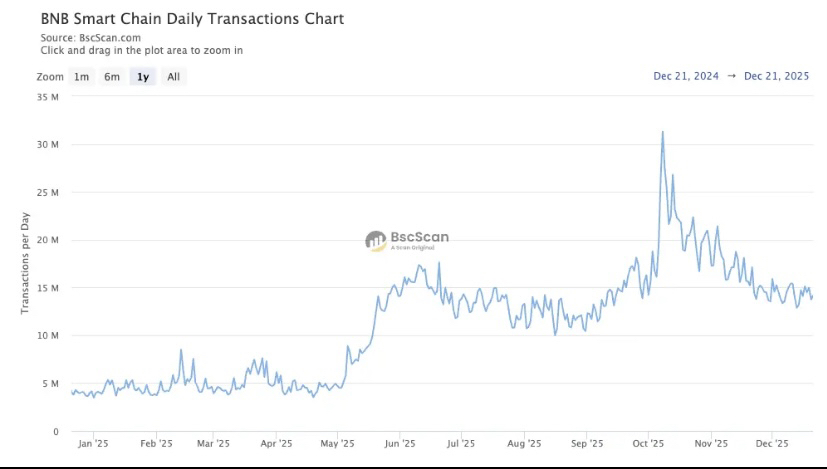
II. Why are TradFi giants fond of this "people's chain"?
BlackRock's BUIDL fund, China Merchants Bank International's $3.8 billion CMBMINT, Franklin Templeton's money market fund... These "financial heavyweights" that require KYC/compliance processes have coincidentally chosen BNB Chain, driven by three underlying logics:
1. Performance is the entry ticket, not an added bonus
Against the backdrop of the Federal Reserve's three interest rate cuts in 2025 and marginal improvement in liquidity, the demands of institutions for on-chain infrastructure have upgraded from "usable" to "user-friendly." BNB Chain has compressed block time to 0.45 seconds through hard forks like Maxwell and Fermi, reducing finality to 1.125 seconds and increasing gas bandwidth to 133 million per second. This "NASDAQ-level" responsiveness makes high-frequency subscriptions and redemptions of money market funds, as well as real-time settlement of RWA assets, possible. Compared to the gas fees of several dozen dollars on the Ethereum mainnet, BNB Chain's cost advantage is not merely about saving money but rather about enabling which business models can succeed.
2. Traffic is value capture
The 2.8 million global users of the Binance ecosystem form BNB Chain's "hidden asset." When BUIDL tokens can be used as collateral for trading within the Binance system, they instantly reach a CEX user market in the tens of millions. This "on-chain issuance - CEX distribution - scenario landing" closed loop allows institutional assets to avoid the awkwardness of becoming an "island" once they go on-chain. Circle's choice to deploy USYC on BNB Chain is precisely because of its diversified user penetration from Southeast Asia to Latin America, providing the best testing ground for the globalization of U.S. dollar stablecoins.
3. Lego-style DeFi composability
Venus Protocol supports CMBMINT fund tokens as collateral, Lista DAO integrates USD1 to build treasury strategies, PancakeSwap launches perpetual contracts for U.S. stocks... These native projects not only serve retail investors but also become the "routers" of institutional assets. Once TradFi tokens are launched, they can seamlessly connect to lending, derivatives, yield aggregation, and other scenarios. This level of plug-and-play ecological maturity allows institutions to focus solely on asset issuance without the need to build their own infrastructure.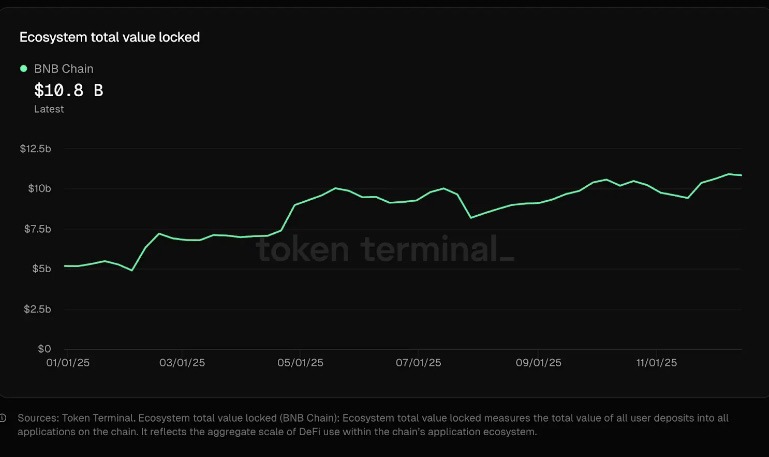
III. The Trio: The non-zero-sum game between retail investors, institutions, and projects
In 2025, BNB Chain staged a brilliant "ecological trio," where three types of roles perform their duties while empowering each other:
Retail investors: from "gold miners" to "liquidity providers"
Even with institutional funds pouring in, the enthusiasm of Degens for trading has not diminished at all. High-leverage tools from Aster PerpDex and the meme launchpad of Four.meme keep retail investors as the eternal "active factor." But roles are evolving—they are no longer just price discoverers but also become the liquidity foundation for institutional assets through Lista DAO's treasury strategies and Venus's collateral lending. When retail investors participate in BUIDL's liquidity mining using USDT, TradFi funds gain the "fuel" for on-chain expansion, while retail investors share in the institutional-grade returns.
Institutions: from "testers" to "asset issuers"
The on-chain role of TradFi institutions has undergone a qualitative change from "buying coins" to "asset tokenization." They are no longer satisfied with holding BTC/ETH but are tokenizing US Treasuries, money market funds, and credit assets themselves. CMBMINT from China Merchants Bank International allows qualified investors to subscribe and redeem on-chain, while BlackRock's BUIDL achieves T+0 settlement through smart contracts. This shift means that institutions have transformed from being "guests of crypto" to "masters of the chain," bringing not speculative funds but real-world cash flow.
Projects: from "traffic catchers" to "value hubs"
PancakeSwap has cut CAKE inflation and launched the AI prediction market Probable; Lista DAO has bound more than a dozen stablecoins to build a yield system with $2 billion TVL; Aster has expanded from perpetual contracts to U.S. stock derivatives. These transformations reveal a trend: pure traffic models are dead, and real income is king. Projects have become the "converters" connecting institutional assets with retail demand, designing yield structures, risk layers, and scenario combinations to allow two seemingly contradictory user groups to find what they need in the same ecosystem.
The results of this symbiosis are surprising—institutional funds have improved the quality of on-chain assets, creating more robust yield opportunities for retail investors; the activity of retail investors has lowered the liquidity costs of institutional assets. BNB Chain proves that the democratization and institutionalization of finance can coexist harmoniously.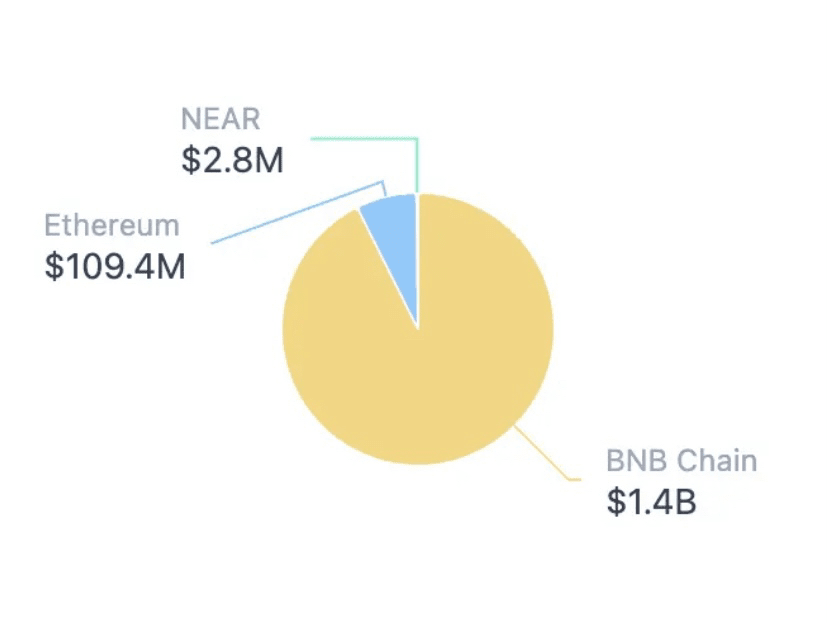
IV. 2026: The key leap from "trading chain" to "asset platform"
Looking ahead to 2026, the challenges and opportunities facing BNB Chain are equally clear. The Federal Reserve may continue to cut interest rates under economic slowdown pressures, and global liquidity is expected to improve further, but the high valuation risks of traditional markets may also spill over to the crypto market. Against this backdrop, BNB Chain's roadmap points to three strategic pivots:
4. The "high-speed rail moment" of RWA
With the implementation of regulatory frameworks like the U.S. "GENIUS Act," the RWA market is expected to jump from the current $18 billion to over $50 billion. BNB Chain aims to become the Prime Broker of the distributed RWA market. Its technical roadmap indicates that it will achieve 20,000 TPS and sub-second finality through a dual-client architecture (Geth ensures stability, Reth enhances performance) and introduce a native zero-knowledge privacy module to support the compliance and confidentiality needs of financial institutions. This means that in the future, when issuing tokenized U.S. Treasuries or real estate funds on-chain, it can meet institutional-grade performance while achieving selective disclosure through ZK technology, protecting trade secrets.
5. The "chemical reaction" of AI and crypto
The rise of AI agents in 2025 has opened new entry points for BNB Chain. In 2026, it will focus on building AI-friendly infrastructure, including AI agent identity registration systems, reputation scoring, and low-cost payment networks. Imagine an AI trading bot that can autonomously manage funds, execute arbitrage, and pay gas fees on BNB Chain without human intervention. This kind of "machine-to-machine" economic activity may open up a trillion-dollar micro-payment market. Binance Alpha validated the effectiveness of liquidity incentives in 2025, and similar mechanisms will tilt towards AI developers in 2026.
6. The "testbed" of prediction markets
From @opinionlabsxyz's macro trading perspective to @0xProbable's zero-fee prediction market, BNB Chain is becoming a hotbed for on-chain prediction economies. These projects are not merely simple imitations of Polymarket but are tokenizing and compositing prediction positions, even integrating with meme culture—such as using PEPE tokens to bet on whether a certain MEME coin can flip DOGE. This model of "prediction as an asset" may give rise to an event-driven derivatives market, providing new tools for hedging traditional finance's "black swans."
7. The "institutional-level unlocking" of privacy modules
In 2025, privacy coins are expected to outperform the mainstream market, and BNB Chain plans to introduce a configurable privacy framework in 2026. This is different from Monero's "full anonymity"; rather, it is a compliance-friendly selective privacy: the transaction parties can hide amounts or counter-parties under regulatory audit while retaining a traceable path. This is a significant boon for trade finance and supply chain finance scenarios that require confidentiality and is key to attracting enterprise-level users.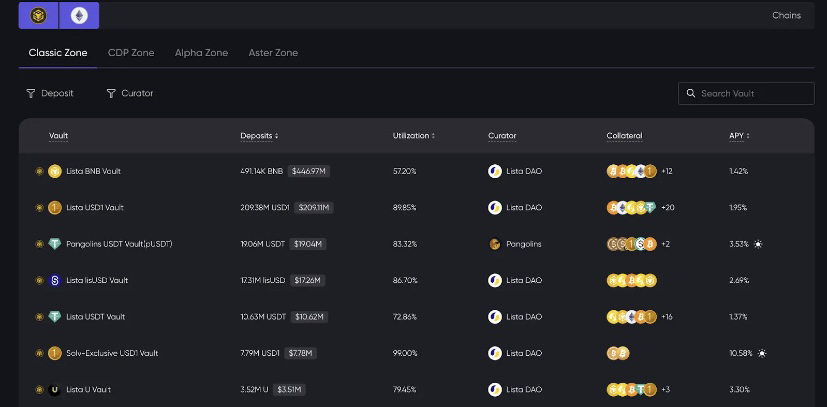
V. Conclusion: The "super interface" of the coexistence era
As Twitter explores social trading amid controversy and Solana indulges in meme factories, BNB Chain has chosen a more difficult yet more valuable path—becoming a "super interface" that connects all narratives instead of being the protagonist of a single story. Its success is not in how many wealth myths it creates, but in proving that the crypto world can accommodate diverse values: the speculative nature of retail investors and the rigorous risk control of institutions, on-chain native innovation and off-chain real assets, the traffic advantages of the East and the capital depth of the West.
In 2026, BNB Chain's vision is to become a "global decentralized financial system," providing CEX-level experiences while retaining Web3 control. This goal sounds grand, but it already has a solid foundation: on the technical front, 20,000 TPS and privacy modules are on the way; on the ecological front, the symbiotic model of institutions, retail investors, and projects has been successfully run; on the macro front, the Fed's interest rate cut cycle and regulatory clarity provide favorable winds.
The future challenge lies in how to maintain the open spirit of the crypto world amid institutionalization? How to keep decentralization while enhancing performance? The answers to these questions will determine whether BNB Chain becomes the operating system of new finance or merely becomes a "high-performance sidechain" of the Binance ecosystem.
But what is certain is that when Wall Street fund managers and meme players from Latin America seek their own benefits on the same chain, when the yield of real-world government bonds seamlessly arbitrages with on-chain DeFi mining returns, we have touched upon the true form of financial democratization—not the elimination of expertise, but the coexistence and mutual prosperity of expertise and the public in the same market.
This is the most noteworthy social experiment in the crypto world in 2026. And BNB Chain is one of the most important testbeds for this experiment.
💡 Interactive topic: Do you think BNB Chain can maintain its "people's chain" essence amid institutionalization? Feel free to share your views in the comments! If you believe it can become a bridge between TradFi and DeFi, please like and share it with more friends. Follow me, and we will delve into the technical details of BNB Chain's privacy module.🚀#BNBCHAİN #BNBChain #BNBChainSunset #BNBChain再次伟大! #BNB走势 $BNB



