
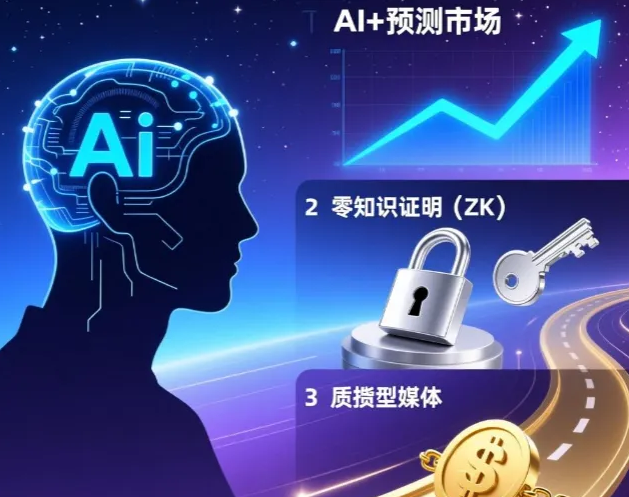
A16z Crypto (managing over $90 billion in a giant fund) recently published a forecast on three major directions for the blockchain industry by 2026.
In simple terms, they believe that the current blockchain is not user-friendly or trustworthy enough, and that these three strategies will be the key to breaking the deadlock in the next two years:
1. AI + Prediction Markets: Let robots be the 'iron-faced judge'
(Original terminology: Prediction Markets, LLMs as oracles)
What are prediction markets? It's like legal 'guessing games'. People bet money on future events, such as 'Who will be the president of the United States in 2026?' or 'Will it rain in New York next Tuesday?'. Bet correctly and make money, bet incorrectly and lose money.
Current pain points: Who judges the results? If everyone bets 'it won't rain next week' and the result is rain, but the referee insists it was cloudy, that's easy to dispute. In the past, it relied on humans or centralized institutions to judge, which was slow and had risks of corruption.
What will 2026 be like? A16z says that in the future, AI (large language models, like ChatGPT) will serve as referees (oracles). AI can instantly read tens of thousands of news articles and data online, not only can it judge results in seconds, but it does so without personal feelings, ensuring absolute objectivity. Moreover, AI robots themselves will participate in trading, helping you earn money automatically in these markets.
In simple terms: In the future, betting will not fear default, with AI as the referee, results will come out quickly and fairly.
2. Zero-knowledge proof (ZK): 'Privacy black technology' that can run on phones.
(Original terminology: zk-SNARKs, zkVM, 10,000x productivity)
What is zero-knowledge proof (zk-SNARKs)? This concept sounds mysterious, but in one sentence: 'I can prove I have money, but I don't need to show you my bank balance.' It verifies facts while protecting privacy.
Current pain points: Although this technology is powerful, it's too slow and expensive to compute; ordinary mobile phones can't handle it, only large servers can manage it.
What will 2026 be like? A16z predicts that related hardware and software (zkVM) efficiency will improve by 10,000 times! What does this mean? It means this technology will become as cheap and fast as sending text messages. Your ordinary smartphone will easily run this high-intensity privacy encryption technology. Blockchain applications will thus become fast, cheap, and secure.
In simple terms: Previously, only supercomputers could handle confidential tasks; in the future, your phone will do it, and it will be incredibly fast, with costs almost zero.
3. Staked Media: Without real money, don't come out and brag.
(Original terminology: Staked Media, Skin in the game)
Current pain points: The internet is full of 'starting with a picture, content all made up.' Plus, AI-generated content is too easy, leading to the proliferation of fake news and junk information. Many influencers in the cryptocurrency circle act to 'cut leeks,' first wildly promoting a coin, and once fans buy in, they secretly sell (this is called Pump and dump).
What is 'Staked Media'? It's like putting 'insurance' on your statements. Want to express an opinion? Fine, you need to stake some money (tokens) on it. If you are an analyst predicting a coin will rise, you have to lock in your own money. If you are a media outlet, you need to stake credibility.
What will 2026 be like? If your prediction is correct, or the news is true, you not only get your principal back but also make a profit. If you are deceiving people, cutting leeks, or predicting incorrectly, the money you staked will be confiscated, and there will be a public 'face-slapping' record.
In simple terms: In the future, experts and influencers will need to have 'skin in the game.' Don't just talk; 'If you can, go ahead; if you can't, don't complain. Put your money where your mouth is.' This will filter out the vast majority of junk information and fraudsters.
Summary and extension (A16z didn't say explicitly, but you need to know)
AI and blockchain are no longer at odds: Previously, people thought AI was about productivity while blockchain was about production relations, and both groups were playing separately. In 2026, they will deeply integrate, with AI handling tasks (processing data) and blockchain ensuring rights (ensuring AI does not misbehave and data is authentic).
Mobile phones are the next battlefield: The prediction regarding 'zero-knowledge proof' actually suggests that future blockchain applications will be fully mobile. Currently, many Web3 applications still rely on computer webpages; in the future, if they are not optimized for mobile, they will face dead ends.
Trust becomes very expensive: The concept of 'Staked Media' is actually very forward-thinking. It implies that in the future, in the age of information explosion, 'free advice' will be the least valuable. Want people to believe you? You have to pay a real price.
In simple terms: Starting from 2026, in the crypto world, betting will have AI judging, mobile phones can run privacy chains, and boasting will require a deposit.
------------I--------- am------- the-------- boundary-------- line--------------
Disclaimer: The content published in this article is intended to share business economic models and spread knowledge, and is not meant to provide any specific advice. The editor does not participate, invest, operate, advise, share, or analyze any projects privately. We strongly recommend that you conduct independent research and analysis before making any decisions and make informed decisions based on your personal situation.
If you like this content, feel free to like, follow, comment, and share for more technical analysis and other topics 🌹#隐私叙事回归 #Aİ #zec #DASH #BTC


