

The yield on Japan's 10-year government bonds soared to 2.330% on January 20, reaching a historical high since February 1999, while the U.S. bond market is experiencing its longest low volatility period since 2020.
This Friday, the Bank of Japan is set to announce its latest interest rate policy, with the market widely expecting rates to remain unchanged. Meanwhile, the yield on Japanese government bonds behind this decision is rapidly rising, as long-term Japanese bonds continue to be sold off.
Market analysis shows that, with the continued depreciation of the yen and a favorable wage growth outlook, policymakers remain vigilant about inflationary pressures, but the specific timing for further interest rate hikes remains unclear.
 I. Japan's Historic Rate Hike Cycle
The monetary policy of the Bank of Japan is at a historic crossroads.
● According to reports from (Nikkei), the market generally expects the Bank of Japan to maintain its recently adjusted 0.75% interest rate level as of December 2025, which is the highest rate in Japan in nearly 30 years. This decision was made against the backdrop of continuously rising bond yields and the upcoming election scheduled for February, complicating the policy path.
● Governor Ueda has previously indicated the possibility of further interest rate hikes. Yusuke Miyairi, a currency strategist at Nomura Securities, pointed out that the Bank of Japan is currently confident that wage growth and potential inflation will remain stable, thus is ready to adjust interest rates.
● The Bank of Japan's policy adjustment reflects its efforts to curb the rising trend of inflation. The latest survey shows that Japanese companies expect wages to continue rising next year, providing the central bank with a strong justification for further interest rate hikes. However, the policy-making process of the Bank of Japan appears more complicated due to different fiscal outcomes brought on by political uncertainty.
II. Japanese Bond Market Turbulence
The Japanese government bond market is experiencing a historic sell-off. On January 20, the yield on the 10-year government bond, which serves as a long-term interest rate benchmark, briefly rose to 2.330%, reaching its highest level since February 1999.
● This surge is not an isolated event. As early as January 13, the yield on newly issued 10-year Treasury bonds rose to 2.160%, marking the highest level in 26 years and 11 months since February 1999. Market analysis points out that this is mainly related to Prime Minister Kishida's consideration of dissolving the House of Representatives, with an increasing view that if a House election were held, the ruling party would win due to high approval ratings.
● Concerns about worsening finances due to the aggressive fiscal policies proposed by Kishida have led to a sell-off in government bonds, resulting in rising yields. Furthermore, data from January 16 shows that the 10-year Japanese government bond yield has reached 2.17%, soaring 98 basis points from the same time last year.
● The continued rise in Treasury yields indicates that market concerns about Japanese fiscal policy are intensifying. This sell-off trend reflects not only domestic political factors but also the overall tension in the global bond market, especially against the backdrop of diverging monetary policies in major economies.
III. U.S. Treasury Market
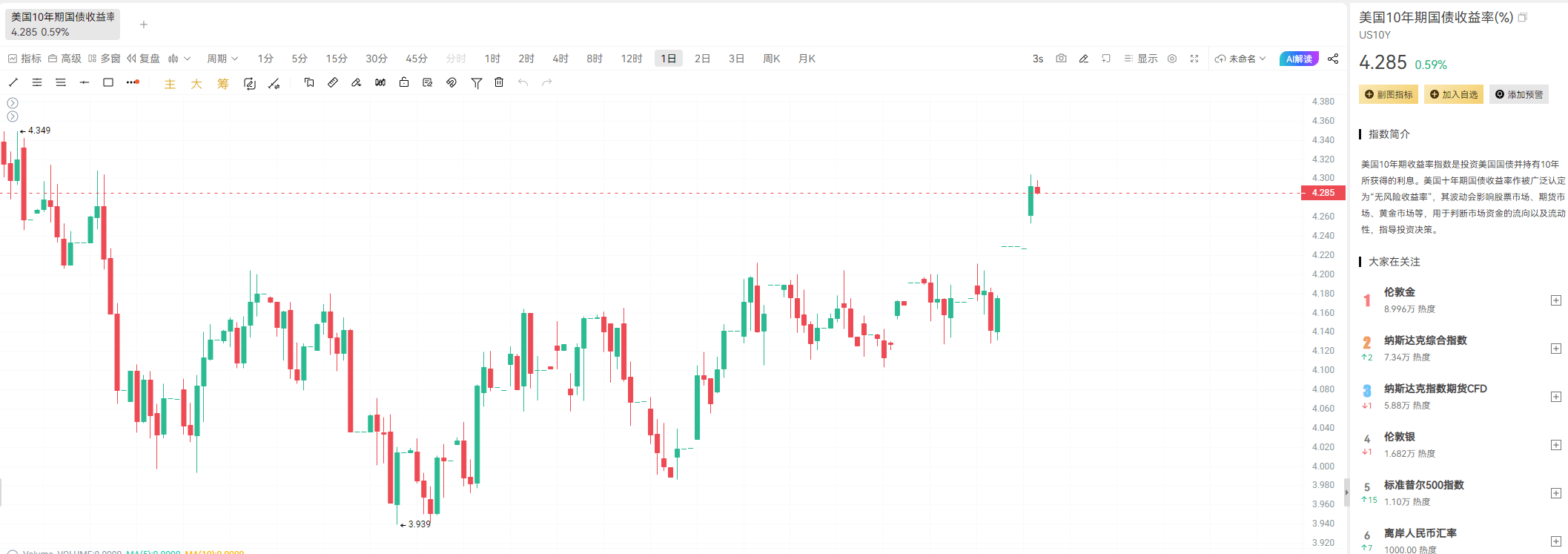
● In stark contrast to the violent fluctuations in the Japanese bond market, the U.S. Treasury market is experiencing an unusual period of calm. As of January 16, the benchmark Treasury yield is moving toward its fifth consecutive week of minimal volatility, which could be one of the longest periods of low volatility in the past twenty years.
● Since 2006, the median weekly trading range for the 10-year Treasury yield has been approximately 16 basis points. However, since early December, that range has narrowed to less than 10 basis points, marking the longest relative calm since 2020. This stability is surprising given that the market has undergone a series of significant risk events.
● Notably, despite facing these risk events, the 10-year U.S. Treasury yield has been tightly constrained between 4.1% and 4.2% since mid-December. As of January 16, the 10-year U.S. Treasury yield was 4.20%, and the 30-year was 4.83%.
● This unusual calm has been viewed by some analysts as a precursor to significant market changes. The last time Treasury yields remained at such low levels for an extended period was in the fall of 2020, when the 10-year yield traded between 0.64% and 0.80% for about six weeks. As the rollout of COVID-19 vaccines signaled economic recovery and the onset of large-scale fiscal spending, this calm was ultimately replaced by a sharp rise in yields.
 IV. The Narrowing U.S.-Japan Yield Spread and Changes in Global Capital Flows
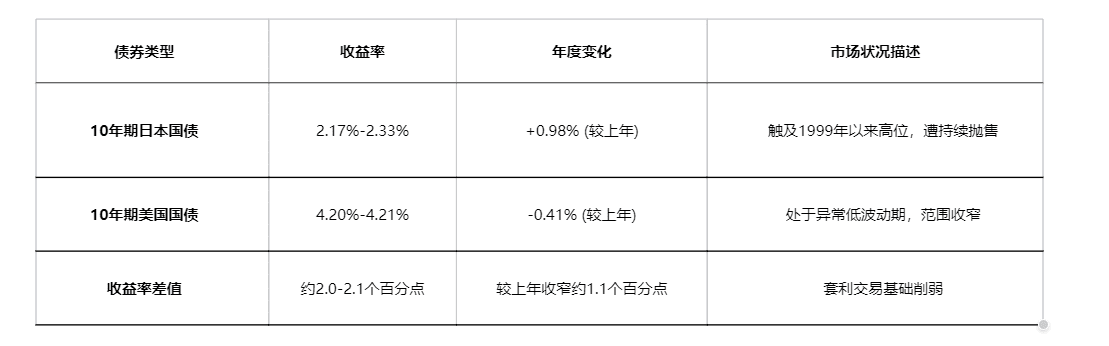
The divergence in U.S. and Japanese monetary policies is profoundly impacting global capital flow patterns. Currently, the yield differential between 10-year U.S. Treasuries and 10-year Japanese bonds is 2.2 percentage points, far below the 3.3 percentage points of a year ago.
● The ongoing narrowing of interest rate spreads directly threatens the 'carry trade' model that has long supported the U.S. Treasury market. This trading strategy involves investors borrowing low-interest yen and investing in higher-yielding U.S. Treasuries or other assets to earn the interest differential.
● As the Bank of Japan may further raise interest rates, the cost of borrowing in yen will increase, significantly diminishing or even collapsing the attractiveness of this carry trade strategy. Ed Yardeni of Yardeni Research clearly stated, 'The Bank of Japan is no longer providing funding support for risk investments in other parts of the world.'
Comparison of Key U.S.-Japan Bond Yields (as of January 16-20, 2026)
Historically, the last time U.S. Treasury yields were so stable for an extended period was in the fall of 2020. Although the current environment is clearly different, this history reminds us that prolonged periods of low volatility may indicate meaningful market changes.
V. Global Market Linkage
The global impact of the Bank of Japan's policy shift is gradually becoming apparent. Larry McDonald of the Bear Trap Report warned that due to the narrowing U.S.-Japan yield spread, carry trades have long been on shaky ground.
● The collapse of this carry trade could trigger ripple effects in the U.S. market. Japanese investors have been the primary overseas buyers of U.S. Treasuries in recent years, pouring hundreds of billions of dollars into the U.S. Treasury market. If rising interest rates in Japan prompt them to withdraw funds from the U.S. Treasury market, it will undoubtedly worsen the situation amid already existing concerns among global investors about the U.S.'s ever-expanding deficits and overvalued assets.
● McDonald further pointed out that the continuous narrowing of interest rate spreads will significantly increase borrowing costs for the U.S. government and the general public. This poses a potential threat to the sustainability of U.S. finances and the consumer credit environment, especially in the current complex domestic political landscape.
● In addition to the impact on U.S. Treasuries, decisions made this Friday may also put pressure on the Japanese stock market. Although the Tokyo benchmark Nikkei 225 index has performed strongly this year, easily surpassing the S&P 500 index in the U.S., the yen's exchange rate against the dollar has risen under expectations of a policy shift.
VI. The Fed's Dilemma: Political Pressure vs. Policy Independence
● In the U.S., the Federal Reserve is facing unprecedented political pressure. On January 16, Federal Reserve Chairman Powell released a video statement responding to an investigation initiated by the Justice Department regarding his testimony about the rebuilding of three Federal Reserve buildings.
● Powell referred to this investigation as 'another attempt by the government to pressure the Federal Reserve to lower interest rates more aggressively than the Federal Open Market Committee deems appropriate.' President Trump told reporters that he was not aware of the investigation until the media inquired.
● This investigation has increased uncertainty surrounding Powell's eventual departure. Powell is not required to step down until his term ends and a successor is confirmed by the Senate. However, North Carolina Republican Senator and member of the Senate Banking Committee, Thom Tillis, stated that he would oppose all Federal Reserve nominees until the investigation is withdrawn.
● Given the committee's narrow Republican majority (13-11), as long as the Democrats remain united, his opposition will effectively block new appointments. This political interference comes at a critical moment for global monetary policy coordination, further complicating the Federal Reserve's ability to respond to domestic inflation and global market fluctuations.
The yield on Japanese government bonds reached 2.330%, a quarter-century high, in stark contrast to the unusual calm in the U.S. Treasury market. The yield spread between the two countries' 10-year government bonds has narrowed from 3.3 percentage points a year ago to about 2.1 percentage points, putting the long-supported carry trade model for U.S. Treasuries at risk.
At the crossroads of global monetary policy divergence, the market is holding its breath for the Bank of Japan's decision on Friday and whether the Federal Reserve under Powell can withstand political pressure and maintain policy independence. Regardless of the outcome, the interaction between the two countries' bond markets will set the tone for global capital flows in the coming years.