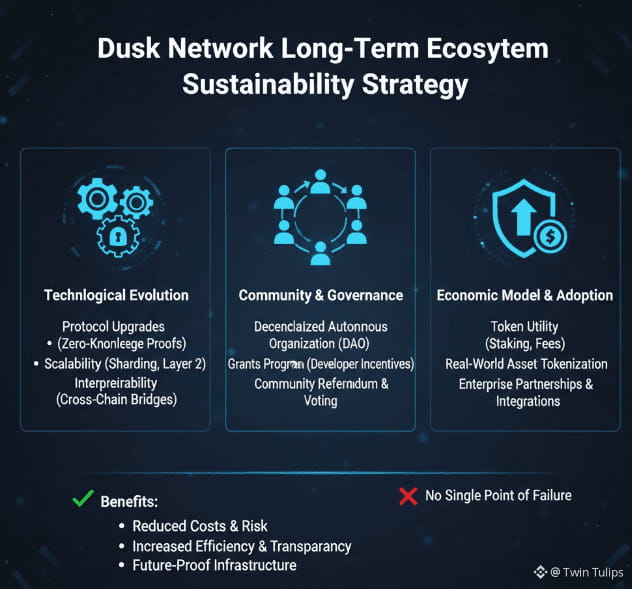
Recently, the popularity of the RWA track has experienced explosive growth. However, as a long-term observer of financial technology, I always feel that most discussions in the market remain superficial, stuck at the primary stage of 'tokenizing U.S. Treasuries.' The real RWA revolution is not merely about asset on-chain, but the reconstruction of the entire financial infrastructure. Dusk Network, especially with their upcoming DuskTrade, is bringing a groundbreaking approach to this track with an extremely hardcore Layer 1 logic.
We need to clarify a core issue first: why do traditional financial institutions always hold a cautious or even wait-and-see attitude towards existing RWA solutions? The answer is simple: compliance and privacy. Current RWA protocols, no matter how well designed, are mostly built on applications layered over Ethereum or its L2. This means they must adapt to a fundamentally transparent underlying environment that lacks native compliance mechanisms. When a regulated entity, like an exchange holding an MTF license, wants to move hundreds of millions of euros worth of securities onto the chain, it needs a system that has compliance logic built-in from the genesis block, rather than a public chain that requires patches and compromises.
The emergence of DuskTrade aims to resolve this fundamental contradiction. It is not a DeFi protocol; it is a compliance trading platform natively supported by Layer 1 blockchain. Its collaboration with the regulated Dutch exchange NPEX, in my view, is the most strategically significant move in the entire RWA space. NPEX not only holds an MTF (Multilateral Trading Facility) license but also has brokerage and ECSP (Equity Crowdfunding Service Provider) licenses. This means DuskTrade starts at the endpoint of the regulatory sandbox; it is not exploring the boundaries of compliance but innovating within the framework of compliance.
The depth of this collaboration far exceeds the typical 'co-branding' or 'integration.' It requires Dusk's underlying technology to seamlessly connect with traditional finance's KYC/AML processes while meeting the stringent demands for privacy and efficiency in securities trading. This is where Dusk's modular architecture and Hedger's privacy engine come into play.
Let's break down the technical essence of Hedger. Unlike some privacy projects that pursue absolute anonymity, Hedger recognizes that absolute anonymity is a regulatory dead end in the regulated financial sector. Hedger adopts an auditable privacy model that cleverly combines homomorphic encryption (HE) and zero-knowledge proofs (ZKP). Homomorphic encryption allows the network to compute and verify without decrypting sensitive information like transaction amounts and asset types, ensuring transaction privacy. ZKP is used to prove the validity of transactions while allowing specific authorized regulators to conduct audits when necessary. This 'privacy but auditable' feature is what traditional financial institutions dream of.
Imagine a hedge fund conducting large securities transactions on DuskTrade. On a traditional transparent public chain, the intentions, amounts, and counterparties of this transaction would be exposed to the sunlight, making it vulnerable to front-running (MEV) or being analyzed by competitors. However, on DuskTrade, thanks to the Hedger engine, the order book is obfuscated, and only the trading parties and the network itself know the transaction details. This not only protects the commercial secrets of institutions but also maintains market fairness.
Now, let's look at the significance of DuskEVM. The launch of the DuskEVM mainnet marks Dusk's official transition from a privacy chain focused on the UTXO model to the modular era compatible with EVM. This is a crucial step for ecosystem building. It significantly lowers the entry barrier for developers. Those familiar with Solidity can now easily deploy their smart contracts on Dusk's Layer 1 while natively inheriting the compliance privacy capabilities brought by Hedger. This elimination of friction will accelerate the explosion of compliant DeFi and RWA applications.
Some may say that EVM-compatible privacy chains are not just Dusk. That's true, but Dusk's advantage lies in its Layer 1 native compliance positioning. General-purpose privacy chains like Aleo pursue comprehensive privacy protection, but they lack native support for financial compliance. Dusk was designed from the start for finance, with its consensus mechanism and token standards (such as XSC, Confidential Security Contract) tailored to the characteristics of securities trading. This deep optimization in a vertical domain is unmatched by other general-purpose public chains.
Of course, we must also acknowledge the challenges. DuskTrade plans to tokenize over 300 million euros in securities, which is a huge figure, but ensuring the security and accuracy of off-chain custody and on-chain mapping of these assets, as well as their legal enforceability in extreme cases, poses a severe test for Dusk and NPEX's cooperative model. Additionally, although DuskEVM lowers the development threshold, attracting enough institutional-level applications and liquidity providers to build an attractive ecosystem in the short term is also a continuous investment project.
However, from a long-term perspective, Dusk's strategy is clear and astute. It has not chosen to compete with the existing DeFi ecosystem but instead has opted for a broader, more disruptive battlefield: the trillion-dollar regulated traditional financial market. By deeply binding with licensed institutions like NPEX, Dusk is setting a new standard for the RWA space: Layer 1 native compliance, auditable privacy, and EVM compatibility. When the waiting list opens in January, what we will see is not just a new trading platform but a prototype for future financial infrastructure. This reshaping of underlying logic is where Dusk's true value lies. It is not chasing trends; it is defining them.
This dedication to compliance makes Dusk particularly unique in the RWA space. It is like a financial engineer quietly cultivating in the noisy Web3 world, laying a secure, efficient, and compliant superhighway for the large-scale migration of traditional finance to Web3 with the most rigorous logic and cutting-edge cryptographic technology. This pragmatic attitude is far more worthy of our attention than projects that only speak of grand narratives.