

@Vanarchain #vanar $VANRY
Looking back at nearly the entire history of Web3, I think there's a fairly clear truth: DeFi-first is not a random choice, but the easiest choice.
Easy to build, easy to measure success, easy to create liquidity, and easy to tell a growth story.
But precisely because it's easy, it also creates a strong inertia, causing most blockchains to be designed around the same type of user: crypto-native, accepting friction, willing to learn new concepts for profit.
Vanar's choice to go consumer-first is not because they deny DeFi, but because they clearly see the limits of that path.
DeFi works well because it sustains itself.
Users accept wallets, gas fees, contract risks, even poor UX, as long as the profits are attractive enough.
This allows the Web3 infrastructure to grow rapidly without needing to solve the problem of general user experience.
But the price to pay is that DeFi does not represent general digital user behavior.
It represents a small group, with very clear financial motivations, and is willing to endure things that ordinary users would never accept.
Vanar starts by acknowledging that.
If the goal is to take Web3 out of the internal loop of crypto, then designing infrastructure around DeFi is not sufficient.
Consumer apps — games, social, media, workflow AI, real-time experiences — have entirely different requirements.
Users do not enter for yield. They enter for the experience.
And when the experience does not meet the expectations of Web2, they leave immediately, with no 'learning time.'
That is why Vanar does not see DeFi as the starting point.
DeFi is optimized for transaction, settlement, and composability.
Consumer apps are optimized for latency, instant feedback, and continuous interaction flow.
These two worlds overlap very little at the experience layer.
A blockchain born for DeFi almost always carries the assumption that every significant action is a transaction.
With consumer apps, that assumption nearly fails right from the start.
Vanar chooses consumer-first because they ask the opposite question: where is blockchain ruining the experience.
The answer is not in TPS or average fees, but in perceived friction.
Wallets, seed phrases, signing transactions, waiting for confirmation, transaction fails — all are 'taxes' on the experience.
DeFi can withstand this tax because profits can offset it.
Consumer apps do not.
A good game or a social app cannot require users to understand those things just to start.
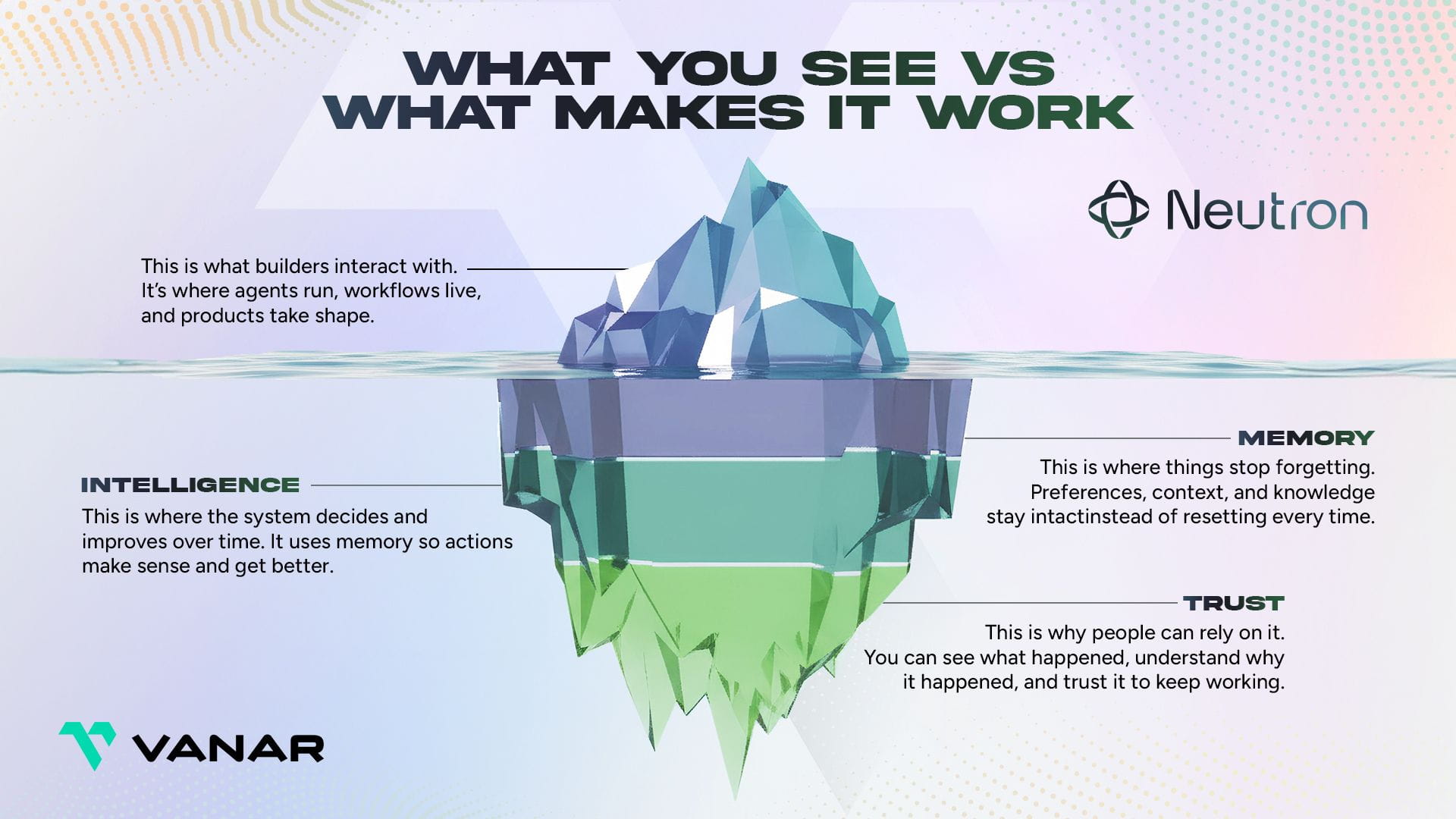
This forces Vanar to view blockchain as an invisible backend, not the center of the product.
What needs speed does not go through block time.
What needs to preserve value must be anchored to the chain.
This is not to downplay the role of blockchain, but to place blockchain in the right context.
DeFi-first places blockchain at the front line.
Consumer-first pushes blockchain to the background.
Another deep reason is that Vanar does not believe sustainable value will come from financializing every behavior.
Play-to-earn, social-to-earn, every 'X-to-earn' model shows the same pattern: when financial motivation is at the center, the product becomes distorted.
Users optimize profit, not the experience.
When the new cash flow stops, the system collapses.
Vanar chooses consumer-first because they believe products must stand firm even without strong financial incentives.
Blockchain just adds a layer of ownership and value capture afterwards, not a reason for users to stay.
From a technical perspective, this choice also says a lot.
DeFi-first blockchains are often designed to optimize composability, EVM-compatibility, and permissionless deployment.
Consumer-first blockchains must optimize for predictable performance, low latency, and the ability to control interaction flows.
These two sets of requirements pull architecture in two different directions.
Vanar accepts sacrificing some generality for better service to a very specific group of use cases.
I also think Vanar chooses consumer-first because they see Web3 as part of the broader digital product market, not a closed ecosystem.
If comparing Web3 with Web3, DeFi-first is reasonable.
But if comparing Web3 with Web2 — where users are accustomed to smooth UX, instant feedback, and nearly perfect abstraction — then DeFi-first almost always loses.
Vanar chooses to enter that harder comparison, where blockchain is not allowed to degrade the experience.
Another point often overlooked is the product lifecycle.
DeFi can launch quickly, iterate quickly, and correct mistakes with incentives.
Consumer apps do not.
A bad game, a laggy app, or a broken experience will be discarded very quickly.
Therefore, the infrastructure for consumer apps must be stable, predictable, and have fewer sudden changes.
Vanar choosing consumer-first means they have to accept slower growth, more discipline, and fewer narratives — something many chains are not willing to do.
Ultimately, in my view, Vanar's consumer-first choice is not against DeFi, but rather a step ahead in the maturity cycle of Web3.
DeFi-first is the logical path when Web3 is still small, needing to bootstrap liquidity and users.
Consumer-first becomes necessary when Web3 wants to break free from itself.
At some point, DeFi will become part of the infrastructure, not the center of the story.
Vanar seems to be betting on that moment.
A moment when users do not enter because they are using blockchain, but because the product is simply good.
Blockchain is just the underlying technology, ensuring ownership, continuity, and the ability to scale value.
It is a long-term gamble, less glamorous, and hard to measure in the short term.
But if Web3 truly wants to become part of everyday digital life, then consumer-first may not be a bold choice, but rather an unavoidable one.
