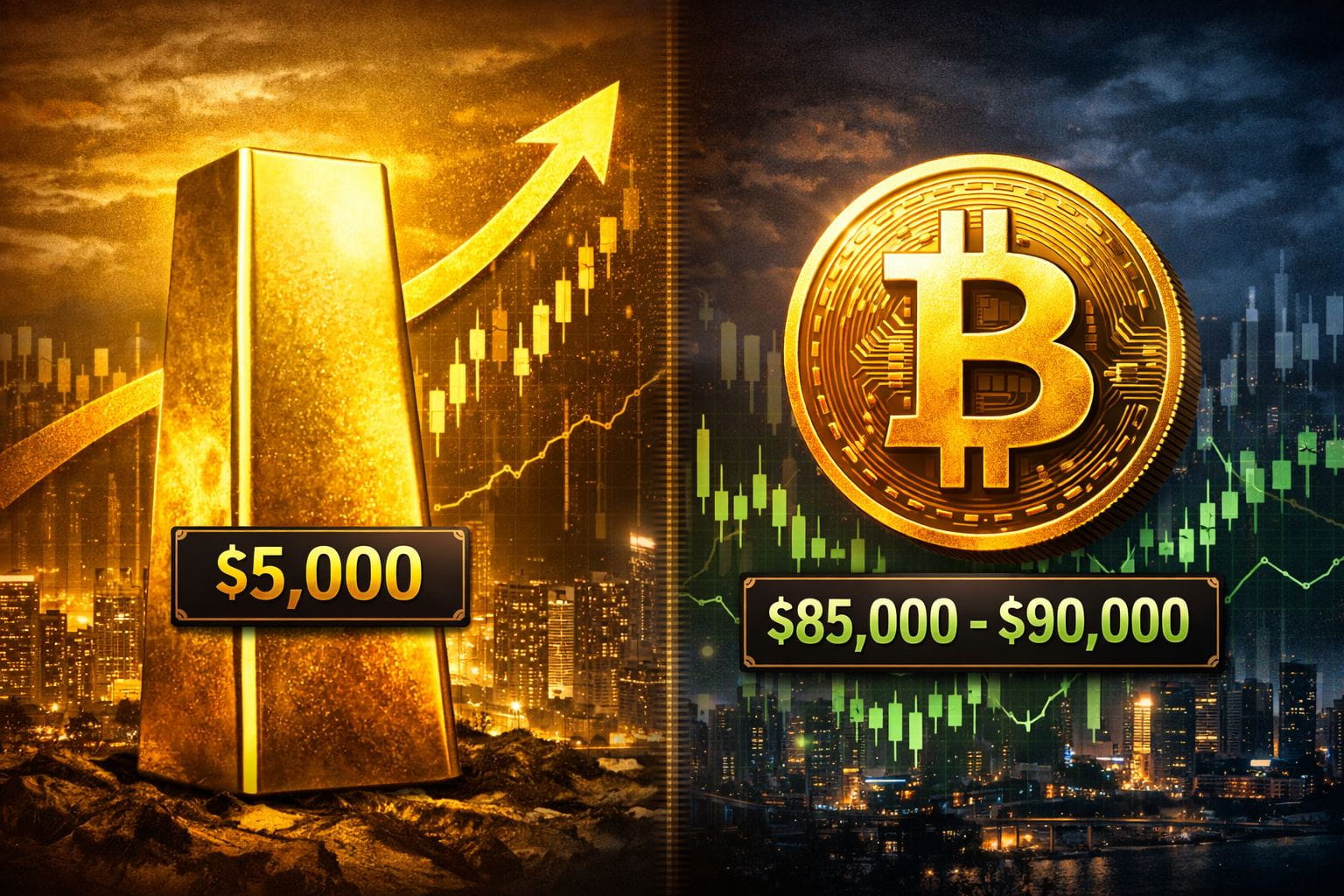
Recently, the most prominent phenomenon in the market is that the price of gold has broken historical highs, around $5,000/ounce, while Bitcoin is still fluctuating around $85,000–$90,000. The divergence between these two is not accidental; it reflects the current market's reassessment of risk appetite, macro environment, and asset properties.
1. Is BTC still 'digital gold'? The market has already given the answer.
Many people are still talking about 'digital gold', but the market tells us that these two are no longer the same thing.
Gold: Whenever there is a slight disturbance in the global situation, the Federal Reserve's ambiguous stance, or a weakness in the dollar, its safe-haven nature immediately shines. Jumping to 5000 is a clear instance of traditional funds 'voting with their feet'.
Bitcoin: It fundamentally didn’t follow this round. It now resembles a high-volatility growth asset, or a 'risk sentiment detector'. When gold surges, it instead fluctuates at high levels, indicating that mainstream funds’ first choice for risk aversion is still not it.
Looking at the exchange rate of gold against Bitcoin, it's clear that short-term funds indeed favor traditional hard assets.
2. Why didn't Bitcoin follow this time?
The core is summed up in one phrase: the driving forces are fundamentally different.
Gold rises due to solid risk-averse demand and global allocation funds pushing it. The greater the uncertainty, the more attractive it becomes.
What about Bitcoin? The current price is more dependent on the overall market's risk appetite and liquidity expectations. Recently, on the macro front, interest rate hikes and cuts are unclear, the dollar is a bit soft, all of which directly benefits gold; however, before the risk appetite fully returns, Bitcoin can only move sideways for now.
Let’s talk about market structure. The gold pool is bottomless, allowing global central banks and large institutions to easily enter and exit; it is a natural tool for macro hedging. Bitcoin's main players are still crypto-native funds, hedge funds, and daring retail investors, which determines that during pure risk-off moments, its performance can't yet compete with gold.
3. The future of Bitcoin: not to become gold, but to become a new asset.
Not being able to keep up in the short term doesn't mean it won't succeed in the long term. The script for Bitcoin is fundamentally not about becoming Gold 2.0.
Ultimate scarcity is the root: the total supply is locked, and halving makes new coins increasingly fewer. This rule, hardcoded in the protocol, will ultimately be its strongest value anchor in the long run.
Institutionalization is just the beginning: ETFs have passed, but large-scale allocations are still ahead. Once more traditional funds truly treat it as part of their asset allocation, the game rules will fundamentally change.
Walk your own path: data has shown that the correlation between Bitcoin and gold or the stock market is decreasing. This indicates that it is forming an independent asset class with its own rise and fall logic, not merely following the trend of risk-off or risk-on.
Therefore, its future role is not to snatch gold's 'risk-averse crown', but to become a unique form of capital and value layer in the digital age.
Each walks their own path; complementarity is the way to go.
Gold breaking 5000 reflects the old world's fear of uncertainty. Bitcoin's sideways movement indicates that the new asset is waiting for its own tailwind. They are no longer in the same race.
In the long run, Bitcoin, with its global circulation, anti-censorship, and absolute scarcity characteristics, aims for broader horizons—becoming a brand new, independent asset class. Gold is responsible for 'stability', while Bitcoin is responsible for 'sharpness'. The current differentiation is precisely the prelude to a reshuffling of asset allocation.
Don’t measure Bitcoin with the yardstick of gold. Be patient, hold onto the spot, the wind will come sooner or later.