Not all sell-offs are the same.
Some are driven by fear.
Others are driven by uncertainty.
The sharp Bitcoin sell-off over the past 24 hours had nothing to do with weak on-chain data or a bad macro print.
It was driven by policy uncertainty — the most dangerous variable in financial markets.
And it all started with a single confirmation from Donald Trump.
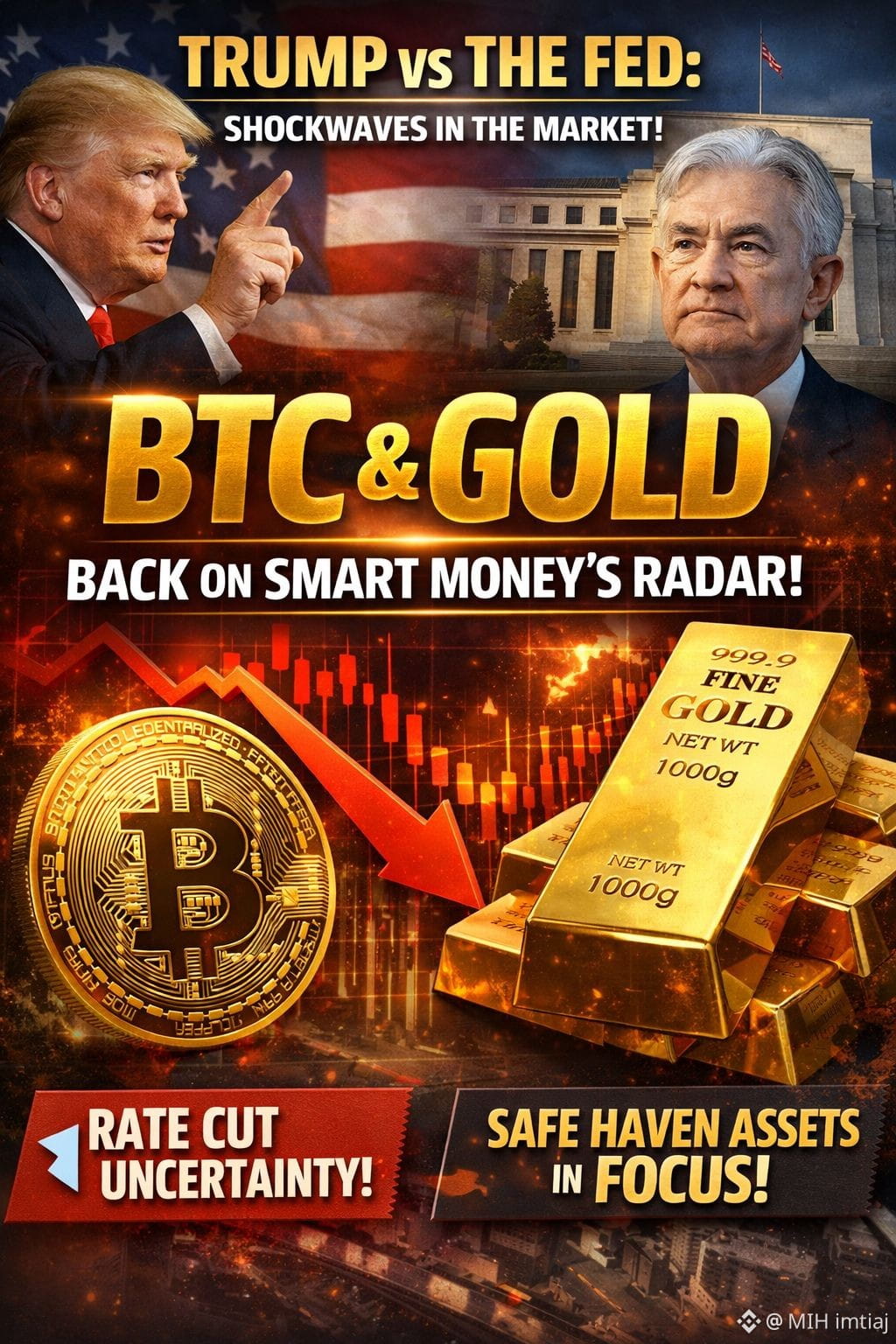
🇺🇸 Trump vs the Fed: A Power Struggle Begins
Donald Trump confirmed that he will make a major announcement tomorrow regarding his pick for the next Federal Reserve Chair.
This was not a routine statement — it was a direct signal of political pressure on the Fed’s independence.
Trump made it clear that his preferred candidate:
Strongly supports aggressive rate cuts
Wants to prioritize economic growth
Stands in direct contrast to the Fed’s current cautious stance
The complication?
Jerome Powell’s term doesn’t end until May 2026.
That means Trump isn’t changing policy today — he’s attempting to set expectations early and shape market psychology ahead of time.
📊 The Current Reality: What the Fed Is Saying
Just this week, Powell held rates steady:
Interest Rates: 3.5% – 3.75%
Inflation: 2.9%
Target: 2%
The Fed’s message is straightforward:
“We’re not done yet. Victory isn’t secured, so patience is required.”
Trump’s view could not be more different.
He has repeatedly stated:
“The United States should have lower interest rates than any country in the world.”
This clash of philosophies is what rattled markets.
🎯 Market Focus Shifts: Who Will Be the Next Fed Chair?
Before Trump’s confirmation, the market saw two main contenders:
Kevin Warsh
Rick Rieder
Each was priced at roughly 35% odds.
After Trump spoke, everything changed.
📈 Kevin Warsh’s odds surged to nearly 88%.
And that’s where discomfort set in.
👤 Who Is Kevin Warsh — and Why Markets Are Nervous
Kevin Warsh is not an “easy money” policymaker.
His background:
Former Federal Reserve Governor (2006–2011)
Served through the 2008 Global Financial Crisis
Former Morgan Stanley executive
Economic advisor to the White House under George W. Bush
His philosophy is clear:
Monetary discipline comes first
Financial system stability matters more than short-term growth
Deep skepticism toward excessive liquidity
🪙 His View on Crypto?
Not friendly.
Warsh:
Does not see crypto as the future of finance
Views it primarily through the lens of systemic risk and regulation
This is why markets paused.
Trump’s rhetoric on rate cuts may not translate into actual policy if Warsh takes the chair.
📉 So Why Did Bitcoin Sell Off?
Bitcoin sold off because:
Expectations suddenly became confused
Markets can’t tell who truly controls policy direction
👉 Trump’s messaging
👉 Versus real-world execution by the Fed
And markets hate confusion.
This wasn’t a reaction to one bad headline —
It was a macro repricing event.
🧠 Smart Money Perspective: Where Opportunity Emerges
Historically, periods of policy conflict strengthen two assets:
🟡 GOLD ($XAU )
Immune to political pressure
Thrives during monetary uncertainty
Rallies quietly when central bank credibility is questioned
🟠 BITCOIN ($BTC )
A hedge against political interference
A long-term beneficiary of monetary instability
Short-term volatility, long-term structural strength
Retail traders react to headlines.
Smart money builds positions during uncertainty.
🔍 The Real Takeaway
✔️ Don’t turn bullish just because Trump mentions “rate cuts”
✔️ Execution matters more than rhetoric
✔️ Policy uncertainty is not a threat to BTC and XAU — it’s long-term fuel
Markets are no longer rewarding emotion.
They are rewarding patience and conviction.
🧾 Bottom Line
This is not the time to panic.
This is the time to position.
$BTC| $XAU
When policy direction becomes unclear,
hard assets start speaking louder.