
Vanar usability, scalability, and security were the main priorities in its design. Low-cost blockchains face a major challenge with spam and block saturation attacks such as when an attacker sends a huge number of transactions to create congestion in the blocks, reducing their performance. To counter this problem, Vanar has implemented a fixed fee and tiered pricing system that were carefully designed based upon extensive testing.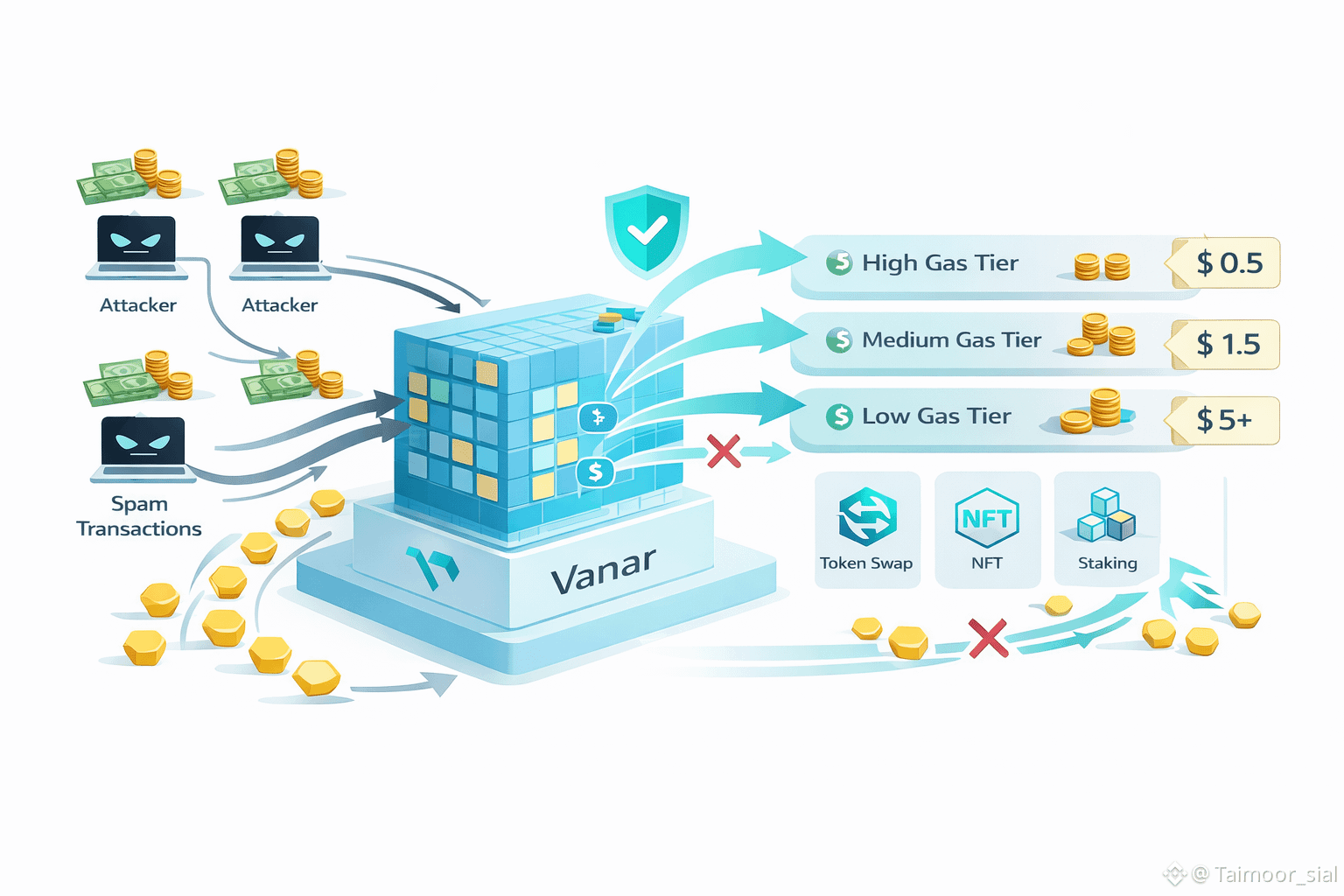
The Problem with Ultra-Low Variable Fees
The fluctuating fees on several blockchains due to user demands or the low fee structure implemented by various blockchains in order to promote users provide an opportunity for the malicious person to attack the network. By submitting a large number of transactions that cost little to submit (high gas fee) are able to fill a block before the legitimate customers have had their transactions processed. This results in network congestion, failure to process the customers' transactions, and consequently potential denial of service..
Vanar Fixed Fee Approach
Vanar has made change by providing fixed transaction fees in USD opposed to conventionally utilizing Gas Token Market/automated market pricing. Doing this allows for consistent and predictable transaction costs for customers while eliminating the unpredictability that is often exploited by violent offenses. In addition, even when Gas Token prices fluctuate widely, Vanar will still charge the same fee for a transaction according to the actual resources used to complete your transaction.
Tiered Fees Based on Gas Consumption
One of the main ways Vanar is able to secure their platform is by using a tiered fee structure – i.e., transaction fees increase with the gas consumption of the transaction. Thus, lightweight transactions such as simple transfers are cheap and affordable to execute; however, high-gas transactions will require larger transaction fees to execute. Therefore, it would be cost-prohibitive for attackers to perform large-scale spam attacks on Vanar’s network, since the price of consuming block-space grows proportionately larger for every unit consumed.
Preventing Block Saturation
Vanar intends to deter deliberately attempting to fill a block by setting high fees for gas-sucking transactions. When someone tries to submit thousands of massive transactions at once (or whenever they do), it becomes increasingly expensive for them to keep submitting. Therefore, the fixed cost of filling up all the space in a block protects legitimate parties who want to use the resources in a block.
Balancing Accessibility and Security
The everyday users as well as the developers will not face any charges. Everyday users and developers can carry out small/medium transactions without incurring any high costs, thus promoting a great amount of activity on the network (mass adoption) and frequency of use cases. The network is protected from harm by aligning transaction fee structure to actual usage of network's resources.
A Sustainable Defense Mechanism
Rather than reacting to security issues with a patch, Vanar's modular fee structure serves as an economic deterrent to bad behaviour within the network. The result is that Vanar discourages malicious activity from damaging its long-term reliability by making it cost-effective to behave well. Furthermore, Vanar provides consistent throughput for all legitimate users, which allows them to reliably perform at a consistent level, regardless of the demand on the system.
By using fixed fee structures and gas-based tiers as transactional fees, Vanar utilizes transaction pricing to provide security from network spam and saturation attacks, while also being economical, predictable, and scalable. In developing these fee structures, Vanar has produced a blockchain network for real-world/high-volume applications.