
The purpose of both Stablecoins (ones that preserve value and provide liquidity) and Money Market Funds (MMFs) (money that also preserves value and provides liquidity) is to provide an equivalent form of prescriptive funds; however, they are different types of funds, originating from different markets. MMFs are established as a result of regulated securities activity and stablecoins are derived from a blockchain environment. As can be discerned through the viewpoint of the Plasma, there are certain similarities and differences between these two types of funds. Both funds will ultimately define how infrastructure and programmatic regulations will define how Digital Currency continues to evolve in future periods.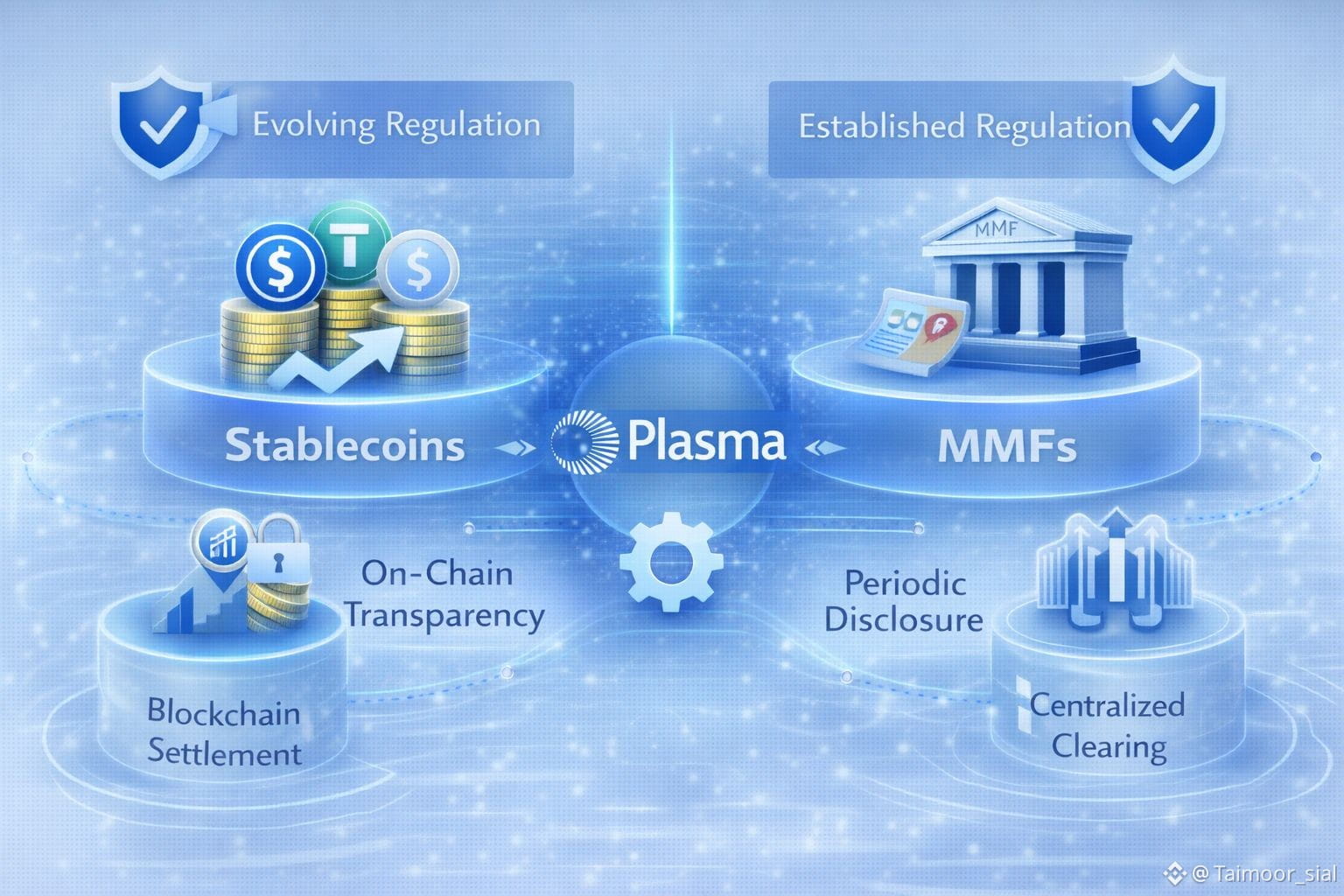
Converging Functions, Different Origins
Institutions and investors have considered Money Market Funds to be low-risk ways of getting liquid exposure to cash-like investments that have been available for many years. Regulators have created regulatory frameworks with very specific rules regarding the quality of assets, the amount of liquidity required to be held in the funds, how information is disclosed about the funds and how operationally strong the funds must be. Stablecoins are new products that provide similar functions on a global basis and can help with payments, settlement, treasury management and transferring value across borders. As more people use these products, regulators are beginning to see these products as a type of financial product instead of an experimental crypto product.
Regulation Is Catching Up—Infrastructure Must Too
Established frameworks for regulated transactions govern money market funds, whereas there is an evolving set of global frameworks to govern the activities of stablecoins. More clarity is emerging regarding reserves and the quality thereof; rights to redeem and how they relate to reserves; the level of transparency required regarding reserve assets and their liquidity; and requirements for risk management. However, Plasma believes that regulatory oversight is only one part of the equation. Even when there is regulatory oversight, there must also be sufficient-level infrastructure in place that will enable stablecoins to deliver predictable results concerning execution time, settlement speed, and operational resilience. Otherwise, there will be no means for reliably enforcing the protections offered by regulations.
Settlement Is the Key Difference
While MMFs typically use traditional money wiring systems and know what hours operations will take place, stablecoins settle directly on the blockchain and thus allow instantaneous transactions on the blockchain around the world. This presents an opportunity and a challenge. Therefore, settlement on the blockchain must be proven to be reliable; able to track transactions; and be able to handle high volumes without clogging the network. Plasma has been designed to solve this problem by focusing on deterministic execution and stablecoins-first settlement. Consequently, redemptions, transfers, and big flows will all act the same even when the network is busy.
Transparency, Privacy, and Institutional Needs
Periodic reporting and auditing are the primary sources of transparency for money market funds (MMFs), whereas stablecoins (e.g., USDC) offer a new kind of continuous on-chain transparency. However, Plasma is aware of the challenges of having complete transparency because this would cause financial institutions to disclose certain types of sensitive financial activity. Plasma's method for having a private settlement is that the private data will be protected while simultaneously maintaining verifiably correct results. As institutional stablecoin adoption becomes closer to reality, and with greater regulatory scrutiny, having a way to balance both of these elements will become much more important.
Infrastructure as the Bridge Between Models
In the view of Plasma, future opportunities will primarily be based on what can happen as you align stablecoins up with financial expectations, not by simply replacing MMFs with stablecoins. Further, as the lines of oversight begin to blur together, and both blockchain-based asset and traditional financial product infrastructure start to intersect with each other, Plasma establishes itself as a neutral /institution to provide a stablecoin-ready /compliant infrastructure to operate on for what would be the level of reliability, predictability and overall compliance compatibility typical of what we think of today with modern finance.
The functions between Stablecoins & Money Market Funds are converging, although they will remain structurally distinct. Regulations will help define the rules but, ultimately, the infrastructure will define if the rules will be effective in real-world environments. Plasma will act as the settlement & execution infrastructure that enables stablecoins to evolve into trusted/credible financial instruments by aligning the efficiencies of Blockchain with the discipline of traditional Money Markets.