
At the foundation of every secure blockchain lies a set of cryptographic guarantees that ensure data cannot be altered, forged, or misrepresented. One of the most critical of these guarantees is collision resistance—a property that plays a central role in how the Dusk Network preserves data integrity while operating at scale.
Collision resistance refers to the difficulty of finding two distinct inputs that produce the same cryptographic hash. In practical terms, this means it should be computationally infeasible for an attacker to manipulate transaction data, account states, or proofs in a way that results in identical cryptographic fingerprints. For a privacy-focused blockchain like Dusk, this property is not optional—it is essential.
Dusk is designed to support confidential transactions, zero-knowledge proofs, and regulated financial use cases simultaneously. These features rely heavily on cryptographic commitments and hashes to represent private data without revealing it publicly. If collisions were easy to produce, an attacker could exploit this weakness to substitute valid data with malicious alternatives, undermining trust in the system. Collision resistance ensures that every commitment, proof, and state transition on Dusk uniquely represents its underlying data.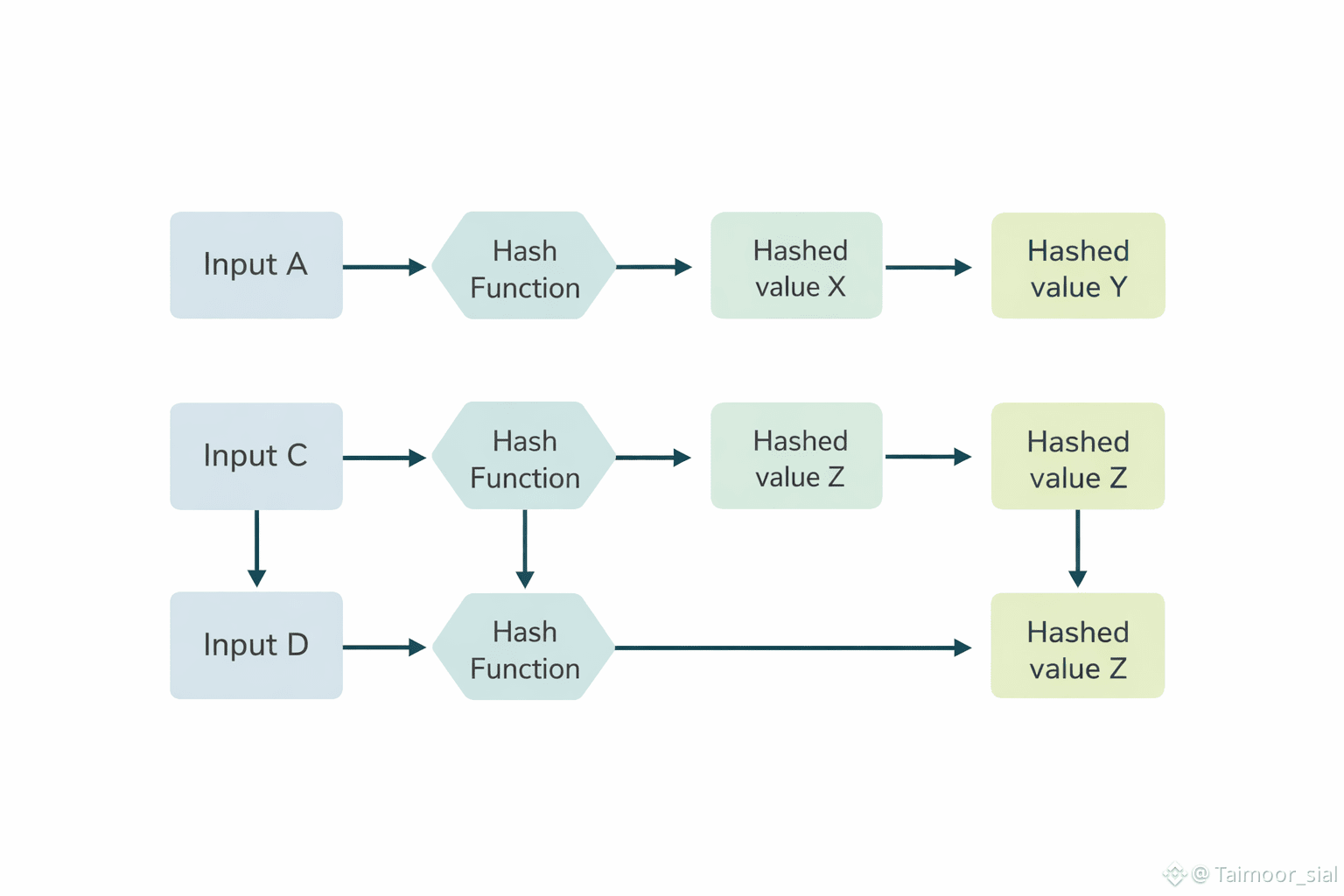
Within the Dusk Network protocol, collision-resistant hash functions are used across multiple layers. They secure transaction identifiers, bind commitments to hidden values, and anchor Merkle tree structures that summarize large sets of data efficiently. By relying on strong collision resistance, Dusk ensures that even when transaction details remain private, the network can still verify correctness and consistency without ambiguity.
This becomes especially important as the network scales. Dusk is built to handle complex financial workflows such as security token issuance, lifecycle management, dividend distribution, and compliance checks. These processes generate large volumes of cryptographic data that must remain verifiable over long periods of time. Collision resistance guarantees that historical records cannot be subtly altered or replaced, preserving auditability and long-term integrity.
Collision resistance also strengthens Dusk’s zero-knowledge infrastructure. Zero-knowledge proofs depend on cryptographic hashes to bind statements to proofs securely. If two different statements could produce the same hash, proof validity would lose its meaning. By enforcing collision-resistant primitives, Dusk ensures that proofs attest to exactly one valid statement—no more, no less.
From a security perspective, collision resistance contributes directly to network trust. Validators, applications, and institutions interacting with Dusk can rely on the fact that cryptographic references are stable and unforgeable. This trust is critical for regulated environments, where legal and financial accountability depends on immutable records.
Ultimately, collision resistance is one of the silent safeguards that enables Dusk to deliver privacy without sacrificing reliability. It allows the network to hide sensitive data while still maintaining strong guarantees about correctness, uniqueness, and integrity. As Dusk continues to scale toward real-world financial adoption, collision resistance remains a cornerstone of its cryptographic architecture—quietly protecting every transaction, proof, and state transition behind the scenes.