
Walrus lies a carefully designed assignment algorithm that determines how data shards are distributed across storage nodes. This algorithm is not a simple placement rule; it is a core mechanism that balances decentralization, efficiency, security, and long-term data availability in an open, adversarial environment.
Walrus operates in epochs, fixed periods during which staking, voting, and storage responsibilities are determined. At the beginning of each epoch, the network evaluates the current set of storage nodes, their relative stake, and the overall storage demand. The assignment algorithm then maps data shards to nodes in a way that reflects each node’s proportional responsibility in the system. This stake-aware approach ensures that nodes committing more resources to the network also carry an appropriate share of storage duties.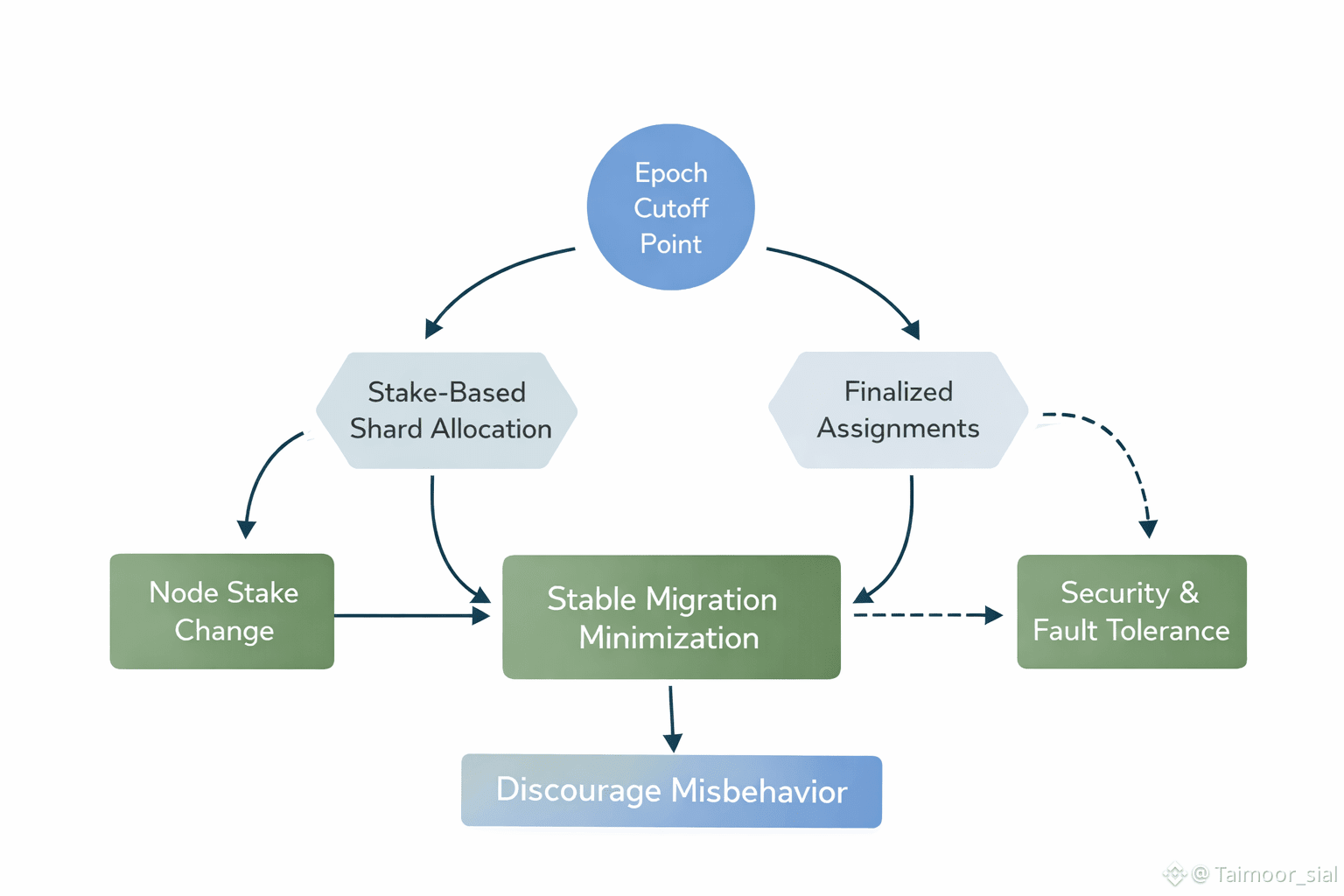
key design goal of the assignment algorithm is stability. Frequent reshuffling of shards would introduce unnecessary data movement, increasing bandwidth costs and operational risk. To avoid this, Walrus introduces a cutoff point in the assignment process. Once this cutoff is reached, shard allocations are finalized for the epoch, and only the minimum required migrations are allowed. This means that even if stake changes slightly, the system prioritizes keeping shards where they are, unless a significant imbalance must be corrected.
Another important aspect is migration minimization. When shard migration is unavoidable—such as when a node’s relative stake drops or rises sharply—the algorithm carefully selects which shards should move and to where. The objective is to rebalance storage while touching as little data as possible. This design choice directly improves network performance and reduces the attack surface during transitions between epochs.
The assignment algorithm also plays a critical role in security and fault tolerance. By distributing shards based on stake rather than static capacity claims, Walrus prevents malicious nodes from overcommitting storage they cannot reliably maintain. If a node fails to cooperate during migration or recovery, the protocol can trigger penalties, including slashing, ensuring that dishonest behavior is economically discouraged.
Importantly, the algorithm is designed for an open network. Walrus does not assume that all nodes will behave honestly. Instead, it anticipates partial failures and adversarial strategies, embedding recovery pathways directly into the assignment logic. Cooperative nodes are rewarded with smooth transitions and stable assignments, while uncooperative ones face clear economic consequences.
Walrus assignment algorithm is the invisible coordinator that keeps the storage network balanced. It aligns incentives, limits unnecessary data movement, and ensures that storage responsibility evolves predictably over time. By combining epoch-based decisions, stake-aware allocation, and migration control, Walrus achieves a rare balance: a decentralized storage system that is both efficient and resilient at scale.