
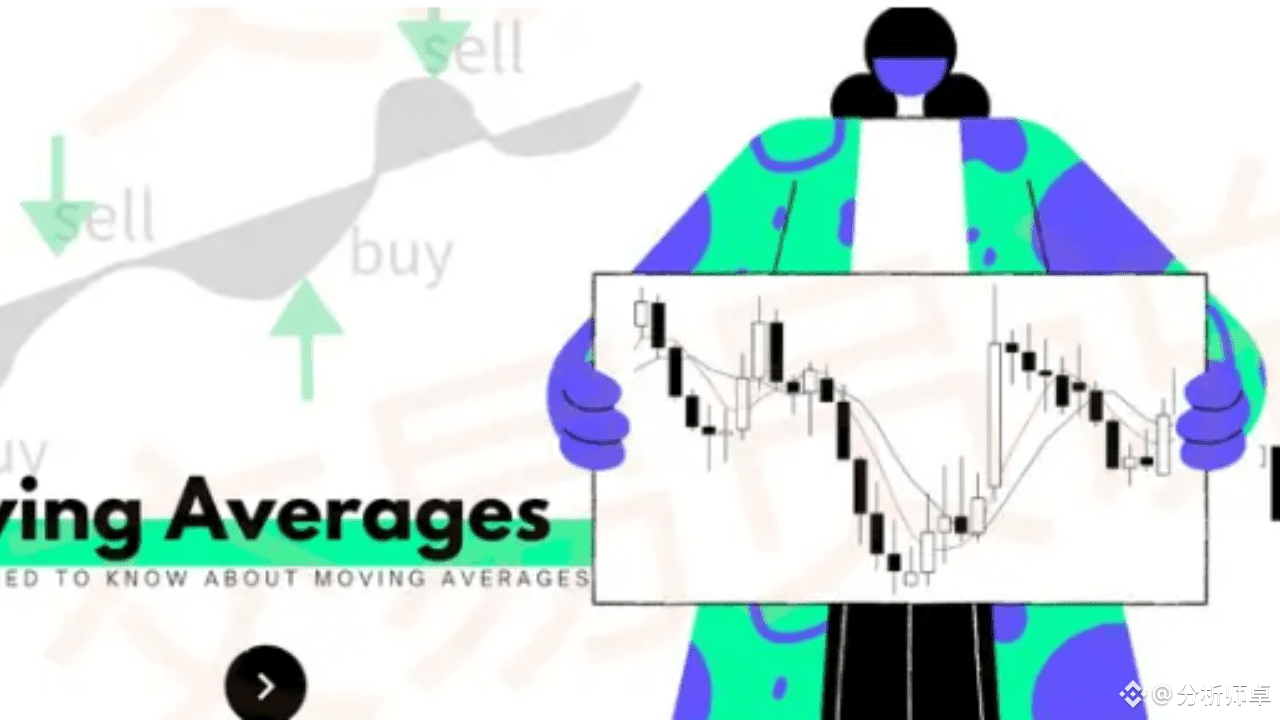
Different types of moving averages, among which the most common are:
(1) Simple Moving Average (SMA)
(2) Exponential Moving Average (EMA)
(3) Multiple Moving Averages (MMA)
Based on years of trading experience, the most widely used types of moving averages in the current market should be simple and exponential moving averages. Therefore, this article mainly discusses these two types of moving averages.
Simple Moving Average
The Simple Moving Average (SMA) is simply the average of past data. As the simplest moving average, it is also currently the most popular one.
The simple moving average calculates the average price over a selected period.
For example, the 50-day simple moving average will select data from the past 50 days (usually at the closing price of the day) and plot the average line accordingly. The simple moving average is the preferred choice for long-term traders.
Exponential Moving Average
The Exponential Moving Average (EMA) is a variant of the moving average—it gives more weight to recent data rather than all data.
Because the exponential moving average is more sensitive to recent price changes, it is better suited for day traders.
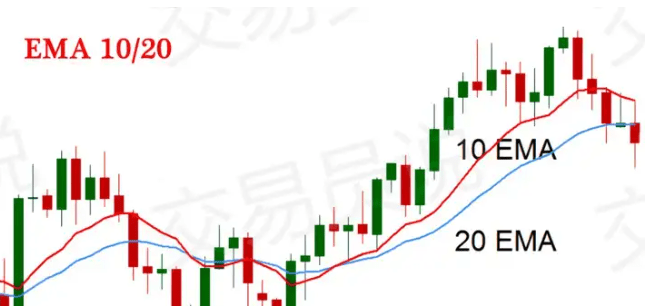
This makes the exponential moving average the preferred choice for many day traders.
Multiple Moving Averages
The combinations of moving averages are divided into 'slow lines' and 'fast lines'.
The figure below will show you multiple moving averages:
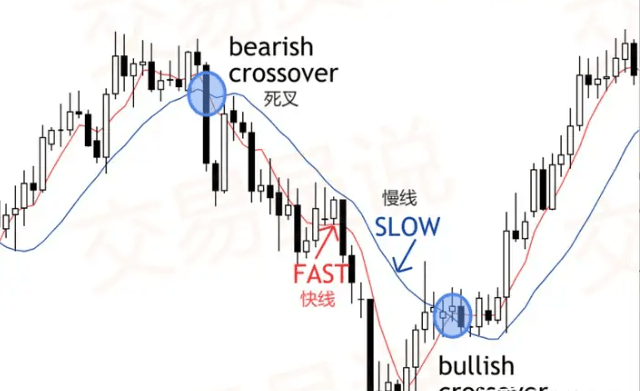
When using two or more moving average indicators together on the same chart, slow (red) and fast (blue) moving averages will appear.
Application.
As a general rule of thumb, typically, the faster the moving average, the lower the time label (timestamp). In other words, the faster the moving average,
the quicker the line changes.
On the other hand, the slower the moving average, the higher the time period used.
For example, if we use a 50-day moving average and a 200-day moving average, the 50-day moving average will be faster. The 200-day moving
average is the slower moving average because it takes more time to influence its curve.