
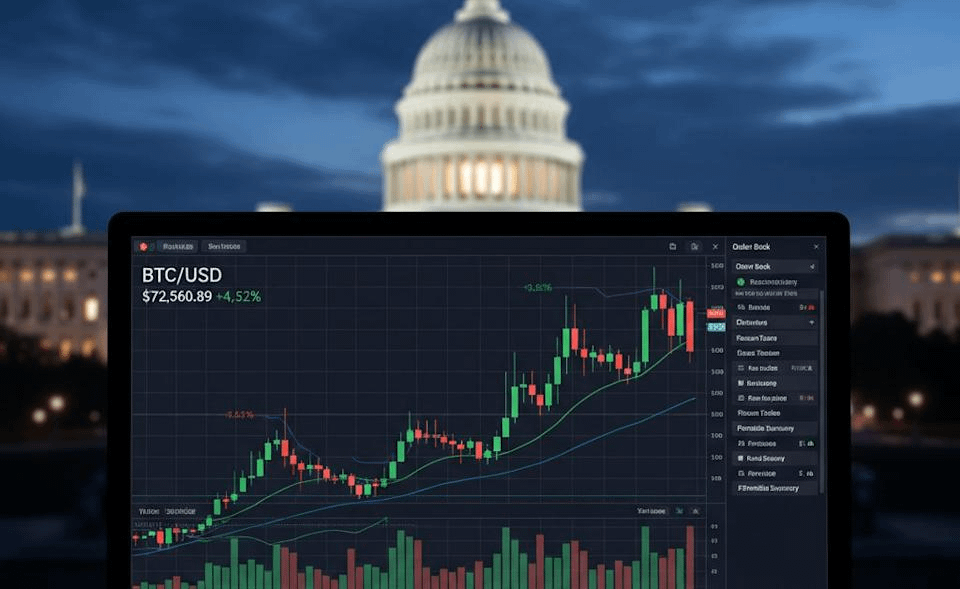
The cryptocurrency market has experienced a new boost in recent days, with BTC approaching or exceeding the $72,000 mark, while other digital assets are also recording positive movements. This rebound is not due to a single factor, but to a combination of macroeconomic, technical, and market elements that are changing investor sentiment.
🛢️ The fall in oil prices improves risk appetite
One of the clearest triggers of the movement has been the recent decline in oil prices. When crude spikes, fear of inflation and more restrictive monetary policies increases, something that usually affects risk assets like cryptocurrencies. However, the recent drop in oil helped alleviate those concerns and allowed capital to flow back into markets like crypto.
Additionally, measures aimed at stabilizing energy supply, such as decisions to increase the availability of oil in the global market, also contributed to alleviating inflationary fears. This created a more favorable environment for digital assets.
📉 More favorable inflation data
Another key factor was the release of more moderate inflation data in the United States. The PCE index —one of the Federal Reserve's favorite metrics— showed an annual inflation rate close to 2.8%, suggesting that inflationary pressures may be gradually decreasing.
When the market perceives that inflation is decreasing, the expectation increases that central banks will maintain or even ease their monetary policy. This scenario usually favors assets like $BTC , $ETH , and $SOL , which tend to benefit when global liquidity improves.
📈 Technical and market derivative factors
The movement of Bitcoin was also influenced by technical factors from the derivatives market. Analysts pointed out that options positions near the $75,000 level generated hedging flows from market makers, which can amplify price movements when BTC approaches those levels.
This phenomenon, known as 'gamma squeeze', can accelerate price increases when traders must buy the asset to balance their exposure.
💰 Institutional capital inflows
Finally, another relevant element has been the steady flow of capital into Bitcoin ETFs. For several consecutive days, net inflows were recorded, suggesting that institutional interest remains present even in times of global uncertainty.
This type of capital tends to have a longer horizon, which may help stabilize the market during phases of volatility.
🔎 A market influenced by the global context
The combination of falling oil prices, favorable macroeconomic data, technical factors, and institutional flows explains why Bitcoin has managed to regain ground in recent days.
Even so, the market remains very attentive to external factors such as the conflict in the Middle East, the monetary policy of the Federal Reserve, and the evolution of the global economy. In this environment, Bitcoin's behavior around $70K–$72K could become a key reference for the rest of the crypto market in the coming weeks.
⚠️ This content is for educational and informational purposes only. It does not constitute financial advice. Do your own research (DYOR) and manage risk appropriately.