
Mira Network is emerging as a formidable competitor in the AI verification field thanks to its decentralized model, unique consensus mechanism, and strong scalability. Below is a detailed analysis of Mira's strengths and competitive ability against other AI projects.
🫵 Strengths of Mira Network
1. Multi-Model Consensus mechanism
Mira does not rely on a single AI model to verify results, but uses multiple independent models for cross-checking, helping to minimize bias and increase the reliability of results.
2. Hybrid Proof-of-Work/Proof-of-Stake mechanism (Hybrid PoW/PoS)
Mira applies a combined consensus mechanism of Proof-of-Work and Proof-of-Stake, where verifier nodes must perform real inference tasks instead of just solving cryptographic problems, while also staking tokens and being subject to slashing if they act dishonestly.
3. Scalability and decentralized infrastructure
Mira collaborates with partners like Aethir and Exabits to provide decentralized GPU infrastructure, helping process billions of tasks daily and reduce computing costs by up to 40-80% compared to traditional cloud services.
4. Real applications and wide integration
Mira has been integrated into many real applications such as Gigabrain (DeFi trading), Learnrite (education), WikiSentry (information verification), helping increase accuracy from 70% to 96% without needing to retrain the AI model.
5. Sustainable development and community support
Mira has raised $9 million in a seed funding round and launched a $10 million Magnum Opus grant program to promote development in AI and decentralized technology.
🫵 Comparison with competitors in the AI field:
AI Project Main strengths Weaknesses / Challenges
Mira Network Decentralized verification, hybrid consensus mechanism, high scalability, diverse real applications Dependent on decentralized GPU infrastructure, needs to expand the user network and verification nodes
OpenAI Advanced AI model, widely applied Issues with reliability and bias in results
Anthropic AI model focused on ethics and safety Lacks decentralized verification mechanism, relies on a single model
Google DeepMind Advanced AI research, abundant resources Lacks independent verification mechanism, focuses on a single model
👉👉👉Mira Network stands out with a decentralized AI verification model, hybrid consensus mechanism, and strong scalability, helping to minimize bias and increase the reliability of AI results. Compared to competitors like OpenAI, Anthropic, or Google DeepMind, Mira has the advantage of providing an independent trust layer suitable for high-accuracy applications such as finance, education, and healthcare.
🔥Here is more detailed information I found about MIRA / Mira Network — technology, tokenomics, advantages, limitations, and points to be cautious about. (Note: as the project is still new, some information may change or be unclear.)
🌼I. Overview & goals of Mira Network
1. Mission / Role (Value Proposition)
MIRA aims to build a 'trust layer' for AI-generated results, meaning turning AI outputs into claims that can be verified by consensus among multiple verifiers.
When users (or AI applications) submit AI content/output + request a verification level (domain, threshold consensus...), the network will convert that output into 'claims', send them to verifier nodes for review, then aggregate results and return a certificate along with results to the requester.
MIRA also aims to combine PoW + PoS (hybrid) in its economic model (economic security). In other words: 'verify' (inference) is similar to PoW but controls random probability, and staking / slashing uses PoS to ensure honest behavior.
In addition to AI verification, Mira Network also promotes the tokenization of real-world assets (RWA), allowing the community to own tokenized shares and receive dividends, etc.
They use a separate chain called MIRA-20 blockchain, with PoSA (Proof-of-Stake-Authority) mechanism — combining authority + staking for safety and fast transaction processing.
2. Current status & listing
Binance announced and listed MIRA on September 26, 2025 — 12:00 UTC, with pairs USDT, USDC, BNB, FDUSD, TRY.
Before entering the spot, the token will appear/trade on Binance Alpha (with Alpha Points / seed tag applied) to support airdrop / launch event.
Binance is also hosting a promotion / prize pool of 6,000,000 MIRA from 26/9 to 10/10 (UTC) to boost trading and user interest.
Binance uses the HODLer Airdrop program to distribute MIRA to BNB holders in Simple Earn / On-chain Yields during the snapshot period (20–22/9) to incentivize BNB users.
🌼II. Tokenomics, allocation & circulation
1. Initial total supply & circulation
Maximum total supply (max supply): 1,000,000,000 MIRA
Circulating supply at launch: approximately ~191,244,643 MIRA (~19.12%)
A portion (2% of total supply, about ~20,000,000 MIRA) is allocated for the HODLer Airdrop program (BNB holders)
2. Allocation / vesting / unlock
Tokenomics announced before launch, including rewards for nodes, ecosystem, application development, team, early investors, etc.
Milestone-based vesting / unlock mechanism — tokens will unlock based on milestones (achievements) rather than a fixed schedule. (For example: requiring completion of 5 airdrop events, or milestones regarding adoption)
In the whitepaper, there is a section discussing slashing (for violating nodes) to protect the network from 'guessing / random outputs' instead of actually verifying.
3. Fundraising & investment rounds
Through crypto rank / ICO tracking: total capital raised ~ $9.85M (mostly from private / early rounds)
There is a node sale (with an investment price for node operators) before the public sale.
🌼III. Technology
1. Verify & consensus mechanism
When a verification request is submitted, the content is converted into claims, then distributed to verifier nodes for inference / verification. Results are aggregated according to the established consensus level (e.g., N of M).
MIRA uses a hybrid PoW + PoS model: inference tasks similar to PoW (with selection space) + staking & slashing like PoS to ensure node honesty.
Nodes stake ETH (or compatible platforms) to participate; if a node intentionally cheats (e.g., guessing), the staked amount may be slashed.
2. Tokenization & RWA (Real-World Asset) integration
Mira aims to integrate the ability to tokenize real-world assets (companies, physical assets, community shares) allowing users to own tokenized shares & receive dividends / revenue sharing.
This model can make the project a hybrid platform: both AI-verification and DeFi / RWA. However, integrating RWA carries many legal, valuation, and off-chain verification risks.
3. Whitepaper status / legalization
According to official information, the Mira whitepaper is undergoing 'legal review' to ensure compliance with Swiss law.
Thus, there is a possibility that the technical / detailed part in the whitepaper may change or be adjusted according to the legal framework.
Mira Network project development team
- Karan Sirdesai (Co-Founder, CEO): Experienced in investing in crypto, AI, and software at Accel, previously worked at BCG.
- Sid Doddipalli (Co-Founder, CTO): Former CTO of Stader Labs, previously Chief Architect at FreeWheel, with educational background from Columbia and IIT Madras.
- Ninad Naik (Head of Research and Product): Former Global Marketplace Director at Uber Eats, held GM role at Amazon AI, with degrees from Columbia University and University of Michigan.
- Stone Gettings (Head of Growth): Technology investor at Accel and a former professional basketball player, graduated from Cornell University.
- Hamid Raza (Head of Engineering): Former engineer at Disney+ Asia and Swiggy, experienced in large-scale digital product development.
- Pragun Dua (Head of Design): A person who has built and sold many AI applications and redesigned the brand for the largest web3 community in Southeast Asia (Superteam).
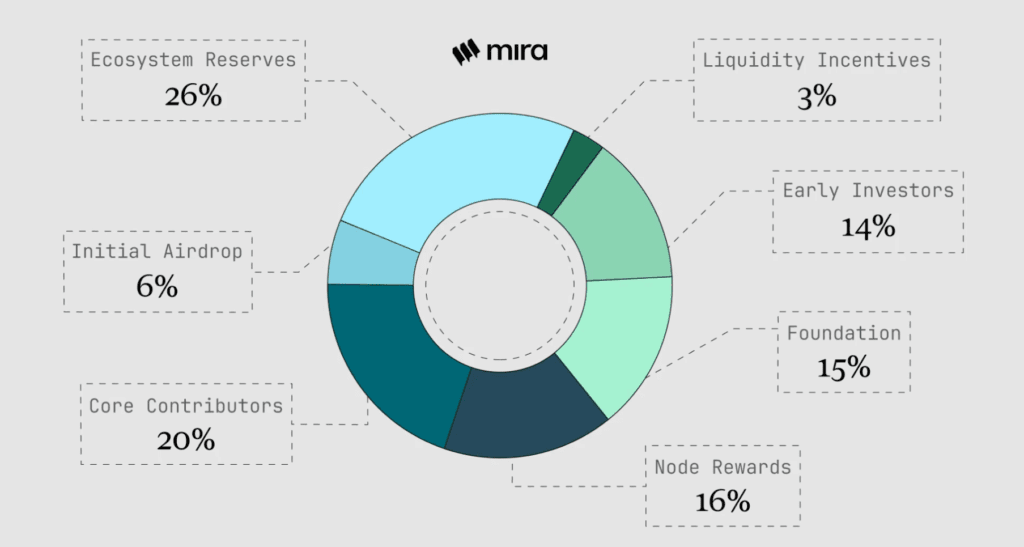
MIRA token distribution
Initial airdrop: 6%
Future Node rewards: 16%
Ecosystem reserve fund: 26%
Core Contributors: 20%
Early investors: 14%
Foundation Fund: 15%
Liquidity Incentives: 3%
Utility of MIRA token
- Staking and AI verification: Node operators need to lock (stake) MIRA to participate in verifying results from AI. If done correctly, they receive rewards; if done incorrectly, they may lose the staked tokens.
- Service payments: Applications in the Mira ecosystem will use MIRA to pay fees when calling verification APIs or using certified AI services.
- Governance: MIRA holders have the right to vote, participate in decision-making about development direction, fund allocation, and important network parameters.
- Ecosystem incentives: MIRA is used as rewards for developers, partners, and the community to attract more projects and applications built on Mira.
- Transaction liquidity: MIRA can act as the base asset when pairing transactions with other tokens in the Mira ecosystem.


