


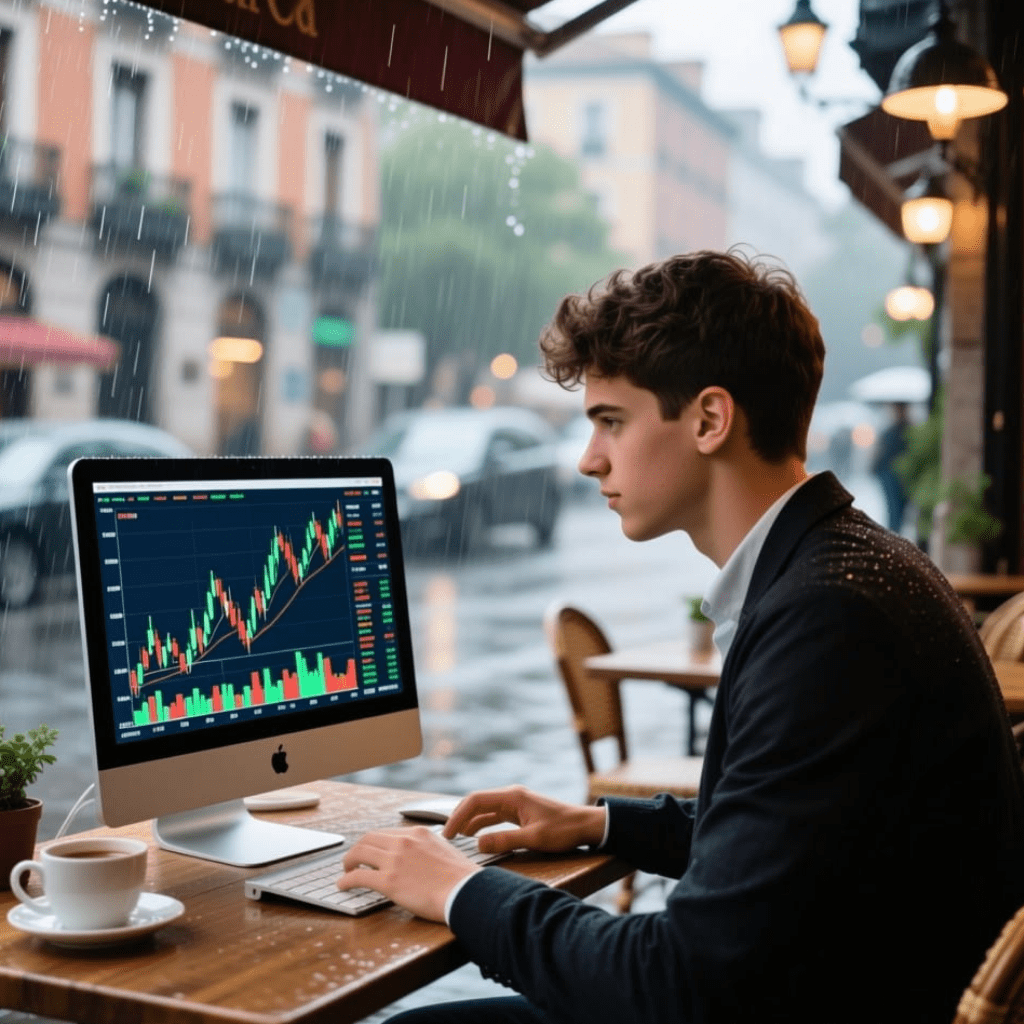
Have you ever sat in front of a chart, with a mix of excitement and anxiety, thinking you were about to change your life forever? I have.
And I want to tell you how that fantasy of easy money brought me to the brink of madness, and how, after many setbacks, I learned something valuable that might help you on your own path.
The Deception of Easy Money
Let's not fool ourselves: what drew us to trading, like bees to a hive, was the promise of easy money. I also fell into that trap. I confused how simple it was to place an order with how easy it would be to make money.
And, as expected, I paid for my naivety. In those days, I arrived with my last $50 to a trading group, desperate to learn, or rather, to make quick money.
Spoiler alert: I lost them AND MUCH MORE. And although it was not immediate, eventually the market taught me my first great lesson: I was not playing, I was being played.
The Market Is Not Your Enemy, It Is Your Reflection
The market is not your enemy, but it can become your worst nightmare if you don't know what you're doing. I discovered this the hard way, losing every dollar I had, every gram of trust, every nerve I had left.
It was as if the market knew exactly where my weak point was, my stop loss, and attacked it mercilessly.
Do you know what my main mistake was? Start backward.
We started by opening the corpse, operating on the victim, diagnosing diseases,
WE STARTED IN COURT attending a COMPLEX LEGAL CASE without understanding in
a devastating innocence, like discovering that you are being deceived by the woman
you love, that FROM THE BEGINNING YOU WERE SENTENCED TO SEVERAL CHAINS
PERPETUALS, condemned to lose every miserable dollar, every drop of trust, every
nerve EVERY TIME the trades went against you as if the market knew exactly your pain point, your STOP LOSS.
That was me in trading. Operating without a plan, without understanding the market, not even realizing that I was doomed from the start.
Since the 17th century, ABSOLUTELY EVERYTHING IN THE MARKET had already started to UNDERSTAND you, the masses, your play and what made us think at some point that
we could do it without preparation, without understanding how it was played, a guy like Dow, another like Wyckoff, another named Richard Dennis, or Cathie Wood
And what made us think (the trader lambo marketing) that we could go against them (surely the story of David against Goliath and our stone a crucifix and a lot of faith).
The Tree That Covered the Forest
I remember a November afternoon when I broke my piggy bank to finance my trading account. I don't know what I expected: a miracle? A stroke of luck?
What I didn't see was the forest. I was so focused on quick money that I ignored the most important thing: study, preparation, trial and error.
It was then that I understood something key: the one who wins in trading is not the one who treats it like a game, but as a science.
TRADING IS A SCIENCE that although it is not studied at the University will take every penny of the scholarship you did not apply for.
Trading is not flipping a coin; those who WIN know what each player is playing for: WINNING AND HOW THEY DO IT IS OUR MAIN OBJECTIVE THROUGH A SYSTEM OR SYSTEMS forget the STRATEGY, FORGET THE TREE. It is about creating a system that works.
But, let's be honest, facing this reality is not fun. And much less easy.
The Obsession to Learn to Fish
My first winning trade was $14. It sounds like nothing, but for me it was a monumental achievement.
It was the result of impeccable risk management and resisting the temptation to sabotage myself.
But the problem was still there: I didn't know how to "fish" on my own. I tried the strategies that initially worked, but then failed because I didn't understand the SYSTEM. Maybe I wasn't meant to understand but to apply it already.
But every brain works differently.
I changed, experimented, adjusted... and in the process, I went from being in the green to those damn red numbers that seem to mock you. Because then I had forgotten a crucial truth: losses are part of the system.
The Scientific Method Applied to Trading
My obsession with understanding the market led me to study great names like Richard Dennis, Dow or Wyckoff to understand how professional traders had made it possible, but if you are not inside the group it is like attending classes as a stowaway
I discovered that they did not see the market as a simple game of chance, but as something that could be analyzed, tested, and optimized.
They used validation tools, logic, mathematics, and statistics to make decisions. And most importantly: they followed rules.
I decided to adopt this approach, although at first I felt like a rookie on the bench, watching professionals play from afar.
But that feeling of being "out of place" was what drove me to change my perspective.
The Point That Changed Everything
The turning point was not a magic course or a secret strategy. It was something much simpler (and painful): to accept that I was doing it wrong.
I started tracking my mistakes, analyzing my numbers, backtesting and measuring my results.
I stopped fighting against the market and decided to observe how it really worked. Thanks to
this Telegram group (which, by the way, is free and is not marketing and you can message me to give you its profile on X and request access), I found a mentor who helped me see what I was doing wrong.
I learned that trading is not just strategy, nor just psychology, nor just mathematics. It is all
that together, a complex system that must work in harmony.
The Final Reflection
Trading has taught me that patience is not just waiting for a trade to develop, but waiting the necessary time to learn correctly.
It is a process of trial and error, of making mistakes doing the right thing, of building a solid system that gives you a statistical advantage.
As my mentor says, "your edge" is not in the strategy, but in doing the right thing over and over again, until time and constant practice turn that advantage into results.
"And now that I think about it, trading is not so different from life. It's not about looking for shortcuts,
It is a matter of building a path that makes sense to you, a system that works.
Because in the end, as the legendary Jesse Livermore said:
"Money is not in trading. Money is in waiting." And believe me, it is worth the wait.
In the next delivery, we will get into the subject of the worst mistakes I have made in my journey through trading and how I have gradually overcome them.
These are times for reading.
I love Bitcoin
