


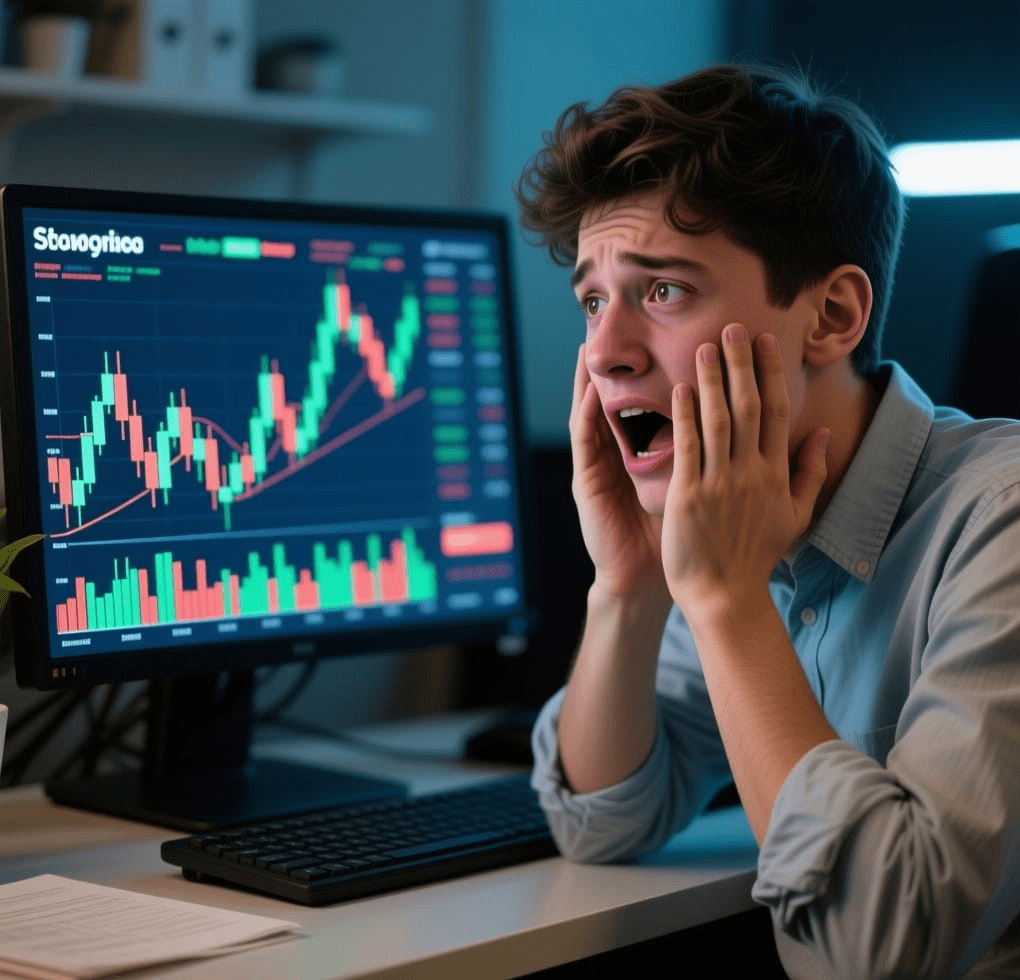
Are you playing to win... or just to not lose?
The true scammer is not that guy in a cheap suit with promises of magical returns. The true scammer is that little voice in your head that paralyzes you, that makes you watch opportunities pass by while you only worry about not losing the little you have.
How many times have you let fear steal your play? How many times have you preferred to stay still, instead of risking to truly win?
The biggest scam is not the one done to you from the outside, but the one you do to yourself every time you give up too soon, every time you prefer the 'security' of not losing to the real possibility of winning. Because in trading, as in life, those who play just to avoid losing... are already losing. Ready to discover the lessons that only a true scammer (or your worst internal enemy) could teach you?
Evil, Utility, and Trading: An Unexpected Triangle
Evil, they say, has a high energy cost but an extraordinary mental impact. Scammers know this: they can spend days, weeks, fishing in the digital ocean, opening accounts, casting hooks, waiting for some unsuspecting person to fall. What's the outcome? Sometimes they win, sometimes they lose, but they are always playing the game of probability, marginal utility, and patient waiting. Does that sound familiar? That's right: trading is the same game, just with more transparent rules and, if you're smart, with a bigger purpose. Now, think about the difference between a traditional job and trading. In the former, you trade time for a fixed and secure reward. In the latter, you bet on developing a skill that can accompany you throughout your life, like Warren Buffett, who at over 80 years old still multiplies capital. But here’s the catch: no one guarantees you a single dollar in trading. In a job, at least you know you’re taking something with you. So why do we keep choosing the uncertain path?
Why Do Losses Terrorize Us More than Gains Motivate Us?
Risk aversion is that invisible monster that whispers to you that a bird in hand is better than a hundred flying. You prefer 50 safe dollars over flipping a coin for 100 or nothing. But expected utility, that cold mathematical formula, does not explain why you cling to a losing trade hoping for a miracle, or why you close a winning one too early for fear of losing the little you've gained. The reality is that we are not rational: we are human, and the market knows it.
The Art of Patience: Lessons from a Professional Scammer
Let me tell you a true story: a scammer, disguised as a tarot reader, hooked me with the patience of a zen monk. He didn't try to convince me; he just waited.
He surrounded me with soft words, giving me space to decide how much his "service" was worth.
His game was not money; it was waiting. His job was to push me to the limit, make me give up, collapse my mind.
Does that sound familiar? It's the same thing the market does when, after a surge, the price lateralizes, drops, makes a new low... and you, impatient, close just before the big move.
These guys play for exhaustion, for statistics, for probability. They know that if they toss enough coins, some will fall on their side.
And in the end, I gave him 10 USDT. Not out of naivety, but because the lesson was worth much more than the lost money.
Three Disruptive Lessons for Trading and Risk Management
1. Risk is Not Avoided, It is Tamed
It's not about eliminating risk aversion but designing systems and strategies that turn it into your ally. Choose markets and methods that fit your profile, not the other way around. In this way, risk ceases to be an enemy and becomes the engine of your consistency.
2. Patience is the Most Underestimated Strategy
The true edge is not in the perfect entry but in the ability to wait. Great returns do not come from big bets, but from small gains accumulated by those who stay in the game long enough for probability to work in their favor.
3. Trading is a Laboratory of Antifragility
Do not try to avoid chaos: embrace it. Build systems that not only survive volatility but strengthen with it. The market rewards those who adapt, experiment, and learn from disorder, not those who seek refuge in static security.
Ready to stop fleeing from risk and start playing to win?
"The most important rule of trading is to play great defense, not great offense."
— Paul Tudor Jones
These are times for reading.

I love #bitcoin