

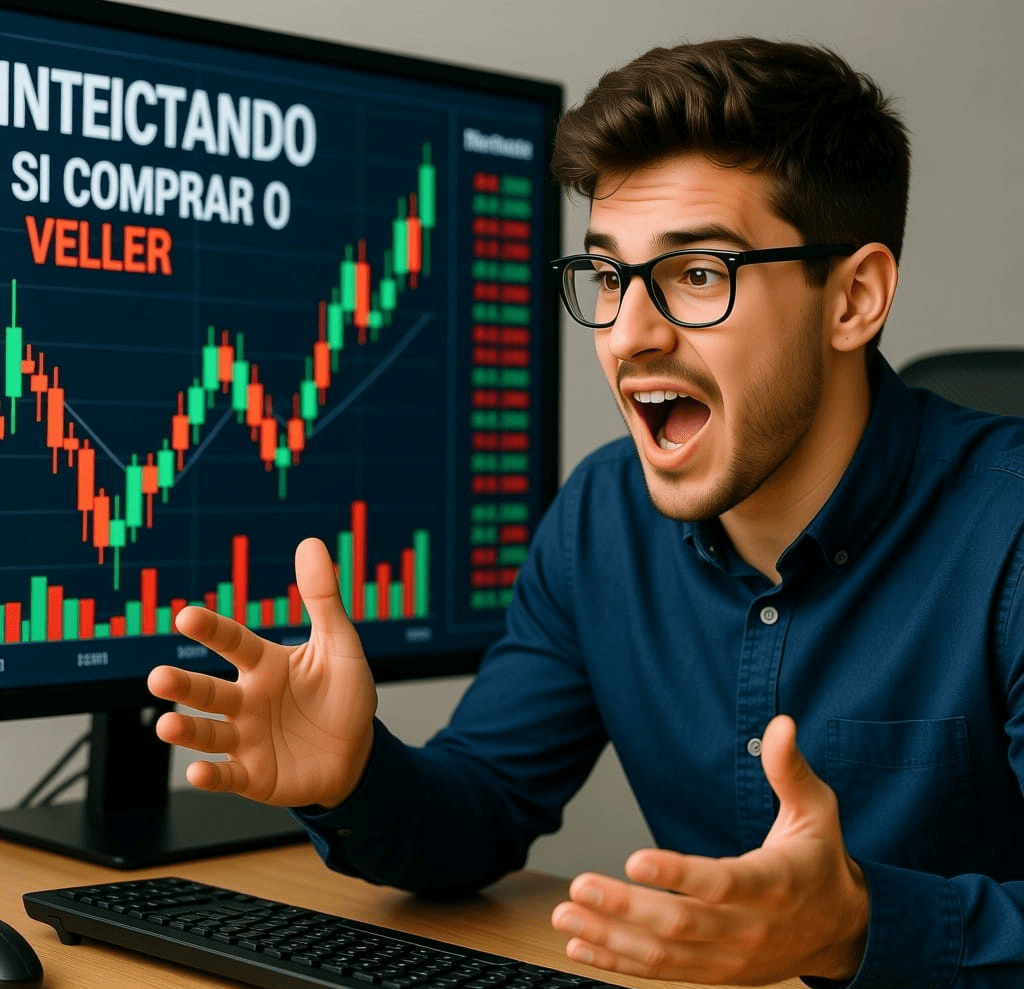
IF YOU STILL WONDER Will today be my lucky day? And you go and open a GRAPH with a NEGATIVE EXPECTATION* but with an UNBREAKABLE FAITH, getting the same results over and over again: LOSSES. Let me tell you that you are not alone.
The reality is that many traders make the same mistake: believing that trading is a matter of chance or instinct. But, is it really like that? Is it possible to face the market without a structured plan and come out victorious? Spoiler: it is not.
Why do we keep losing in the market?
Einstein said: 'You cannot solve a problem from the same level of consciousness from which it was created.'
And although this may sound like a motivational phrase, its message is totally related to trading. If we keep approaching the market with the same mindset and the same mistakes, how do we expect to obtain different results? Benjamin Graham, the father of 'value investing', also left us a valuable lesson by warning us that ignoring popular opinion is key.
The market (or 'Mr. Market', as Graham called it) is full of emotions, moods, and impulsive decisions that can lead us to ruin if we follow them blindly.
Both phrases lead us to a powerful conclusion: if we don't change our mindset and our approach to the market, we are doomed to repeat the same mistakes.
The system: Your compass in the markets
And this is where a critical point comes in that many traders overlook: your trading system is your compass. Is your trading system the problem? Let's be honest: most traders lose because they don't have a clear or functional system.
They are part of that 95% who believe that trading is about luck, intuition, or just 'getting lucky' once in a while.
But have you ever wondered if the problem is not 'always beating the market,' but that your approach is wrong? A good trading system is not about winning every trade.
It's about finding a structured method that works in the long term, one that aligns with your goals, your risk tolerance, and your ability to manage emotions.
And here comes the uncomfortable reality: there are systems that, no matter how much you try to improve them, simply do not work.
Retail Vs. Institutions
If you keep trading without understanding this, you are fighting a losing battle from the start.
What holds us back as retail traders? As independent traders (or 'retail traders'), we don't have the tools that the big players in the market have:
Advanced software with artificial intelligence.
Multidisciplinary teams analyzing statistical data, charts, and patterns.
Access to mathematical modeling and sophisticated prediction tools.
So, what can we do? Leverage our greatest advantage: agility combined with strategic anticipation.
While the big players deal with huge volumes and face limitations due to their size, we, as retail traders, have the ability to be more precise, more flexible, and, above all, more proactive. We can anticipate market movements quickly and adapt to changes swiftly, something that big players cannot always do due to their structure and scale.
The key is to develop a mindset that prioritizes observation, analysis, and the creation of clear rules based on recurring patterns. Agility is not just about moving fast, but also knowing where to move before it becomes evident to others.
How to change your approach from today? It's time to stop trading as if the market were a game of chance. Reflect:
How much time do you spend studying effective trading systems?
Do you understand your risk tolerance and how to use it to your advantage?
Are you willing to stop trading as you have done until now to adopt a more strategic approach?
For me, the change occurred when I stopped obsessing over entries and individual strategies.
Although they are important, if they are not part of a structured trading system, they make no sense. A trading system is not just a strategy; it's a methodology that includes clear rules, risk management, and a long-term vision.
In addition to knowing what to do when you enter drawdown, it is essential to assess whether your system is truly profitable in the long run, that is, to understand its mathematical expectation.
You must clearly analyze what your average losses and gains are, and, most importantly, identify the statistical advantage that makes that system a winning one — in other words, understand what differentiates it and makes it effective. For a long time, I didn't have this clarity; I was just stumbling between losses and ignorance.
What changed? Finding someone who really knows what they are doing, someone who is where I want to be tomorrow. That learning is the most powerful leverage you can have on your path as a trader.
Guessing the weather
A clear example of when you have UNBREAKABLE FAITH that today you will win, but I have a question for you, which I asked myself when I finally understood which side I was on when trading:
Would you guess the weather just by looking at the sky?
When I started trading, my approach was no different from looking at the sky and trying to predict whether it would rain or not.
How many times have you accurately forecasted the weather without using tools or studies? Probably few, right? Now imagine approaching the market in the same way: without preparation, without data, without rules.
It's a recipe for disaster. Trading is not about luck; it's about probability (and here I sound like her repeating her words, but how right she is).
And to win at this game, we need clear rules based on patterns, statistics, and a structured vision.
Final message
If you feel trapped in a repetitive cycle of mistakes and frustrations while trading, it's time to change your mindset and your approach.
Don't keep approaching the market the same way expecting a different outcome. As Albert Einstein said, 'Insanity is doing the same thing over and over again and expecting different results.'
And to conclude with a reflection from the legendary trader Ed Seykota:
"Win or lose, we all get what we want from the market. Some seem to enjoy losing, so they win by losing."
It's reading time.
I love Bitcoin

(Mathematical expectation: It is a metric that determines whether a trading strategy is profitable in the long run, meaning whether money will be made over a considerable period of time)