


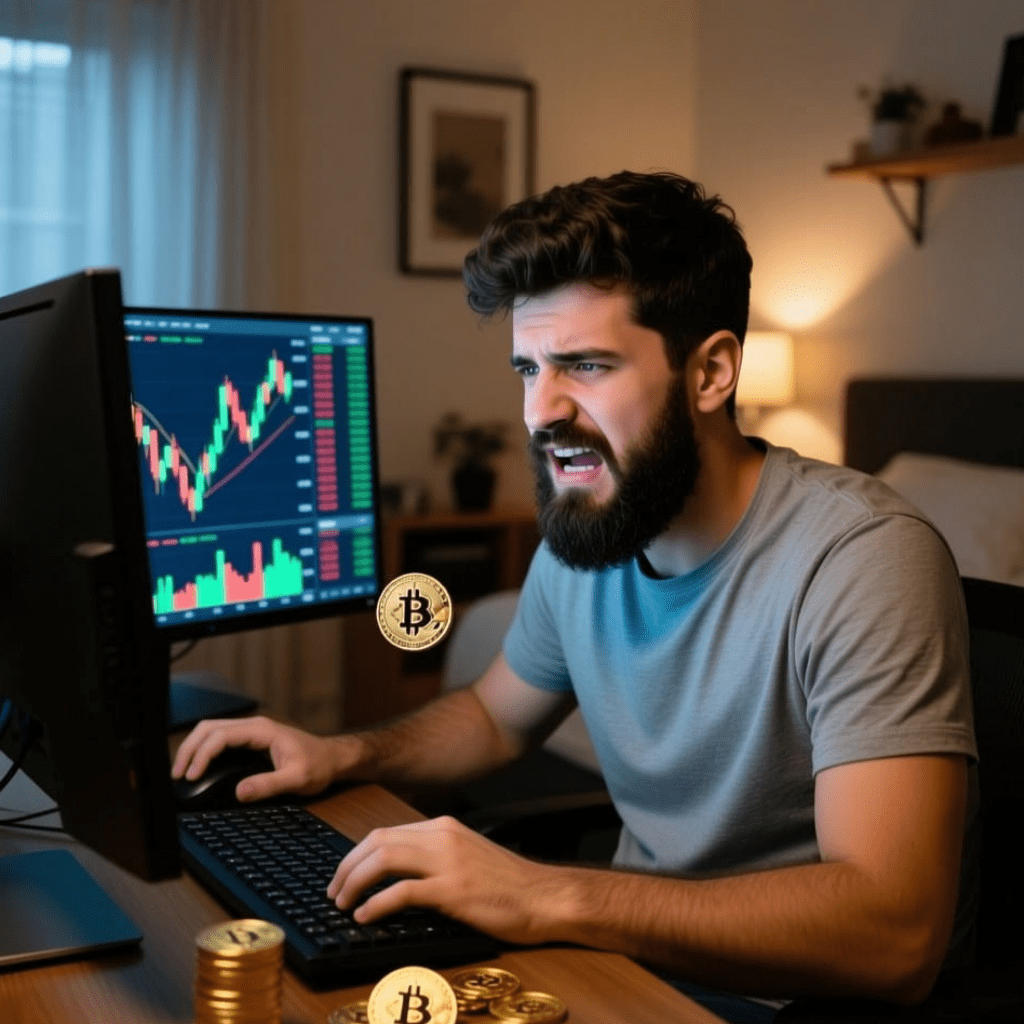
“There are three types of people: those who learn by reading, those who learn by observing, and those who have to urinate on the electric fence by themselves.” Munger
Can you guess what type I was? Exactly: the third one. I learned the hard way, figuratively speaking, through shocks and hits. I discovered that trading is not learned from books or by watching others trade. It is learned by losing money and understanding why you lost it. The market gives you no respite. It will take everything from you before giving you anything.
So now I ask you:
How much longer will you let your "instinct" destroy your trading account?
Have you ever wondered why you keep losing money in the market, despite "feeling" that you were right? If you have ever trusted that magical hunch, that "instinct" that told you the market was going to move in one direction... let me tell you something: you are playing a dangerous game.
Trading is not magic, nor superstition, nor blind faith in your emotions. It is a battlefield where the impatient lose to the patient, and those without a financial plan lose profits to those who trade with strategy, with a system.
The ruthless truth of the market: The market is not a casino, although it may seem so to many. Behind every movement, there is a force that dominates it: liquidity.
That liquidity does not appear by magic; it comes from a huge group of traders who do not know what they are doing. For every 100 traders, there is one who knows how to transfer that liquidity to his account.
What side do you want to be on?
Trading is not a matter of "feeling". It's a game of probabilities, of mathematics, of applied statistics. If your trades don't work out and you keep blaming the market, it may be time to admit that you don't have a system. Or worse, that you have one, but you lack the discipline to follow it.
Will intelligence make you a better trader?
No, and this may surprise you. Many believe that being smarter will automatically make them better traders. But the truth is this: a high IQ can work against you. Over-analysis paralyzes you. Information overload makes you doubt. And while you keep questioning every detail, the market keeps moving, crushing the indecisive.
As Warren Buffett said:
“Eating mistakes is essential, as long as the correct ones outweigh the incorrect ones.”
In other words: mistakes are going to happen, but if you don't learn from them, you are finished. Done.
What is the key? I WARN YOU IT'S BORING:
Rules, management, and time in the market.
The problem is not the market. The problem is you and your execution. It took me time to understand that I needed a system based on three fundamental pillars:
Clear rules: Before entering a trade, you need a list of conditions that must be met. No exceptions.
Risk management: Each trade must have a calculated risk. An account without risk management is an account destined to disappear.
Time in the market: Experience cannot be bought or learned in a course. It is only gained by trading, making mistakes, and learning from them.
How ridiculous is it to trust your "instinct"?
Think about it: Jesse Livermore, one of the most legendary traders in history, did not trust his instinct; he trusted the data.
I studied order flow, volume, and understood market psychology.
And what do we do? Trade with x20 or x50 leverage because we "feel" that the price of Bitcoin is going to go up or down. It's ridiculous. The market does not reward blind faith or hunches. It rewards strategy, logic, and discipline.
Mistakes as a path
One of the best tools you can have as a trader is a trading journal. Write down every entry, exit, and outcome. Reflect on what you did right and what you did wrong. But above all, understand that trading is not for mathematical geniuses. It's for emotionally stable people. As traders, we must accept that losses are inevitable.
What really matters is how you manage those losses and how you improve your system with each mistake. The market will not forgive you if you do not learn quickly.
Conclusion:
Are you cut out for trading or not? The market is not for everyone.
If you are not willing to accept losses, learn from your mistakes, and trade with a clear and defined system, trading is not for you. And that's okay. Perhaps passive investment is more your style.
As Charlie Munger said:
“If you're not willing to watch the market drop 50% without panicking, you're not cut out to be a shareholder.”
So, if you are starting, stop trusting your intuition, your instinct, in short, stop predicting what the market will do and build a system. But above all, follow it.
Because at the end of the day, what works is not the hunch, it's your ability to adapt, learn, and execute that system with discipline.
Remember this:
The market can be your servant, but if you do not have a system that you follow with discipline, you will always be its slave.
These are times for action

I love Bitcoin