

At the beginning of October, the first batch of Chinese named Meme coins on BNB Chain (represented by 'Binance Life') suddenly became popular and quickly spread to the English-speaking circle, with many overseas players starting to learn Chinese and trade Chinese Memes.
Unlike the previous Meme craze led by Solana, this time the main stage has completely shifted to BNB Chain. The creation and trading activity surrounding 'Chinese topic coins' surged, driving the interaction and discussion activity of BNB Chain. The price of BNB also significantly increased with market sentiment, becoming one of the most outstanding mainstream assets after BTC.
However, after the short-term volatility event in the industry on October 11, market sentiment tightened for a time. The Chinese Meme market also cooled down for a while, but it was Coinbase that broke the silence. Jesse Pollak, the head of Coinbase's Base chain, had previously expressed dissatisfaction with Binance regarding listing fees, yet unexpectedly used 'Binance Life' as an example during the Base application demonstration. This scene went viral, further promoting the Chinese Meme narrative of BNB Chain across chains and reigniting community discussions.
After the October 11 incident, the trading platform Binance invested $400 million to launch the 'Same Boat Plan', subsidizing loss-making users and institutions. The entire market gradually entered a self-repair phase, with on-chain activity rebounding and mainstream assets steadily recovering. Despite experiencing fluctuations, the structural resilience and internal momentum accumulated in the third quarter of this year have not been broken - the total market capitalization of crypto assets has exceeded $4.02 trillion by the end of Q3 2025.
Throughout Q3, both spot and derivatives trading volumes on Binance grew compared to Q2, with a total trading volume of $9.93 trillion continuing to hold more than 1/3 of the market share, indicating strong fee income; BNB's market cap grew to $145.998 billion in Q3, reflecting Binance's valuation to some extent; while BNBChain generated $357.3 million in fee income by the end of Q3, representing its earning capacity as the underlying layer of Web3.
In the current situation, Binance still firmly holds the top position in global trading volume. As the exchange industry’s 'one strong and many strong' pattern tends to solidify, each player needs 'fresh water' increment, leading the battle to the chain, while 'XX life' is merely a microcosm of traffic alignment.
Binance leads Q3: trading volume and share both rise.
With Bitcoin prices repeatedly hitting new historical highs, the total market capitalization of crypto assets exceeded $4.02 trillion by the end of Q3 2025, a 16.2% increase compared to the end of Q2's $3.46 trillion and a 72.5% increase compared to the same period in 2024 ($2.33 trillion).
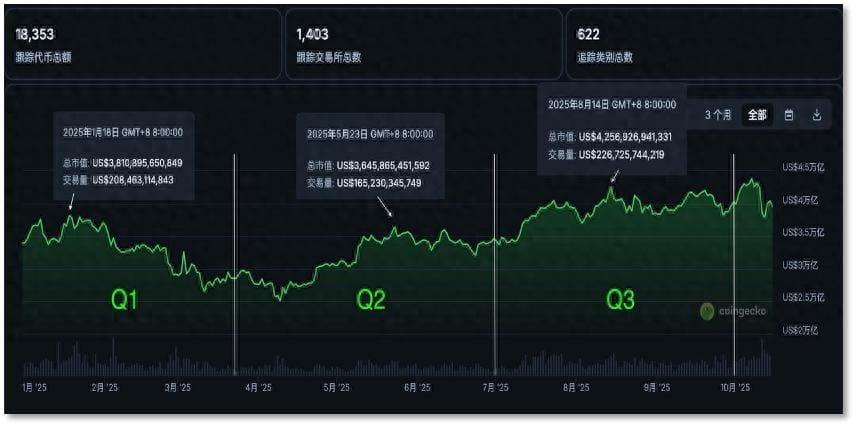
2025 Crypto Asset Market Capitalization Trend Chart
The top 10 exchanges contributed a total trading volume of $28.7 trillion in Q3, a 32.87% increase compared to Q2 ($21.6 trillion). Among them, the total spot trading volume was $4.9 trillion, a 36.11% increase compared to Q2 ($3.6 trillion); the total derivatives trading volume was $23.7 trillion, a 17.32% increase compared to Q2 ($20.2 trillion).
Looking at the performance of the top 10 exchanges, Binance occupies 34.59% market share with a total trading volume of over $9.93 trillion (spot + derivatives), being the only crypto asset trading platform that has consistently occupied 1/3 of the market share.
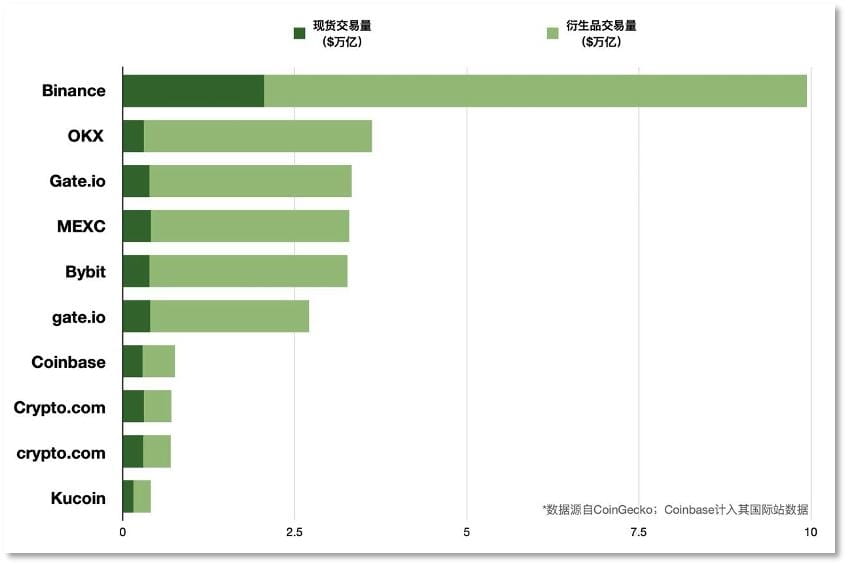
In Q3 2025, Binance's trading volume still occupies a leading position.
During the same period, exchanges with more than 10% of total trading volume share included OKX (12.60%), Bitget (11.58%), MEXC (11.45%), and Bybit (11.36%). The overall market pattern of the exchange industry has not changed much in the short term.
Whether in spot or derivatives, Binance's market share in Q3 holds an absolute leading advantage, and both have increased compared to Q2.
According to CoinGecko's data statistics, during Q3, among the top 6 platforms by total trading volume market share, Binance's spot trading volume was $2.05 trillion, occupying 41.26% of the market share, a 3.27% increase compared to Q2. Bybit and Bitget's market shares also saw slight increases, with increases of 0.57% and 0.38%, respectively.
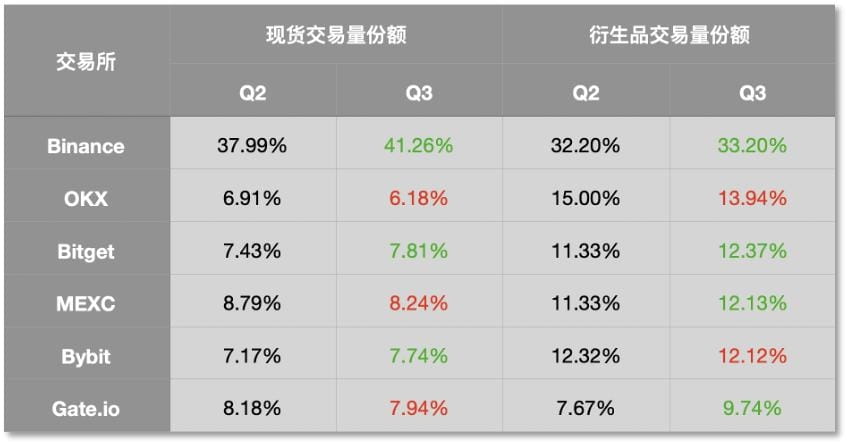
In Q3 2025, Binance's spot/derivatives increased by 3.27% and 1%, respectively.
In the top 6 of the derivatives market, Binance still leads with a trading volume of $788 million, accounting for 33.20% share, significantly ahead of the other 5, with a 1% increase from Q2; Gate.io's share increased by 2.07%, the largest increase; Bitget's share grew by 1.04%, surpassing Binance; MEXC saw a slight increase of 0.8%.
While leading in trading volume market share, Binance set a record with a net inflow of $14.8 billion in Q3, solidifying its dominant position in the centralized exchange (CEX) sector.
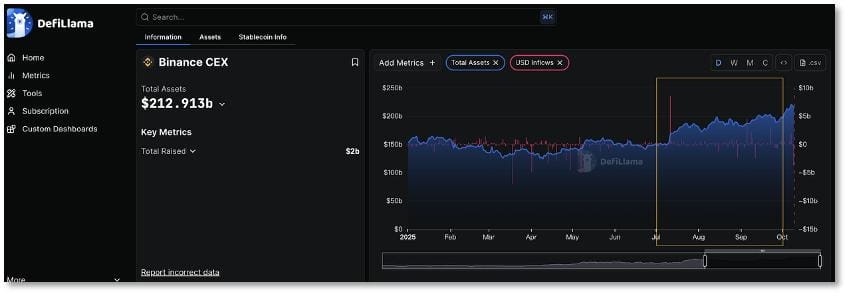
In Q3 2025, Binance's net inflow exceeded $14.8 billion.
However, it is worth noting that despite the total market capitalization of crypto assets increasing by 16.2% and trading volume scaling up by 32.87%, there has not been a significant shift in the market shares of various trading platforms, and the overall pattern tends to solidify. In the competitive process, both defense and offense for each platform appear to be quite difficult, urgently requiring new breakthroughs.
Market leader Binance seems to have long seen the limitations of the exchange's stock competition and has early turned its strategic vision to the chain. The phenomenal product Alpha in the second quarter was a 'key move' and has increased investment in the third quarter.
BNBChain active addresses increased by 57% month-over-month, and the 'chain version of Binance' releases DEX potential.
The integration of Alpha into Binance's main site is like firewood, and the Alpha airdrop is the spark that has completely ignited BNBChain, with its popularity continuing from the beginning of the year to the present.
The latest report from CryptoRank shows that BNBChain, along with Solana and Avalanche, is among the 'best-performing blockchains in Q3 2025'. BNBChain's DEX trading volume reached $225 billion, the highest level since Q4 2021, second only to Solana ($365 billion) and Ethereum ($337 billion).
However, in terms of active address numbers, BNBChain began to surpass other chains in September, reaching a new high level of 52.5 million, a 57% increase month-over-month; during the same period, Solana and Ethereum's figures were 45.8 million and 8.9 million, respectively. The number of BNBChain's transactions also grew significantly, increasing from 892 million in Q2 to 1.22 billion in the third quarter.
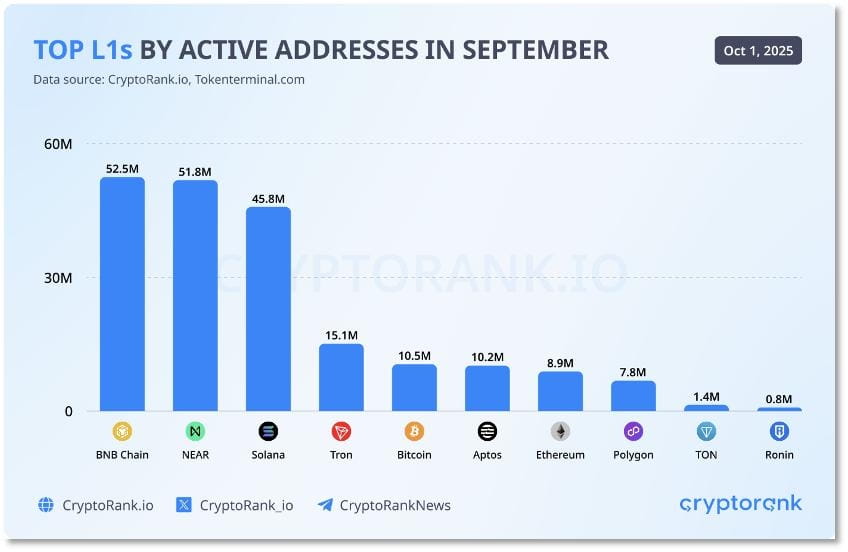
In September, BNBChain's active addresses exceeded 52.5 million, ranking first among mainstream chains.
The significant increase in activity allowed BNBChain to generate $357.3 million in fee income before the end of Q3. According to CryptoRank, BNBChain's revenue reached $2.2 million in September, hitting the highest level since March.
In addition, DefiLlama data shows that the number of protocols on BNB Smart Chain (BSC) reached 1033 at the end of Q3, 2.7 times that of Solana (381) and gradually approaching Ethereum's (1638); the TVL on BSC reached $8.729 billion. Although it is still far from Ethereum's ($87.415 billion), it is only $2.6 billion short of catching up with Solana ($11.368 billion), but BSC's TVL recorded a monthly increase of 15.02%, becoming the strongest growing underlying layer among the top 10 public chains in terms of TVL.
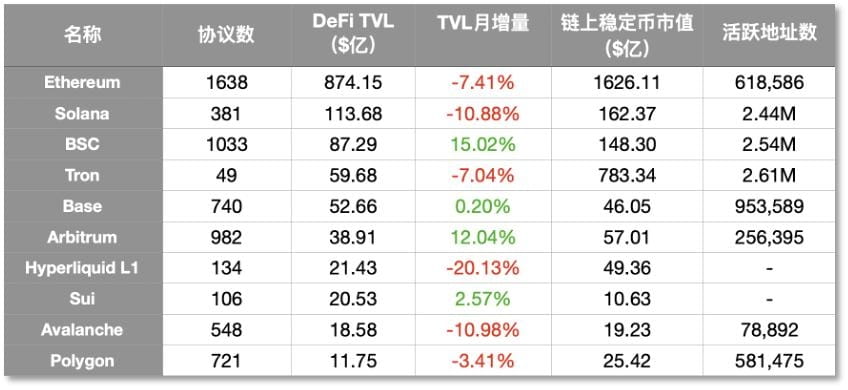
Among the key indicators of various chains, BSC's TVL monthly growth rate is significant.
If Alpha is the key for Binance to open up chain ecology growth in Q2, then the Perp DEX 'Aster' that appeared on BNBChain is the successor. This perpetual contract DEX saw multiple metrics grow in September, with daily revenue reaching $7.2 million, even exceeding the derivatives sector's 'big bomb' Hyperliquid ($2.79 million). Its growth also led to a 55% surge in BNBChain's perpetual contract trading volume in Q3, reaching $36 billion.
The continuous growth of on-chain transactions and TVL in BNBChain has benefited from cost reduction and increase.
When trading becomes the main use case on-chain, on September 24, BNBChain validators proposed to lower the minimum Gas price from 0.1 Gwei to 0.05 Gwei and shorten the block generation interval from 750 milliseconds to 450 milliseconds. This proposal marks the third major fee reduction in the past 18 months, with a long-term goal of reducing the fee per transaction to about $0.001.
In fact, BNBChain has previously reduced transaction fees multiple times: from 3 Gwei to 1 Gwei in April 2024 and from 1 Gwei to 0.1 Gwei in May 2025, totaling a reduction of 75%.
The fee reduction in May brought significant results: the median transaction fee dropped by 75% (from $0.04 to $0.01), and the daily transaction volume surged by 140%, exceeding 12 million transactions. It has been proven that there is a strong correlation between fee reduction and the increase in network usage.
The measures taken in September to reduce fees again paved the way for BNBChain's upgrade from a general public chain to the underlying layer of a financial system.
In the past, BNBChain has already gathered established DEXs and DeFi platforms such as PancakeSwap, Venus, Uniswap, Solv Protocol, and Aave. The emergence of Aster has filled the gap in the derivatives sector on the BSC chain, creating immediate value for itself and BNBChain.
The flourishing of BNBChain's on-chain ecology also verifies the judgment made by Binance founder Zhao Changpeng (CZ) three years ago: DEX has huge potential. Alpha and Aster have become the best answers three years later, and this 'Double A' DEX has also tested BNBChain's ability to handle high-frequency trading on-chain.
As described in a media headline, Binance has created two 'little Binances' - Alpha focuses on 'on-chain spot' while Aster takes on 'on-chain contracts'. Under fierce market competition, it seems that only Binance itself can disrupt Binance.
But the question is, although the on-chain potential is limitless, how can we get more cars running on the highway? This not only relates to the incremental sources of the Binance ecosystem but also determines how much value 'on-chain income' BNB can still create.
BNB reaches a new record of $1376. Where is the next growth point?
If we follow the logic of traditional capital markets, when the Binance ecosystem not only has super products that can support its value but also possesses strong profitability, the capital market will estimate its value. Currently, the $150 billion market cap of BNB can be seen as the market's strong expectation for Binance, allowing it to return to the top 3 of crypto assets. Can the new additions continue?
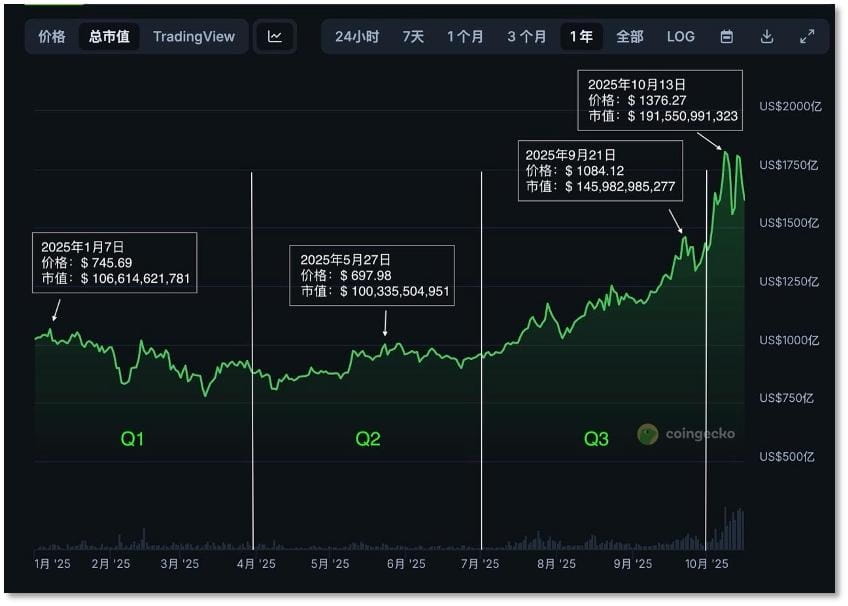
BNB's market cap performance this year.
Part of the driving force behind this round of growth comes from capital's optimism about BNB's potential, especially as Bitcoin (BTC) and Ethereum (ETH) have been rapidly creating various treasuries by institutions.
As noted in a recent client Q&A report by American investment bank Jefferies targeting large institutional investors, crypto assets are still at the '1996 stage', just like the early internet boom, and have greater growth potential. 'Many companies are actively formulating investment strategies and determining how to allocate funds between tokens, ETFs, digital asset treasury companies (DAT), and publicly listed companies with risk exposure.'
'Focusing too much on Bitcoin prices distracts people from the disruptive potential of blockchain technology across various industries,' said Jefferies analysts, echoing investment strategies from the 1996 internet era: be selective and emphasize lasting utility. Jefferies suggests analyzing tokens like early tech startups and prioritizing 'adoption, development, usage, and use cases.'
BNB is one of the targets that meet this suggestion.
In June and July of this year, several publicly listed companies in traditional industries announced plans to include BNB in their balance sheets. When CZ revealed that over 30 teams are preparing projects involving BNB reserves, this momentum further grew in Q3.
By August 25, Web3 'old cannon' B Strategy announced plans to raise $1 billion with the support of YZi Labs to establish a publicly listed company in the United States that will hold BNB as a financial asset and invest in the BNB ecosystem. YZi Labs is seen as the 'strongest family office' in the crypto circle, which began to operate independently after being spun off from Binance in January this year, managing the funds of Binance founder CZ and a few early Binance executives.
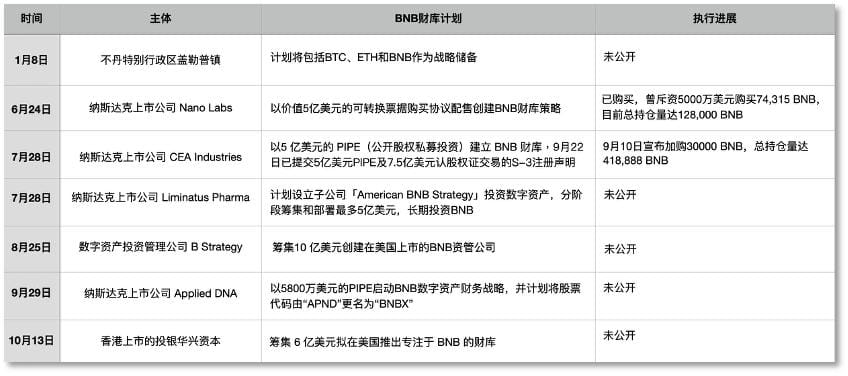
Multiple institutions have included BNB in their reserve/treasury plans.
On October 13, Bloomberg reported that Hong Kong-listed investment bank Huaxing Capital plans to raise $600 million to launch a treasury focused on BNB in the United States. Once completed, this project will become the largest single investment in BNB by a publicly listed company. Additionally, on October 9, news of SoftBank (9984.T) subsidiary PayPay Corp acquiring 40% of Binance Japan's shares has also reached the market.
News of institutional investment and acquisitions, combined with the increase in on-chain activities, further boosted market confidence, providing support for BNB's subsequent rise.
Although investing in BNB still means investing in the future of Binance, BNB has long since jumped out of the narrative of being an exchange's platform token. It has become a comprehensive crypto asset that integrates trading, payment, public chain fuel, and investment tools, catering to different groups of people.
In the words of Binance users, 'for trading users, BNB can offset transaction fees to save trading costs; for investors, it is a pass for participating in early projects and earning returns in Launchpool and TGE; for developers, it is gas for building decentralized applications on BNBChain.'
By September, institutions prioritizing 'adoption, development, usage, and use cases' have arrived. Compared to the Meme frenzy, such participation can become the hard core driving force for the incremental growth of the BNB ecosystem.
On September 24, global investment giant Franklin Templeton, managing $1.6 trillion in assets, announced that it is expanding its proprietary Benji technology platform into the BNBChain ecosystem, looking to leverage BNBChain's technological advantages, including its scalable low-cost infrastructure and high transaction throughput, to further enhance Benji's expertise in the institutional-level tokenization space and create on-chain financial assets.
On October 15, CMB International Asset Management Co., Ltd. (CMBIAM), a wholly-owned subsidiary of China Merchants Bank, put a money market fund with assets under management exceeding $3.8 billion on-chain with BNBChain. By deploying CMBMINT and CMBIMINT Tokens on this chain, investors can subscribe using fiat or stablecoins and redeem their held assets in real-time through DigiFT's proprietary liquidity management smart contract.
That's right, RWA, a channel that has already connected traditional financial assets with Web3 technology/crypto world in practice. For on-chain infrastructures like BNBChain, large-scale adoption is necessary to validate its value; compared to Meme, that is a more transformative new world.
As more institutions like Franklin Templeton and CMB International adopt BNBChain, the continuously expanding, upgrading, and cost-reducing BNBChain can achieve its long-term goal - to become the cornerstone of the financial system - which is the true destination for BNB after crossing the noise of Meme speculation and reaching a new high of $1376.
(Disclaimer: Please strictly comply with the laws and regulations of your location; this article does not constitute any investment advice.)


