

Recently, the globally renowned investment bank JPMorgan Chase has 'planned to accept Bitcoin and Ethereum held by global institutional clients as collateral for loans.' This news is once again seen by the cryptocurrency industry as an important indicator of 'institutional recognition.'
In fact, behind the surge in the first half of the year in the cryptocurrency market led by Bitcoin, institutional investors are the important 'driving force.' As ETH, SOL, and BNB have been included in the asset reserves of some listed companies and even used by multiple companies as treasury assets, the institutional market has once again shown strong incremental potential.
According to the joint report by EY and Coinbase (2025 Institutional Investor Digital Asset Survey), asset management companies, hedge funds, private banks, venture capital funds, family offices, and other influential institutional investors in asset allocation decisions have shown a strong interest in crypto assets. The report indicates that 86% of surveyed institutional investors already have exposure to digital assets and plan to further expand their allocation after 2025.
The entry of institutional investors is closely related to the progress of regulatory compliance for crypto assets in multiple jurisdictions. Meanwhile, top global crypto exchanges like Coinbase and Binance are also increasing and optimizing investment tools for institutional clients to secure a foothold in the 'institutional bull' market.
Institutional demand for crypto asset investment is surging.
'Institutional demand drives record growth.' In October 2025, the Chicago Mercantile Exchange Group (CME Group) disclosed in its third-quarter crypto asset market insight report that its crypto asset futures and options trading volume exceeded $900 billion, setting a new historical high.
In the second half of this year, the globally renowned crypto asset trading platform Binance has accelerated the launch of multiple services aimed at institutional clients.
In July of this year, Binance launched institutional lending services, providing institutional clients with cross-collateral features between spot, full-margin leverage, and unified accounts. Soon after, Binance announced that the Binance tripartite custody service designed for compliant institutions would waive the collateral asset fees by the end of the year.
Starting from September 30, Binance has launched a crypto-as-a-service (CaaS) solution for institutions, offering early access to mature licensed banks, brokers, and trading platforms.
A series of actions by Binance has quickly responded to the current surging demand for institutional crypto asset allocation.
(2025 Institutional Investor Digital Asset Survey Report) shows that 59% of institutional respondents plan to allocate more than 5% of their asset management scale to crypto assets; institutions' allocations are not just limited to holding mainstream crypto assets like Bitcoin (BTC), Ethereum (ETH), Ripple (XRP), and Solana (SOL), but will also delve into staking, lending, derivatives, and other DeFi scenarios. 57% of respondents have included tokenized assets in their 'planned allocation' to achieve portfolio diversification.
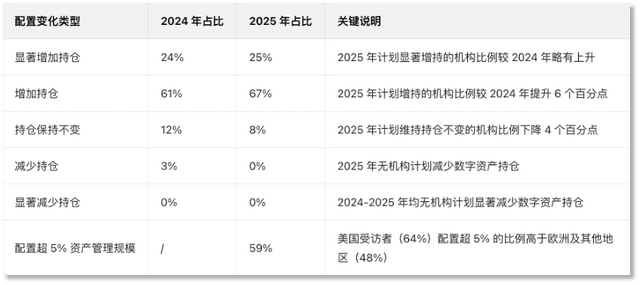
Institutional allocation of crypto assets month-on-month changes
Currently, traditional asset management companies and hedge funds are the most mainstream and largest institutional clients in terms of capital.
According to public news, hedge funds such as Bridgewater and Renaissance Technologies have already incorporated crypto assets as part of their global macro strategies to hedge against fiat currency depreciation or include them in a new asset class; multi-strategy hedge funds like Millennium Management may trade crypto assets to obtain early returns.
Investment banks and asset management institutions like Goldman Sachs and JPMorgan have begun to offer crypto asset derivatives, such as futures, options, and swap transactions, and execute block trades on exchanges on behalf of clients; BNY Mellon and State Street have entered the digital asset custody service market.
As Catherine Chen, head of Binance VIP and institutional business, described, 'The growth rate of demand for digital assets is faster than ever, and traditional financial institutions can no longer stand by. However, building a crypto asset service system from scratch is both complex and expensive, and the risks are significant. Therefore, we created 'Crypto-As-A-Service'— a trusted, ready-to-use infrastructure solution for institutions.'
As early as May 2018, the U.S. crypto asset trading platform Coinbase began offering products aimed at institutional investors, claiming that 'more than 100 hedge funds have announced plans to trade and invest in crypto assets,' indicating that institutional clients' interest in digital assets emerged 7 years ago. Coinbase also subsequently launched an institutional-level custody service platform, and increased products adapted for institutions in the following years.
Undoubtedly, top crypto asset trading platforms like Coinbase and Binance have become an important bridge between traditional finance and new digital asset finance.
For trading platforms at the top of the crypto asset industry chain, gaining widespread recognition from institutional clients not only signifies a large scale of custody and trading volume but also importantly proves that the emerging finance supported by blockchain can achieve widespread adoption.
How does Binance build institutional trust?
To gain favor from asset management firms, hedge funds, and banks, exchanges must meet the needs of institutions.
(2025 Institutional Investor Digital Asset Survey Report) shows that the top three reasons institutions are willing to allocate to crypto/digital assets are 'higher returns than other asset classes' (59%), 'investing in innovative technology' (49%), and 'hedging inflation' (41%); while the main concerns include regulatory uncertainty (52%), volatility (47%), and asset custody security (33%).
It can be seen that compliance and security remain the most concerning factors for institutions entering the crypto asset space, and they are also the primary trust issues that crypto asset trading platforms must address when accommodating institutional clients.
In the anticipated $3.28 billion global custody market, not all platforms can provide true institutional-level security guarantees and clear regulatory support; therefore, licensed and compliant institutional custody services are crucial.
Currently, top custodians such as Anchorage Digital, BNY Mellon, and Sygnum Bank have strong regulatory protections, including OCC, NYDFS, and FINMA licenses, as well as comprehensive audits from globally renowned accounting firms, making them the preferred custodians for hedge funds, mainstream brokers, liquidity providers, and fintech companies.
When building the institutional client service system, Binance prioritized resolving compliance and security needs. As early as December 2023, Binance launched the first banking tripartite cooperation model in the crypto exchange industry, allowing investors to deposit trading collateral outside the exchange while continuing to trade seamlessly on the Binance platform. Among them, Sygnum Bank is one of Binance's tripartite banking partners. This digital banking group holds a Swiss banking license and has CMS and major payment institution licenses in Singapore, collaborating with Binance to provide custody and trading services for hedge funds, brokers, and other institutional clients.
Binance began supporting tokenized real-world assets (RWA) in July, such as USCY and cUSDO, allowing institutional clients to hold these income-generating tokenized assets through third-party banking partners, in addition to traditional collateral like fiat currencies and government bonds.
In August of this year, according to the Financial Times, Spain's BBVA also reached a tripartite banking agreement with Binance, allowing customers to store their digital assets in accounts outside the crypto asset exchange, increasing asset custody options for security. Under the new structure, BBVA will custody customer funds in the form of U.S. Treasury bonds, while Binance accepts these Treasury bonds as trading collateral.
This architecture follows the model long adopted by traditional financial markets, significantly reducing counterparty risk. By separating custody from execution, institutions can better coordinate crypto asset management with internal risk control and external compliance requirements, without needing to share assets or lose control.
While building trust through security, Binance has also constructed a comprehensive product suite targeting the trading needs of VIP and institutional clients, including block trading services, derivatives, institutional lending, and more.
By September of this year, Binance launched the 'Crypto-As-A-Service' (CaaS) solution again, attempting to capture more traditional institutional clients from an experience perspective.

Binance launched the CaaS solution.
The Binance CaaS solution is designed for regulated large financial institutions planning to enter the crypto asset market on a large scale, seamlessly integrating multiple functions such as trading, liquidity acquisition, custody, compliance, and settlement into the institutions' own platform systems, thereby eliminating the high costs and technical burdens of developing complex infrastructure from scratch.
Compared to other service providers in the industry, the core innovation of Binance CaaS is that it combines Binance's global order book access capability with the internal liquidity of institutions, allowing institutions to match orders directly among their clients in a 'best price match' manner.
This efficient use of internal liquidity not only significantly enhances trading efficiency and reduces costs, but more importantly, due to the deep integration with Binance's underlying infrastructure, even if the scale of internal orders is limited, institutions can still directly access Binance's global spot and futures markets, thereby achieving a consistent execution experience and tight spread performance.
Public data shows that as of now, the registration volume of Binance's institutional clients has increased by 97% year-on-year, and the average daily trading volume has reached $88 billion. Binance places such great importance on institutional clients not only due to market share considerations but also closely related to its long-term strategic goal of promoting 'financial inclusion.'
Binance CEO Richard Teng stated that to promote the widespread adoption of crypto assets, a robust regulatory and compliance system is needed, and institutional adoption is becoming a key driving force. 'Think about foreign exchange, commodities, stocks, and bonds; it always starts with institutional adoption, then corporate and high-net-worth individuals, and finally retail.'
He pointed out that since last year, the industry has undergone tremendous changes— the United States was the first to approve crypto asset ETFs, followed by approvals globally. 'Ultimately, it has given crypto assets the credibility they deserve, and we have seen a sharp increase in adoption. Fidelity, BlackRock, Charles Schwab, and even JPMorgan have transformed from skeptics of crypto assets to believers, offering crypto products. Therefore, the institutional wave is coming.'
(Disclaimer: Readers are advised to strictly abide by the laws and regulations of their location; this article does not represent any investment advice.)


