

On December 8, Binance's official website reported that the number of registered users officially surpassed 300 million. 'USERS TRUST US,' the platform confidently declared in bold white letters against a black background under the continuously increasing number.
300 million users means that for every 30 people globally, 1 is using Binance. This milestone once again confirms the bold statement of Binance co-CEO He Yi: 'We are not starting a business; we are making history.'
From its inception in 2017 with fewer than 10 tokens and only supporting 2 service languages, Binance has grown over more than 8 years into a one-stop 'super platform' serving users in over 180 countries/regions, with user growth far exceeding that of traditional Internet giants like Amazon and PayPal.
To more accurately summarize today's Binance, this largest global cryptocurrency exchange platform is no longer just a trading venue. Thanks to its comprehensive product system and the inherent efficiency of crypto assets, Binance has built a digital financial ecosystem that meets the different needs of investors and practical users alike, promoting it worldwide with astonishing execution, especially in those corners where the demand for modern finance is most urgent.
Among the hundreds of millions of migrant workers globally, Binance is an important tool for efficient and low-cost cross-border remittance; in countries like Argentina and Turkey, Binance has become a 'digital refuge' for locals against inflation; in rural areas of Africa, such as Kenya or Nigeria, residents far from the banking system have their first contact with modern financial services through Binance; in some regions of Southeast Asia with low credit card penetration and inadequate electronic payment infrastructure, products like Binance Pay offer convenient daily payment solutions.
Behind the number '300 million' lies not just a monotonous image of 'investors,' but a vibrant group scattered across the world, using Binance to gain a new lifestyle with advanced and popularized crypto finance. Alongside great products like Amazon and Uber that transform people's life experiences, 8-year-old Binance is uncovering the deep power of crypto assets to drive financial inclusion.
There is 1 Binance user for every 30 people globally.
Reaching the milestone of 300 million registered users is not only a business number but also a symbol of an era. Based on the United Nations' prediction of a global population of about 8.2 billion, for every 30 people, there is one Binance user. This penetration rate means that crypto finance has quietly integrated into the daily lives of hundreds of millions of people worldwide.
Since its launch in July 2017, Binance has reached the 300 million user club in just over 8 years. Looking back to the previous generation of tech and financial giants, payment giant PayPal took 19 years to reach 300 million users; the e-commerce empire Amazon took over 20 years to achieve the same goal.
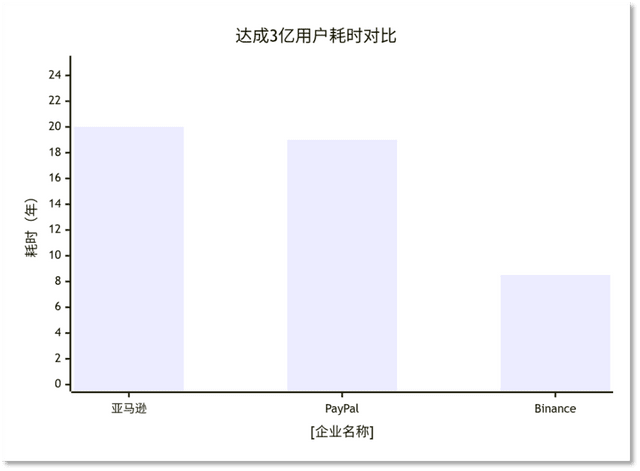
Binance reaches 300 million users faster than Amazon and PayPal.
Notably, most companies with over 300 million users globally are giants from the Web2 era that connect people to people or people to information. Binance has become the first major application to enter this club primarily based on crypto assets and blockchain technology, a 'native Web3' application.
In the field of cryptocurrency exchanges, Binance remains at the forefront. According to the cryptocurrency exchange report published by Token Insight for Q2 2025, Binance ranks first in both spot and derivatives market share at 35.39%, more than double that of the second place.
With the user base surpassing 300 million, Binance continues to consolidate its leading position within the crypto industry. According to estimates from CoinGecko, Singapore payment company Triple-A, and others, the total number of cryptocurrency trading users worldwide is expected to be between 550 million and 600 million. This means that Binance's user base alone exceeds the total number of users from all other centralized exchanges. In other words, 1 in every 2 crypto users globally is using Binance.
Binance's historic breakthrough is also the 'iPhone moment' of the entire crypto industry. The choice of 300 million users from over 180 countries and regions not only recognizes a platform but also fully validates the enormous potential of crypto finance, proving that cryptocurrencies and related financial services are no longer marginal 'geek toys' or speculative tools, but a new category of financial assets and infrastructure that can attract participation from a global scale of users with solid demand.
Five engines drive the 'Binance speed.'
From the growth curve of Binance users, its user growth rate has accelerated over the past 8 years. It took about 5 years to reach the first '100 million,' 26 months to reach the second '100 million,' and only 17 months to reach the third '100 million.' Binance's growth trajectory resembles an increasingly faster 'growth flywheel,' driven mainly by five engines working together.
The first engine is Binance as a 'super product platform,' which has evolved from a single-function 'trading venue' into a one-stop 'digital financial life entry.'
Looking at the Binance ecosystem, it encompasses not only spot and derivatives trading but also C2C entries for multiple fiat currencies, lending, wealth management, Binance Pay, BNB Chain, Web3 wallets, crypto academies, LaunchPool, and more. These product lines form a complete suite of services surrounding crypto assets.
Global users can exchange over 130 fiat currencies for crypto assets through Binance's C2C entry, conduct spot and derivatives trading, invest in steady financial products via Binance Earn, or use Binance Pay for daily payments or merchant settlements. Additionally, by utilizing Web3 wallets and BNB Chain, users can explore the on-chain ecosystem with low thresholds. This 'one-stop' experience meets various demands of crypto users, significantly enhancing user retention and asset accumulation. Binance's official website shows that its customer funds exceed $163.7 billion, ranking first in the industry.
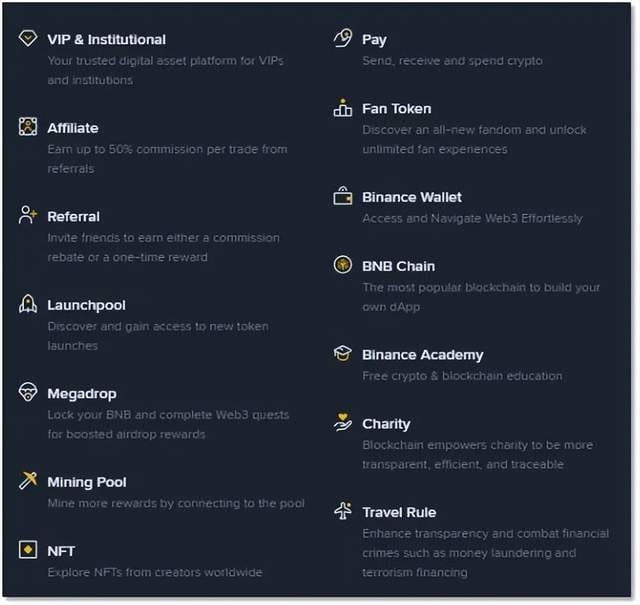
Some products on Binance.
The second engine stems from the innovative economic model centered around BNB established since Binance's inception.
As a platform token, BNB deeply binds the development of Binance with user interests. Users who pay trading fees with BNB can enjoy discounts, creating rigid demand. More importantly, Binance regularly repurchases and destroys BNB with profits, and this deflationary mechanism directly creates value for all holders, allowing users to spontaneously become 'shareholders' and 'promoters' of the platform. Additionally, BNB, as the fuel (Gas) for the BNB Chain ecosystem, extends its value support from exchange operations to a vast array of on-chain applications. This design aligns the fates of BNB holders with Binance and BNB Chain. As Binance grows, BNB has risen from single digits to over a thousand dollars, providing substantial returns for the platform's loyal users.
The third engine is Binance's strategic approach to global operations, adhering to a borderless positioning and deep local penetration.
Since its inception in 2017, which only supported two service languages, Binance has now expanded its supported languages to over 40 and provides 24/7 customer service. However, its globalization is not just simple language translation, but rather 'global exploration, localized actions.'
Among all commercial entities, Binance, which has yet to establish a headquarters, is particularly unique. Perhaps the absence of a headquarters also means that regions around the world can become focal points for business development. Over the years, Binance has precisely targeted multiple high-growth markets within the legal and regulatory framework. In Turkey, it integrated the most popular local payment methods; in Brazil, it connected with the instant payment system Pix; in Africa, it partnered with telecom operators to launch zero-fee transfers. These initiatives address financial pain points such as high inflation, costly cross-border remittance, and lack of banking services, allowing it to rapidly accumulate users.
The diversified market layout leads to highly dispersed user sources, not relying on a single national market. This strategy effectively avoids regional policy risks, ensuring a continuous source of growth.
The fourth engine is that Binance consistently creates growth hotspots through continuous product innovation and long-term user benefits.
Whether it's this year's Alpha airdrop, TGE, or previous models like LaunchPool, Megadrop, and Launchpad, Binance continuously innovates mechanisms to actively cede industry dividends and platform benefits to users, creating a strong new user acquisition effect.
On one hand, through platforms like TGE subscription and Launchpad, ordinary users can participate in early investments of quality projects in a fair manner, creating a tremendous wealth effect, with the launch of each popular project being a large-scale user growth event.
On the other hand, Launchpool and Megadrop support users in staking assets to receive free token airdrops for new projects. This 'zero-cost' mechanism has a strong appeal to incremental users and can effectively stimulate new user engagement.
The fifth engine is Binance's long-accumulated reputation advantage and influential brand presence.
In the uncertain cryptocurrency industry, reputation is the most valuable asset. Binance has long maintained its industry-leading position, making it the default choice for many new users entering the crypto world. This brand trust reveals immense value at critical moments, such as during the FTX exchange crisis in 2022, when Binance was seen as a safer 'safe haven,' leading to a significant increase in net inflows.
In terms of compliance construction, Binance collaborates with global regulators and has obtained compliance licenses in multiple countries. Especially after settling with the U.S. Department of Justice and paying a fine of $4.3 billion in 2023, the platform has raised its compliance efforts to an unprecedented height. Compliance operations have attracted a broader mainstream user base and institutional clients.
A one-stop 'super product' serves as the foundation, the BNB win-win model acts as the adhesive, global operations expand, innovation and benefits serve as the continuous booster, and brand reputation provides security and assurance. These five engines work together to form a powerful driving system, allowing Binance's 'growth flywheel' to spin at high speed.
The warmth of digital finance beyond trading.
When 300 million people flock to Binance, what are they doing? Are there really that many people engaged in cryptocurrency trading? Just as Binance is not merely an exchange, it also serves a multitude of functions in the eyes of different groups.
According to third-party analytics and information revealed by platform executives, Binance has over 40% of its users from developing countries and regions, including Southeast Asia (Vietnam, India, the Philippines), Latin America (Argentina, Brazil, Mexico), and Africa (Nigeria, South Africa, Kenya). In these regions, Binance exists not only as an investment tool but also as an efficient and low-threshold financial instrument.
For the hundreds of millions of migrant workers globally, Binance can be the primary choice for cross-border remittance.
In the past, a Filipino worker doing domestic service in Dubai would pay about $25 in fees to remit $300 to family in Manila through traditional banks, with the money arriving after 3 days. However, through Binance, she can easily convert her fiat earnings to USDT and send it to her family's Binance account with zero fees; upon receipt, her family can convert USDT into Philippine pesos and withdraw it to a local bank account or e-wallet.
The entire process takes only a few minutes and is extremely low-cost. According to World Bank data, the average fee for traditional cross-border remittances is 6.5%, while this method can significantly save costs, allowing for real increases in family living expenses.
In countries where the value of fiat currency is plummeting, Binance can also serve as a 'digital refuge' for ordinary people to protect their savings.
In high-inflation countries like Argentina and Turkey, annual inflation rates often reach 30% to 100%. This means that a regular worker's salary could lose one-tenth of its purchasing power by the following month if kept in a bank. However, with Binance, they can convert their monthly income into stablecoin dollars and, when needing to pay rent, utilities, or shopping, convert back into necessary fiat currency for consumption, protecting their family's wealth from significant depreciation due to fiat currency devaluation.
In underdeveloped regions like Africa and Latin America, Binance acts as the first financial account in the lives of the 'unbanked' population.
Data shows that about 1.7 billion adults worldwide still do not have bank accounts, yet most of them own smartphones. Binance provides them with an entry point for financial services.
Imagine a small vendor named Kiplin in a market in Nairobi, Kenya, who has no fixed business address or stable income proof, making it impossible to meet traditional bank account opening requirements. But with just a smartphone and internet connection, he can register for a Binance account, and then receive payments from customers in other cities or even abroad using cryptocurrency. He can also invest small idle funds through Binance Earn to earn modest returns.
Binance has greatly lowered the access threshold for financial services. This allows people like Kiplin, who were once excluded from the traditional financial system, to safely save money, receive payments, and make transactions for the first time.
In regions with low credit card penetration and incomplete traditional payment infrastructure, Binance supports small transactions and offers flexibility.
A freelance designer in Vietnam provides design services to overseas clients via online platforms, but each project only pays a few dozen dollars. Using channels like PayPal incurs high fees and withdrawal inconveniences. Through Binance, he can request clients to pay in USDT, receiving these small amounts at almost zero cost, and flexibly hold, use, or exchange them. At the same time, he can also use products like Binance Pay for everyday spending without needing to withdraw.
The lively examples above demonstrate the functions and responsibilities Binance presents beyond its 'exchange' attributes. After more than 8 years of development, it has provided a set of globalized, low-cost, permissionless digital financial tools to millions of ordinary people.
Whether it's laborers in the Philippines, employees in Argentina, or vendors in Kenya, they use Binance not for speculation, but to solve real and urgent survival and development issues such as cross-border remittance, wealth preservation, and access to basic financial services. Perhaps this is the fundamental reason why a large proportion of its 300 million users come from developing countries — where cryptocurrency demonstrates a humanitarian warmth that transcends speculation.
Through a super application, Binance meets different levels of demand from investors to practical users, especially in corners where traditional finance fails, creating a brand new, inclusive digital financial infrastructure. This construction method leads Binance and the future of crypto finance towards broader soil, and its fourth '100 million' users may arrive even faster.
(Disclaimer: Readers should strictly comply with the laws and regulations of their location; this article does not constitute any investment advice.)
