
In the cryptocurrency world, you need to find a way to earn 1 million in capital. The only way to grow from tens of thousands to 1 million is through rolling positions.
Once you have 1 million in capital, you will find that life seems to be different. Even if you don't use leverage and just hold a spot that rises by 20%, you will have 200,000, which is already the income ceiling for most people in a year.
Moreover, when you can grow from tens of thousands to 1 million, you will grasp some ideas and logic for making big money. At this point, your mindset has also calmed down a lot, and from then on, it's just copy and paste.
Don't always think about tens of millions or even billions; start from your actual situation. Bragging only makes the braggers comfortable. Trading requires the ability to recognize the size of opportunities; you can't always have small positions nor can you always have large positions. Usually, just play with small guns, and when a big opportunity comes, then bring out the heavy artillery.
For example, rolling over positions is something you can only do when a big opportunity comes along. You can't keep rolling over positions. It's okay if you miss out, because you only need to successfully roll over positions three or four times in your lifetime to go from zero to tens of millions. Tens of millions is enough for an ordinary person to become a wealthy person.
The concept of rolling over positions itself is not risky; in fact, it's one of the most correct approaches to futures trading. The risk lies in leverage. You can roll over with 10x leverage, and you can do it with 1x leverage as well. I usually use 2x or 3x leverage, and if you catch it twice, you can still achieve dozens of times the return. At the very least, you can use 0.x leverage. What does this have to do with rolling over positions? This is clearly a matter of your own choice of leverage. I have never told you to trade with high leverage.
Furthermore, I have always emphasized that in the crypto market, you should only invest one-fifth of your money in crypto trading, and only invest one-tenth of your spot money in futures trading. At this point, the funds in futures trading will only account for 2% of your total funds. At the same time, you should only use two or three times leverage in futures trading, and only trade Bitcoin+. This can be said to reduce the risk to an extremely low level.
The following are the instructions for rolling over positions:
●Adding to a position after achieving a floating profit: You can consider adding to your position after achieving a floating profit. However, before adding to your position, you need to ensure that your cost basis has been lowered to reduce the risk of loss. This does not mean blindly adding to your position after achieving a profit, but rather doing so at the right time.
●Core Position + T+0 Rollover: Divide your funds into multiple parts, keeping a portion as a core position while using the remaining portion for buying low and selling high. The specific proportions can be chosen based on your risk tolerance and capital size. For example, you can choose to use half a position for T+0 rolling, 30% of the core position for T+0 rolling, or 70% of the core position for T+0 rolling. This approach can reduce holding costs and increase returns.
In my opinion, the "appropriate time" in the definition mainly has two meanings:
1. Add to your position during a breakout from a consolidation pattern, and then quickly reduce your position once the breakout occurs and you capture the main upward wave.
2. Increase trend-following positions during pullbacks in a trending market, such as buying in batches when prices pull back to the moving average.
There are several ways to roll over positions, the most common being through position adjustments. Traders can gradually reduce or increase their positions based on market changes to achieve profitability. Traders can also use trading tools such as leverage to amplify returns, but this also increases risk.
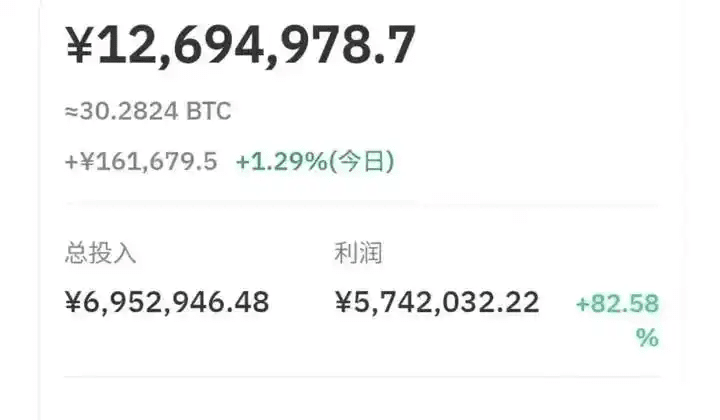
I've been trading cryptocurrencies for over ten years now. From being liquidated to achieving financial freedom and supporting my family through cryptocurrency trading, my capital increased 50 times in 2024. If I hadn't withdrawn funds twice to buy houses, it would have increased 85 times.
The above method was also tested with a small account: a principal of 50,000 reached 10 million.
Having spent many years navigating the cryptocurrency market, I have developed a set of effective investment strategies.
These ironclad rules apply not only to novices but also to veterans, helping them stay clear-headed and achieve stable returns in complex market environments.
1. Fund Management: Act with Caution and Diversify Risks
Focus on one coin with less than 100,000: When funds are limited, concentrate on holding one potential coin and conduct in-depth research on its fundamentals and technical aspects.
With 200,000 to 300,000, try two cryptocurrencies: When you have a little more capital, you can diversify your funds across two cryptocurrencies to reduce the risk of relying on a single currency.
For funds under 500,000, three to four are sufficient: When funds increase further, hold a maximum of three to four cryptocurrencies to avoid excessive diversification.
No matter how much capital you have, don't hold more than five cryptocurrencies: Regardless of the amount of capital you have, don't hold too many cryptocurrencies to avoid management difficulties.
Concentrate your resources in bull markets and manage your positions lightly in bear markets: During bull markets, concentrate your funds on investing in the most promising cryptocurrencies; when the market is unfavorable, operate with light positions to reduce losses and be able to withdraw in time if you incur losses.
2. Trend is King: Follow the market, don't go against it.
Watch the news and learn the techniques: Understand market dynamics and technical indicators to improve your investment success rate.
A rebound after a decline is often a trap, and a pullback after an uptrend may be a pitfall: do not blindly buy the dip or chase the highs, but follow the trend.
Don't try to guess what the major players are thinking: the actions of market makers are difficult to predict, so focus on your own investment strategy.
3. Act only when the market is bustling; respond flexibly.
Act when the market is active: When the market is hot, investors are in a positive mood and are more likely to seize opportunities.
Flexible operation, not rigid: Adjust strategies in a timely manner according to market changes, and do not stick to old models.
4. Stop-loss and take-profit: Protect principal and lock in profits.
Set a fixed stop-loss point: Stop losses in time when incurring losses to avoid greater losses.
Gradually increase the selling price: When profitable, gradually increase the selling price to ensure that profits are not lost.
5. Buy fast and sell fast: Make decisive decisions and avoid hesitation.
Buy quickly: When you spot an opportunity, buy decisively to avoid missing out.
Sell decisively: Sell when you reach your target or when the market turns around to avoid losses caused by greed.
6. Think carefully before adding to your position.
Ask yourself honestly: Before adding to your position, consider whether you are willing to invest new funds under the current circumstances. If the answer is yes, then consider adding to your position.
7. Focus on long-term strategies, supplemented by short-term strategies.
Avoid frequent short-term speculation: Short-term trading can easily lead to a loss of direction and affect one's mindset.
Follow the trend: Large sums of money should follow market trends and hold promising cryptocurrencies for the long term.
8. Avoid blindly buying at the bottom; approach the market rationally.
A large drop does not mean it's time to buy the dip: When the market falls sharply, it does not necessarily mean that the bottom has been reached, and blindly buying the dip may result in further losses.
Few people make money in the market: Only a small number of people can truly make money in the market. Stay rational and don't blindly follow the crowd.
A major bull market is not only a test of market fluctuations, but also a test of investors' mentality. Staying calm and adhering to the aforementioned ironclad rules are essential for steady progress through bull and bear market cycles and ultimately achieving wealth growth.
In the crypto world, it all boils down to a battle between retail investors and market makers. If you don't have exceptional technical skills, you'll only get fleeced! If you're interested in strategizing together and profiting from market manipulation, follow me. Welcome to discuss crypto with like-minded individuals!
Enough with the chit-chat!
I'm sharing my trading strategies and insights with my friends. There's a saying, "Standing on the shoulders of giants can save you ten years of struggle." If you happen to see this and want to improve your cryptocurrency trading skills, be sure to read it carefully, study it thoroughly, and I recommend saving it!
When trading cryptocurrencies, one should view the market with a developmental perspective, which is the state of Wuji (the ultimate void).
How should this sentence be understood?
In layman's terms, it means whenever you have time, you can open your computer and check if you can place an order to make some money.
For example, I'll randomly open a trend chart now, without any prior preparation. I don't have any trend cycle or trading cycle in mind; I just want to make a quick in-and-out trade, like a quick profit on a five-minute chart. So, I'll open a five-minute chart randomly, as shown in the image.
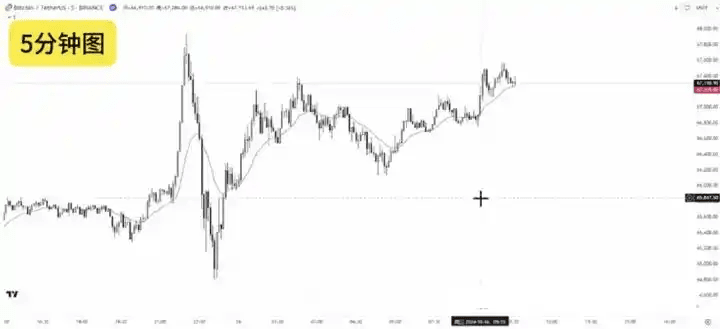
(Figure 1)
If I consider five minutes as my trading cycle, I'm now going to open a 20-minute trend cycle to see what the market is doing! (Figure 2)
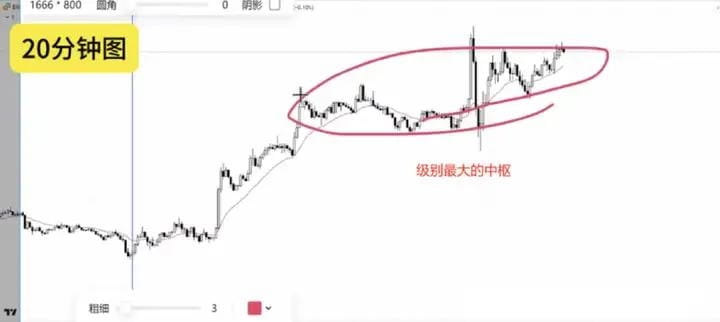
As shown in the diagram above, if we cut along the blue line, the circled area represents the largest consolidation zone. The specific level of the upward movement is irrelevant. My focus now is on following this trend!
It will either fall or rise and break through the previous high. So now I'm looking at the five-minute chart to see if it will give me an opportunity to go long after the fall.
As shown in the image below, a less-than-ideal entry candlestick pattern appeared (Figure 3), so I abandoned the trade.
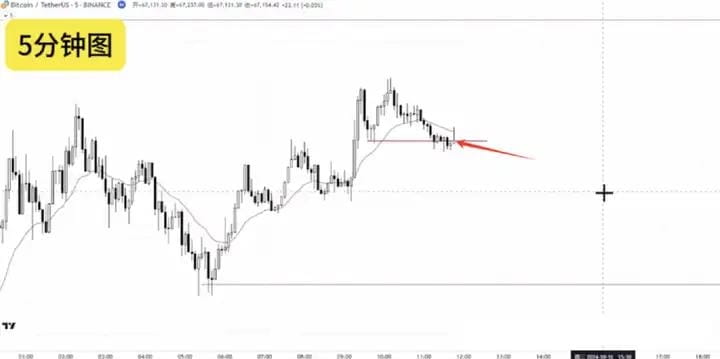
(Figure 3)
We continue to wait for a signal that the support level is valid again. Then I think there's a small double bottom here, and this decline may be over.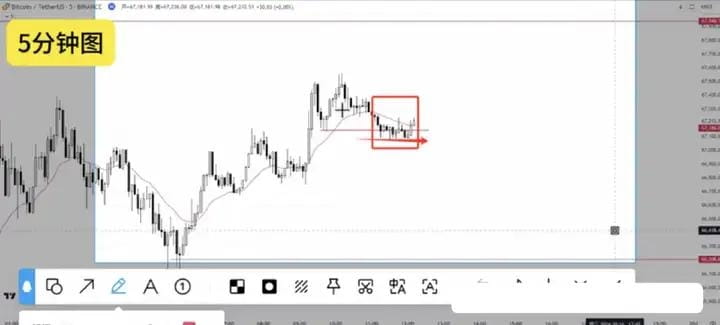 (Figure 4)
Then, if I hit the stop loss, I'll just buy again at the lower price. So I'll enter the market directly here. If I hit the stop loss, it's okay, I can place my T1 order here, my T2 order here, or even my T1 order can go directly to the previous high.
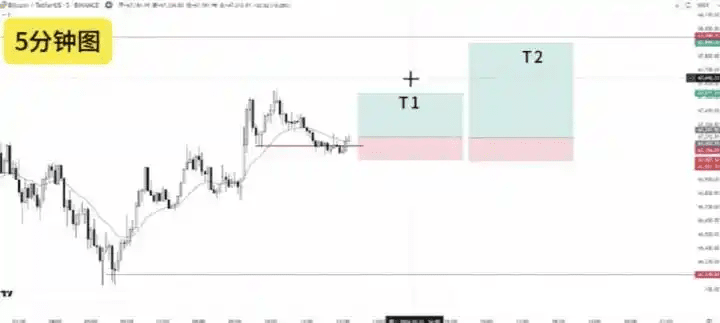
(Figure 5)
Then we'll see how it goes next. It's okay if the stop-loss was triggered. Now I want to prepare for another revenge trade—but this current pattern looks like a morning star, but it didn't actually break the high of the first candlestick, right?
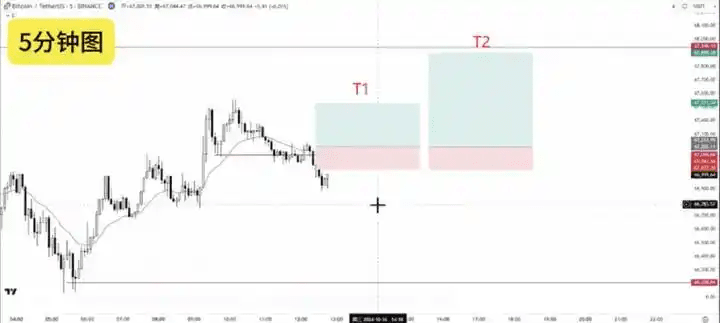
(Figure 6)
We say that a good morning star pattern is when the third (E) candlestick breaks through the high of the preceding candlestick. This is similar to how, when we learn about fractal patterns, we call top reversal patterns and bottom reversal patterns "good-looking top reversal patterns."
If a bottom reversal pattern breaks through the high of the first candlestick, then for a top reversal pattern to ideally break through the low of the first candlestick on the third candlestick, it should break through. Since it didn't break through, I think I'll wait and see.
This point is indeed a potential buy, but the signal candlestick pattern and entry candlestick are not up to par. Since it's a revenge move and we only have one bullet left, we must be cautious. I'll wait patiently then.
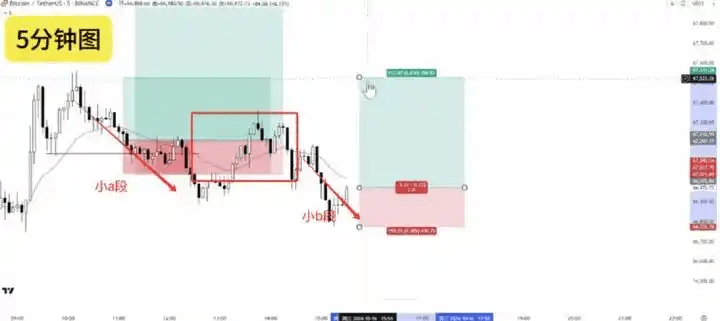
(Figure 7)
Okay, let's see a piercing pattern here. The high 1 point of the doji is invalid, let's continue. Here, the signal is still relatively strong because it can be seen as a modified engulfing pattern. Most importantly, this divergence is just too good to pass up, as shown in the picture. Because this is the largest level of consolidation, this is segment A, this is segment B, so we decided to complete the revenge here.
The profit-taking plan remains the same as before: 22.8, and the next level up is this position. Then, we proceed with our revenge plan. (See the diagram below) Take profit on T1, and also on T2.
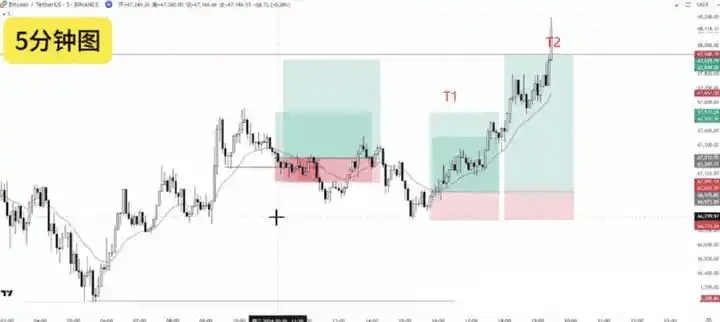
(Figure 8)
So you see, from the moment we started preparing to place our first order, which was at 12 o'clock, or from the moment we started monitoring the market at 11 o'clock, to the moment the actual trade was closed and the profit was secured, reaching the take-profit target on both T1 and T2 at 7:30 pm, it was less than 8 hours!
This means I can open the trading screen whenever I have time. Today, I have some free time, so I'll just turn on the screen and check the trading board on my computer to see if I can make some money!
Therefore, there is no such thing as following the trend or going against the trend. I just take profits on whichever segment I see. This is the state of having no levels. I don't have any trend cycles or trading cycles. This is about looking at the market with a developmental perspective, which is the state of Wuji. This is the first explanation.
Another interpretation is to examine your current position from a trend-following perspective to maximize profits. So, how do you examine your current position from a trend-following perspective?
Examine your current holdings from a trend-following perspective to maximize profits.
How exactly should we understand this? Let's take an example:
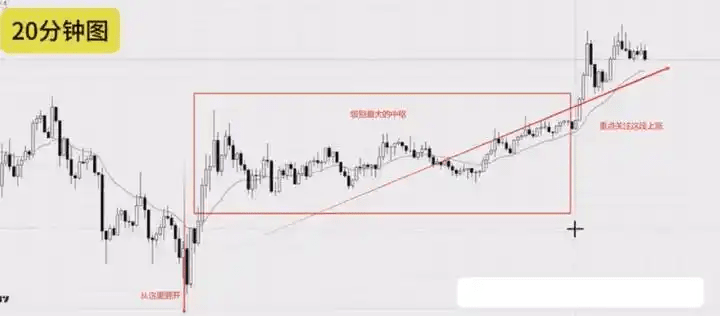
For example (as shown in the image above), this is a 20-minute chart for Bitcoin, and the 20-minute chart is currently my trend cycle. Looking at the correlation coefficient, let's split it open from the left; our focus now is on the upward movement at this level.
So the largest consolidation zone in this upward trend is this consolidation zone. Obviously, this upward trend is not on a 20-minute chart; it must be longer than 20 minutes.
Therefore, the first step ensures that this is greater than or equal to the current cycle.
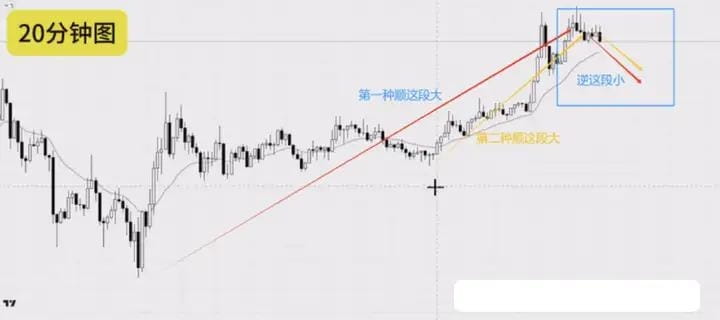
We have two options: one is to follow the trend of the red arrow (smaller than the red arrow), or the other is to follow the trend of the yellow arrow (larger than the yellow arrow). Either way, we need to reverse the downward trend indicated by the arrows.
So our current goal is clear: to find the end point of this downward trend marked by the blue box in the trading cycle, and then enter a long position, hoping that the trend leg 1 is not equal to leg 2. Our defensive position is the central pivot below.
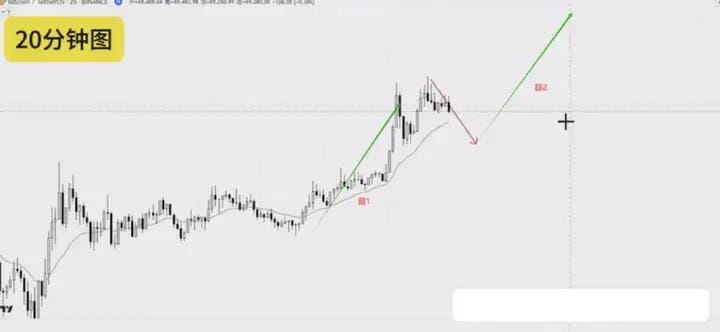
Next, we move on to our five-minute chart. Since we are now confirming the timeframe, the bias from the 20-minute chart is bullish, so we are focused on going long and observing whether this decline is over. When a very good engulfing pattern appears, add a high of 1.
Let's see if there's a divergence in this decline. If there is, then we decide to enter the market. If there's a stop loss, we can place another order below, right? Then, the T1 take profit is placed here, and the T2 take profit is the leg 1 equal to leg 2 that we just measured.
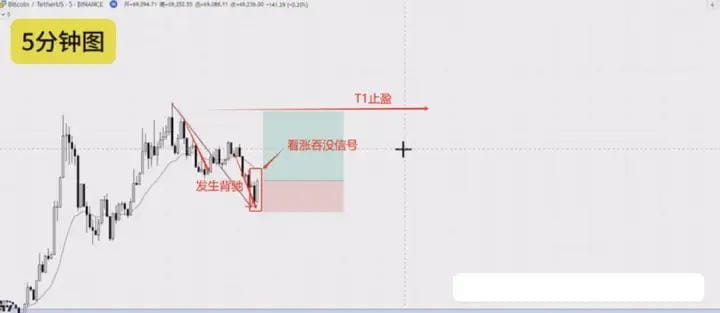
However, we now need to take a developmental perspective, a perspective without hierarchical limitations, to maximize profits. Therefore, we won't set T2 or T1; after taking profit, we'll keep a small initial position. We'll exit when the market completely reverses. After entering the market, we'll observe subsequent market movements and take profit if the market moves smoothly.
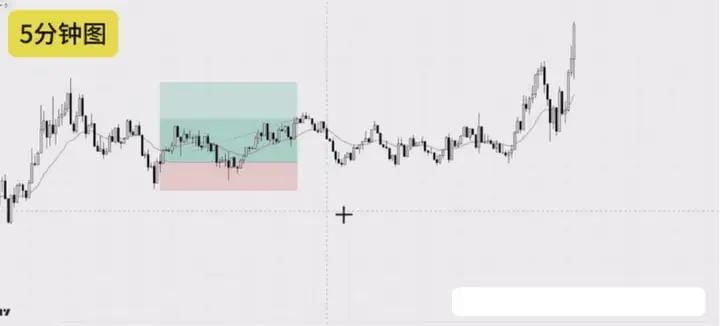
After taking profit, we shouldn't adjust our stop-loss order yet, because what we need to examine now is this newly initiated upward trend, which is still quite healthy. Furthermore, its largest consolidation zone is located here (as shown in the diagram below).
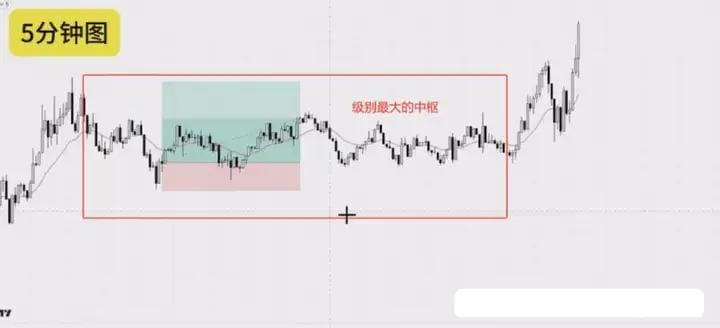
As long as this central pivot point is not broken, and even if it is not broken, it still has the potential to continue to grow upwards, so we still place our stop loss at this position, marked in red. Then we take profit on T1, and we exited 50% or even 70% of our position, leaving only a small portion as the base position.
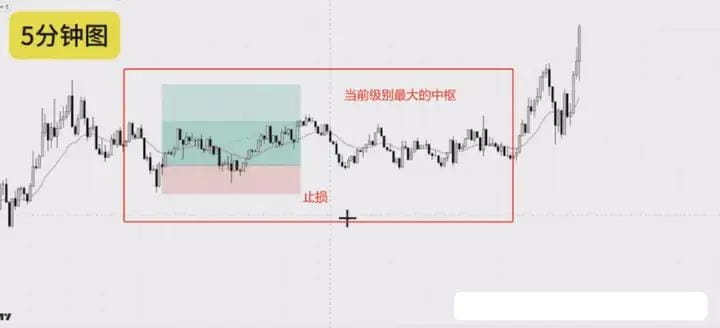
As I've said many times, the initial position isn't actually for making money; it's for lowering the average price and strengthening our holding mentality. Then, as the price continues to rise, we examine whether there's potential for further growth.
Good news. Please note that this price level has actually been broken. In other words, for short-term trading, this has already triggered the stop-loss order.
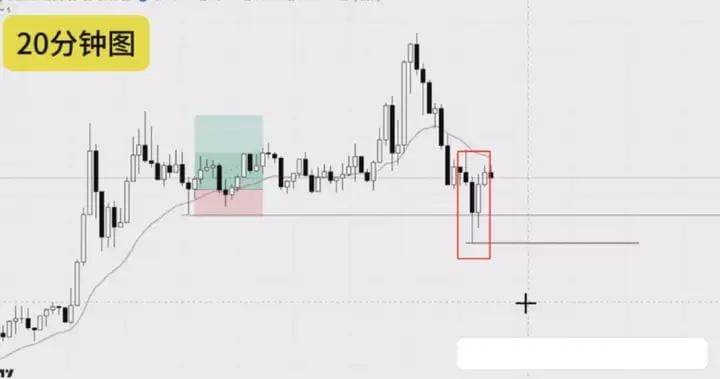
However, we can determine if a downward break below the largest consolidation level constitutes a genuine breakout of the bullish reversal. Here, "breakout" refers to a genuine breakout, but in the current situation, it's merely a false breakout.
Therefore, our key focus should be on whether it will actually break through. If it does, then this upward trend may truly be over, because all three price action patterns have already formed!
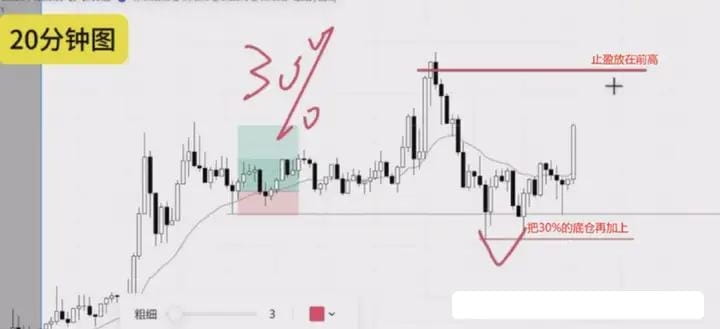
The price continues to rise without breaking through. If we still have our initial 30% position, we could add another 70% at this point (as shown in the chart above), aiming to capture the previous high, or even higher. Then, if the situation turns unfavorable, we can reduce the remaining 70% position and sell it off.
This means viewing the market from a growth perspective, with a developmental viewpoint. All I need to know is that the level I'm currently examining hasn't reached its end, hasn't reversed, and hasn't reached its final stage. That's enough.
The above describes the so-called state of Wuji (the state of nothingness). This is the highest level of technical analysis and trading, and the height we constantly strive for. However, I don't recommend beginners study or obsess over this. It's good enough to first understand the golden combination of trend cycles and trading cycles.
Here, I'd like to extend another of my golden rules: Rule number ten, take profit on long positions with upper and lower dense trading zones, and take profit on short positions with lower and upper dense trading zones. In other words, take profit on long positions with the lower boundary of the previous densely traded area above, and take profit on short positions with the upper boundary of the previous densely traded area below.
Someone once said that this single sentence of mine is worth a million dollars; it's incredibly useful. How do you understand this sentence? Open any chart. For example, if I see a double bottom and want to go long, the previous area of dense trading volume is the area circled in this box (see the image below). The lower boundary of that previous area of dense trading volume is the horizontal line. So, if I go long at the circled area, my take-profit order is at the lower boundary of the previous area of dense trading volume.
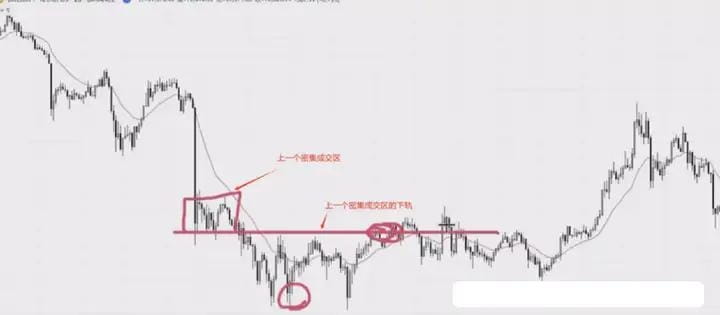
Here you see, the market didn't rise much further. You took profits here first, then it just hovered around this point. Holding this position must have been very uncomfortable, so it's better to exit here, right? Or reduce your position. The logic for shorting is the same. Which area of dense trading volume corresponds to this?
That's the upper rail of the previous densely traded area, which is your take-profit level for shorting. You see, the market hit its take-profit level right there, and then there was a significant pullback, even resulting in a stop-loss order being triggered, right?
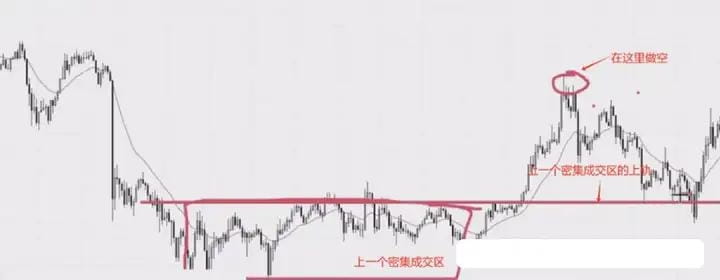
So you're losing money because you don't know how to take profits. This profit-taking rule is truly invaluable and incredibly useful.
In essence, this market principle conveys the same meaning as "the moon wanes when it's full" and "water overflows when it's full": cultivate the good habit of taking profits and not being overly greedy. Don't try to earn the last penny; be generous with profits and moderate with losses. This is the principle of taking profits when going long, with upper and lower limits; and taking profits when going short, with lower and upper limits.
I lost everything in my first two years of cryptocurrency trading, but then made a profit in the next five! Through trial and error, I've summarized eight ironclad rules. They're short but contain a lot of valuable information. If you think they don't make sense after reading them, feel free to say whatever you want!
1. Divide your funds into 5 parts, and only invest one-fifth at a time! Control your stop loss at 10 points. If you're wrong once, you'll only lose 2% of your total capital. If you're wrong five times, you'll only lose 10% of your total capital. If you're right, set a take profit of more than 10 points. Do you think you'll still be trapped?
2. How to further improve your win rate? Simply put, it's about following the trend! In a downtrend, every rebound is a trap for buyers; in an uptrend, every drop creates a golden buying opportunity! So, is it easier to make money by buying at the bottom or buying low?
3. Avoid cryptocurrencies that have experienced a rapid, short-term surge, whether mainstream or altcoins. Very few coins can sustain several major upward waves. The logic is that it's difficult for a coin to continue rising after a short-term surge. When prices stagnate at a high level, they can't be pushed up further and will naturally fall—a simple principle, but many people still want to gamble.
4. MACD+ can be used to determine entry and exit points. If the DIF line and DEA form a golden cross below the zero axis and break through the zero axis, it is a solid entry signal. When the MACD forms a death cross above the zero axis and moves downward, it can be regarded as a signal to reduce positions.
5. I don't know who invented the term "averaging down," but it has caused countless retail investors to stumble and suffer huge losses! Many people average down as they lose, only to lose more – this is the most taboo thing in cryptocurrency trading, putting themselves in a dead end. Remember, never average down when you're losing; only add to your position when you're winning.
6. Price indicators are paramount, but trading volume is the soul of the cryptocurrency market. Pay attention when the price breaks out from a consolidation low, and decisively exit when there is high volume but stagnant price at a high level.
7. Only trade cryptocurrencies in an upward trend. This maximizes your chances of success and saves time. A 3-day moving average turning upwards indicates a short-term uptrend; a 30-day moving average turning upwards indicates a medium-term uptrend; an 84-day moving average turning upwards indicates a major uptrend; and a 120-day moving average turning upwards indicates a long-term uptrend!
8. Insist on weekly review sessions to check if the rationale for holding cash has changed, technically examine the weekly candlestick chart to see if it aligns with your initial assessment, and whether the trend has shifted. Adjust your trading strategy promptly based on these reviews! #BTC
In the crypto world, it all boils down to a battle between retail investors and market makers. If you don't have exceptional technical skills, you'll only get fleeced! If you're interested in strategizing together and profiting from market manipulation, follow me. Welcome to discuss crypto with like-minded individuals!

