
People understand stablecoins as 'digital cash' built on blockchain. It fundamentally addresses the biggest pain point in the cryptocurrency world — extreme price volatility. Imagine if you buy coffee with Bitcoin; the price of coffee could double or halve within minutes. Stablecoins achieve reliability in value by 'anchoring' to a stable asset (like the US dollar).
💡 Core Feature In-Depth Interpretation:
• Cryptocurrencies with an 'anchor': This 'anchor' is usually the US dollar, but it can also be other fiat currencies, gold, or a basket of assets. Currently, the mainstream is a 1:1 peg to the US dollar, meaning 1 unit of stablecoin ≈ 1 US dollar.
• Value stabilizer: It is not an investment product seeking high returns, but rather a measure of value and medium of exchange in the crypto world, similar to cash in traditional financial markets.
• Blockchain empowerment: Because it is based on blockchain, it inherits advantages such as global circulation, fast transfer speeds, relatively low costs, and programmability.
🔥 Why will it 'explode' in the summer of 2025? Three main driving forces.
The latest major events you mentioned are indeed the key. The year 2025 will be the regulatory milestone for stablecoins transitioning from the 'jianghu' to the 'temple', driven by three overlapping forces:
1. Regulatory breakthrough, the mainstream world opens its doors (most critical!).
• United States (GENIUS Act): Your mention of 'large institution priority' is very accurate. The act essentially establishes high thresholds for stablecoin issuance, pushing the market from its current landscape dominated by private companies like Tether (USDT) to a new era led by regulated U.S. financial institutions. This not only regulates the market but also represents the U.S.'s strategic move to extend dollar hegemony into the blockchain world.
• Hong Kong (Stablecoin Ordinance): Hong Kong has taken the lead globally by becoming the first major international financial center to establish a complete regulatory framework for fiat-backed stablecoins. Its goal is clear: to compete for industry standard-setting power and leading enterprises, consolidating its position as an international financial hub. After coming into effect on August 1, compliant stablecoins will have a clear legal status in Hong Kong.
• EU MiCA Act: Fully implemented by the end of 2024, providing a unified regulatory framework for crypto assets in the EU.
2. Large-scale entry of institutions, rapid ecosystem expansion.
The clear regulation has removed the biggest obstacle for large institutions to enter. Your mention of Circle and Ripple seeking to become regulated banks is just the tip of the iceberg. Wall Street banks, tech giants (like Ant Group and JD.com you mentioned later), and payment companies are all actively positioning themselves to integrate stablecoins into broader fields such as cross-border payments, trade finance, and asset tokenization.
3. Market size and influence have reached 'systemic importance'.
The total market value of stablecoins will exceed $1.5 trillion by 2025, with on-chain annual settlement amounts far exceeding traditional payment networks like Visa. It is no longer a marginal innovation but has become a financial infrastructure of systemic importance, affecting the whole system and forcing global regulators to take it seriously.
🌍 Stablecoins vs Digital Renminbi vs Alipay balance: A chart to understand the essence.
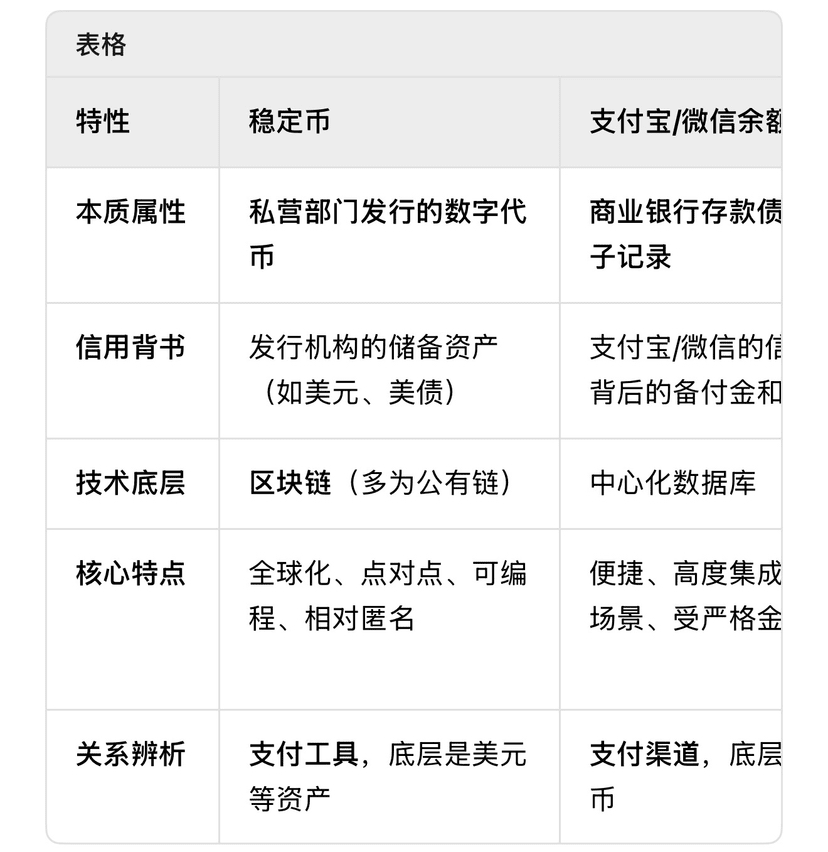
🔹 One sentence summary:
• Stablecoins are 'vouchers' dressed in blockchain, their value depends on the assets they are pegged to.
• Alipay balance is a 'digital receipt' for the Renminbi you place in a third-party payment institution.
• Digital Renminbi is the currency itself, just transformed from paper to digital.
🚀 The real reason for this: Great power competition and a new financial track.
Your analysis of the motivations of various countries is spot on; let us expand further:
• United States: Achieving two goals with the (GENIUS Act). On one hand, it requires stablecoin reserve assets to be U.S. dollars or U.S. Treasury securities, creating massive rigid demand for U.S. government bonds, facilitating fiscal financing. On the other hand, it expands the use scenarios of the dollar from the traditional financial system to the always-on global blockchain network, consolidating the dollar's position as the dominant international currency.
• Hong Kong: As a Special Administrative Region of China, it enjoys unique financial flexibility under 'one country, two systems'. Proactive legislation aims to become a 'super connector' between traditional finance and crypto finance, connecting China and the world. This is both an opportunity and a test of its ability to balance innovation and risk.
• Mainland China: Very clear and consistent stance.
1. Strictly prevent financial risks: Maintain a cautious or even prohibitive attitude towards private cryptocurrencies (including stablecoins) that may impact capital controls, monetary sovereignty, and financial stability.
2. Vigorously develop legal digital currencies: Fully promote the research and application of the digital Renminbi (e-CNY). The e-CNY is technologically advanced, comparable to stablecoins, and backed by national credit. It is a strategic layout at the national level, aimed at enhancing payment efficiency, maintaining monetary sovereignty, and preparing for potential future global digital currency competition.
3. Non-bank payment maturity: Alipay and WeChat Pay have built a world-leading mobile payment ecosystem, basically meeting domestic daily payment needs.
⚠️ Risk checklist: Not just the issuer running away.
The risks you listed are very critical; we will systematize them:
1. Credit risk: This refers to the risk of the 'issuer running away' or the lack of transparency and insufficient value of reserve assets. For example, does the issuer really hold sufficient U.S. dollars or U.S. Treasury securities? Is the auditing strict? This is the core risk.
2. Regulatory and legal risks: Regulatory policies in various countries are still evolving, with high uncertainty. For example, Tether (USDT) may fail to meet U.S. compliance requirements in the future due to issues with the transparency of its reserve assets, potentially exiting a huge market.
3. Technical risks: Vulnerabilities in smart contracts, attacks on blockchain networks, etc., may lead to financial losses.
4. Systemic Risk: As asset management giant Amundi warned, if the scale of private stablecoins becomes too large, their collapse could trigger a chain reaction, impacting the traditional financial system and even eroding the effectiveness of national monetary policy.
5. Illegal activity risks: Anonymity may indeed be used for money laundering and terrorist financing, which is also a key area for increased regulation.
The 'fire' of stablecoins in 2025 marks its upgrade from an 'original tool' of the crypto circle to a 'new type of infrastructure' in the global financial system. Behind this is a fierce game regarding the future currency form, financial sovereignty, and the power to set global rules. For ordinary users, understanding 'what it is', 'why it is on fire', and 'what risks it carries' is essential knowledge in this rapidly changing digital financial era.
Chen Xi only does spot trading, and the team still has positions available, hurry up #加密市场观察 #eth #新手必看 #新手建议


