
Some expressions in the world of finance seem to have turned into simple clichés to fill gaps in the videos and articles of any content creator.
Phrases like "don't invest money that you can't afford to lose" or "the first rule is not to lose money, the second is to remember the first" we have heard so many times that they have almost lost their meaning.
For me, one of the few that really makes sense is this; having a clear strategy and above all a long-term one.
The problem is that most small investors do just the opposite:
they only look at the short term, get dragged by the day-to-day noise, and make impulsive decisions without a defined plan.
In this article, we are going to try to do the opposite:
see what is really happening with the price of Bitcoin, what sense it makes to talk about targets like $150,000 for 2025, and, above all, how a long-term view can help you avoid making the same mistakes that retail or small investors without strategy make.

📉 Healthy correction or end of the bull cycle?
When the Bitcoin price corrects sharply, the same question almost always arises:
"Has the bull market ended or is it just a breather before continuing to rise?"
To try to answer it, we must first separate short-term noise from long-term structure. In the short term, we see aggressive candles, liquidations in futures, fear on social media, alarmist headlines, and a general feeling of panic.
In contrast, when we zoom out and look at the long term, what really matters is that the fundamentals of Bitcoin remain the same as always: a limited supply, an increasingly robust network, and adoption that continues to grow, both at the user and institutional level.
From this perspective, many analysts interpret the recent drop as a phase of consolidation after months of almost vertical rises. In other words, a necessary pause to "clean" excess leverage, euphoria, and late entries from people who were just chasing the latest market movement.
Others, on the other hand, fear that we are witnessing the beginning of a prolonged bear market. Their argument is supported by the fact that after each major bull cycle, the BTC USD pair usually experiences deep corrections and long periods of sideways movement, during which the price seems dead for months.
The reality is that no one has a crystal ball and it cannot be known with certainty at what exact point in the cycle we are.
What is within your control is how you position yourself: whether you act like a nervous trader who only looks at the five-minute chart or like someone who understands that, even when the price of Bitcoin drops, they see the opportunity to accumulate more satoshis.
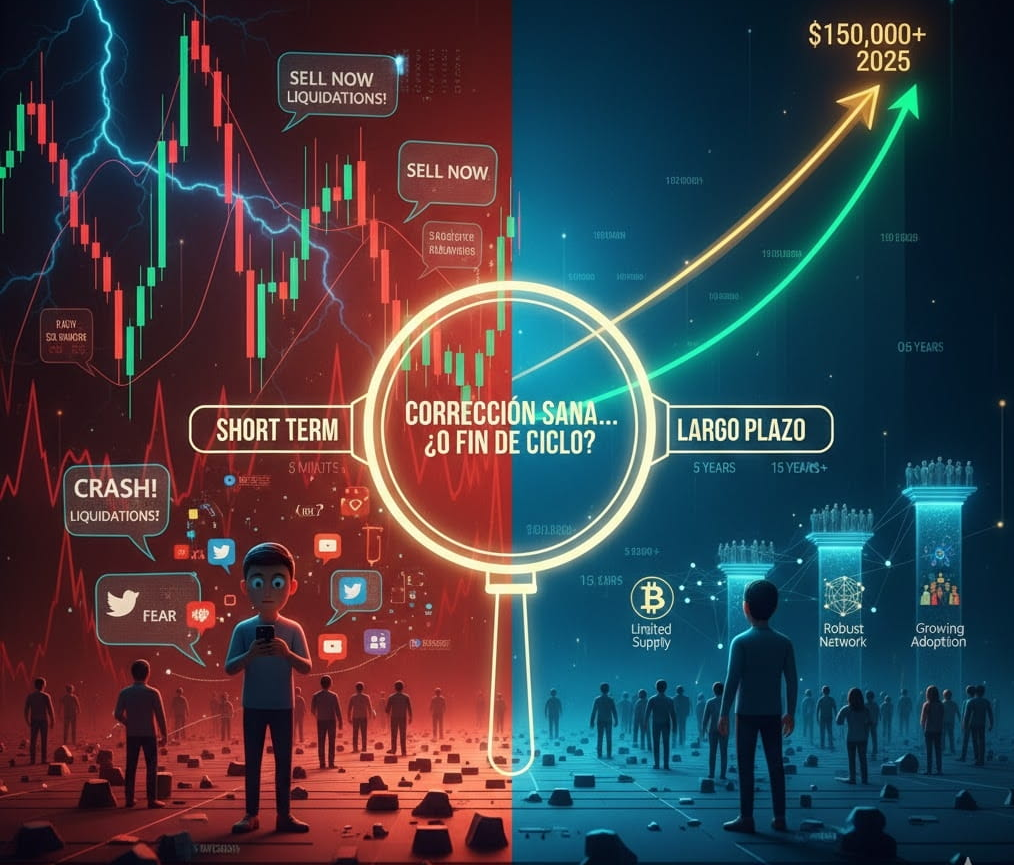
In the end, the problem is not so much whether Bitcoin corrects by 30% more or 30% less, but from what horizon you are looking at it.
Those who build a vision and a strategy for 5, 10, or 15 years see these phases as a natural part of the path and adapt their strategy instead of constantly improvising and ultimately losing money with it.
And it is precisely with that long-term view that it makes sense to continue analyzing whether it is logical to talk about Bitcoin in six-figure zones looking towards 2025.
Does it make sense to talk about a Bitcoin at $150,000 in 2025?
Talking about a Bitcoin at $150,000 may sound very optimistic if you only look at the graph of the last few weeks, but it starts to make more sense when you see it from historical behavior and its fundamentals.
In previous cycles, after each halving, the Bitcoin price has experienced very aggressive expansion phases, in which it has multiplied several times from its previous highs. This does not guarantee that history will repeat itself exactly the same, but it does give us a reference: Bitcoin tends to move in large ranges, both upwards and downwards.
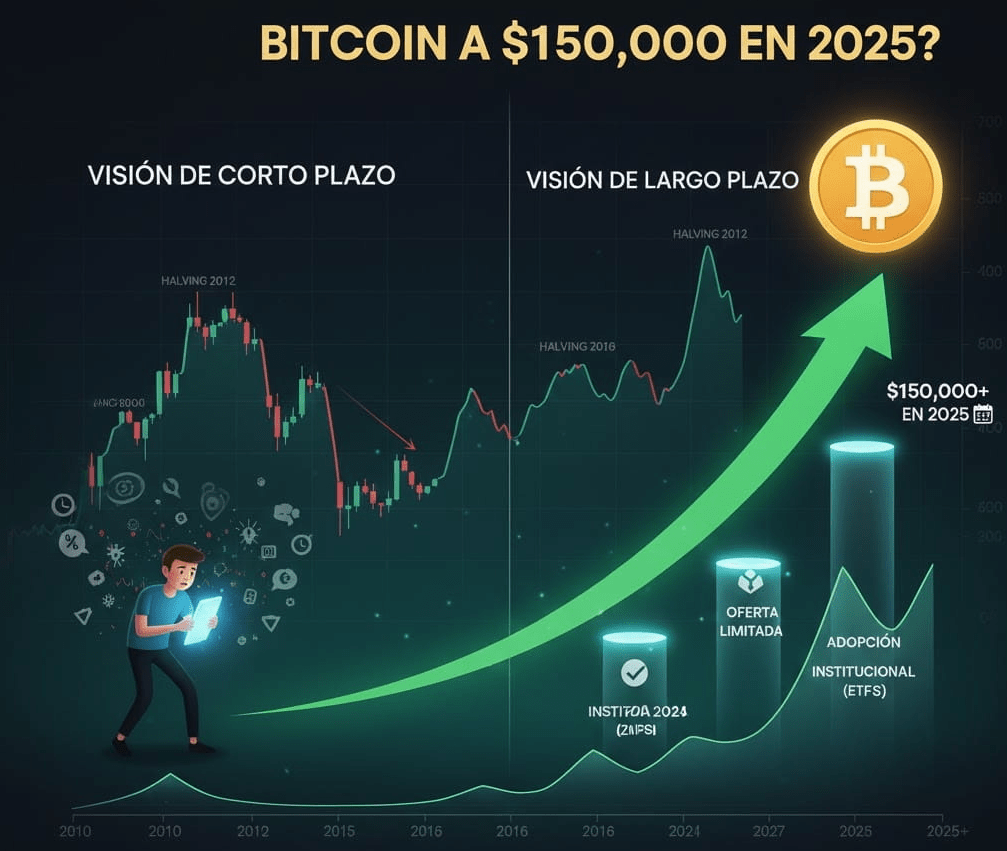
The most convinced bulls, like Michael Saylor and other advocates of BTC as "digital gold," rely on several arguments:
The supply of Bitcoin is limited and known in advance.
There are more and more regulated products (ETFs, institutional vehicles, professional custody) that make it easier for new capital to enter.
Adoption is advancing both at the retail and institutional levels, and more and more people understand the value of having part of their wealth outside the traditional financial system.
If you look at this with perspective, that is when it makes sense to ask questions like:
"Where could the Bitcoin price be in 5 or 10 years if adoption continues to grow at the current pace?"
It is quite different from the typical obsession of refreshing the BTC/USD pair every five minutes to see if it has risen by 2% or fallen by 3%.
It also helps a lot to look back:
If you compare how much 1 bitcoin was worth against the euro ten years ago with its current price, the debate stops being whether it will correct a bit more or a bit less this month, and becomes whether you are playing the short-term game or the long-term game.
Is it safe to say we will see $150,000 before the end of 2025? No.
Is it an impossible scenario within the logic of Bitcoin and its cycles? Not at all.
The difference lies in how you use it in your strategy: as a promise to cling to... or as just a simple scenario within a broader and more realistic plan.
📊 How to expose yourself to Bitcoin without depending on predictions?
Beyond the eye-catching headlines about price targets, what really makes the difference in your results is not whether you guessed a number, but how you manage your position over time.
One of the most common strategies among those who think long-term is DCA (Dollar Cost Averaging), or in other words: investing a fixed amount periodically, regardless of whether the market is rising or falling. This way, you stop trying to guess the perfect bottom of the Bitcoin price and focus on building a position calmly.
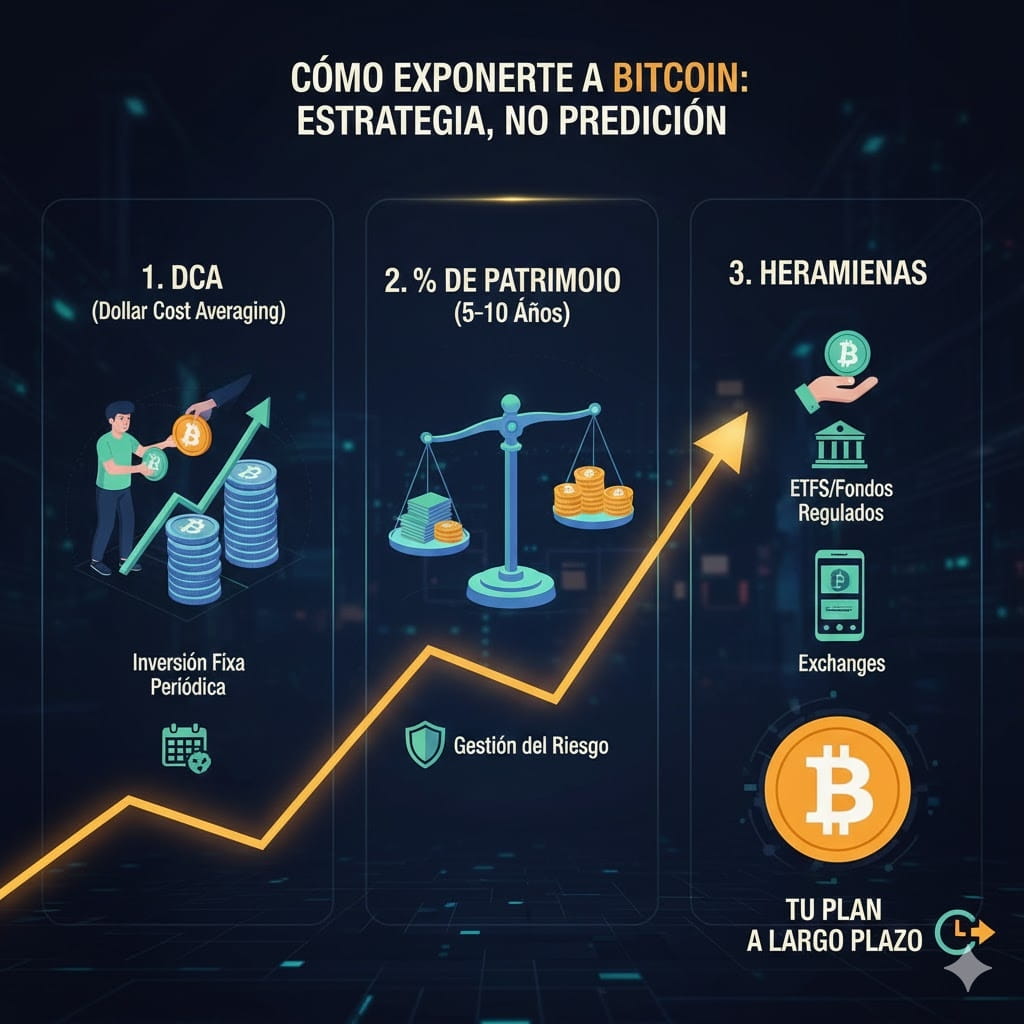
Another key piece is deciding what percentage of your wealth you want to allocate to Bitcoin. It is not the same for someone who puts 5% of their savings into BTC, thinking long-term, as for someone who enters with all their capital because they saw a video promising "the opportunity of your life." The former is applying a strategy; the latter is playing the lottery.
It is also important the type of tool you use to expose yourself to Bitcoin:
Buy BTC directly from a trusted exchange and hold it yourself.
Use regulated products that replicate the behavior of the BTC/USD, such as certain ETFs or investment vehicles.
Combine both according to your profile and knowledge.
In all cases, checking the Bitcoin price in real-time or following its price can help you position yourself, but it should not be what determines your day-to-day decisions. If every movement on the chart makes you change your mind, you actually do not have a strategy, you have a rather altered and unclear state of mind.
The idea is exactly the opposite: first define your vision and your future plan, and then use the market simply as a tool to execute it.
⚠️ Volatility, risks, and the importance of having patience
So far we have talked about potential, scenarios, and strategies, but there is something that should never be lost sight of: Bitcoin is a volatile and risky asset. That is part of its nature.
Throughout its history, the Bitcoin price has experienced drops of 50%, 70%, or even more, before marking new highs over time. Those who are not mentally prepared for that volatility tend to make the same mistakes:
Buy late, when everyone is talking about Bitcoin and the BTC/USD is at its highs.
Sell in panic during a correction, convinced that "this time it is over."
Repeat the cycle over and over, burning capital and energy.
This must be added to other risks: regulatory changes, possible restrictions in some countries, security problems if keys are not managed well, or simply the fact that no one knows how the market will behave in the coming months.
That is why, more than trying to guess the future, the key is to accept volatility as part of the game and adjust your position size, your timeframes, and your expectations accordingly. If you are clear about your 5, 10, or 15-year horizon and have a reasonable plan, it is much easier to stay calm when the market turns ugly.
Patience is not just a philosophical virtue: in Bitcoin, it is literally a winning strategy.
Conclusion
In the end, beyond whether Bitcoin reaches $150,000 in 2025 or not, the important question is not "how much will it be worth?" but "what role do I want it to play in my long-term strategy?"
The price of Bitcoin can continue to rise, correct, or move in sideways ranges for months, but the fundamentals that support it and the way you approach this asset make the difference between investing sensibly or feeling trapped in the day-to-day noise.
If you understand that you are in a long-distance race and not a sprint, each correction stops being a drama and becomes an opportunity to accumulate more Bitcoin, and continue building and accumulating wealth with patience.
Check the price of Bitcoin here:
https://www.binance.com/es/price/bitcoin
#Bitcoin #BTC #ATH