

The Sentiment Pressure Index (SPI) can clearly reflect the pressure and changes in BTC bullish and bearish sentiment. The green line represents bullish sentiment, while the red line represents bearish sentiment. When the red line is at the bottom and the green line peaks are gradually increasing, it indicates a trend initiation; when the price continues to rise but the green line declines, it indicates a weakening of bullish sentiment, which is usually a signal of a temporary top.
The above is the basic usage of the index, but here we need to focus on the situation of 'the index is about to or has inverted', that is, when the green line drops to align with the red line and when the red line exceeds the green line. The former usually indicates the mid-term of a bull market (pullback area), while the latter only occurs in the early or mid-late stages of a bull market (oversold area).
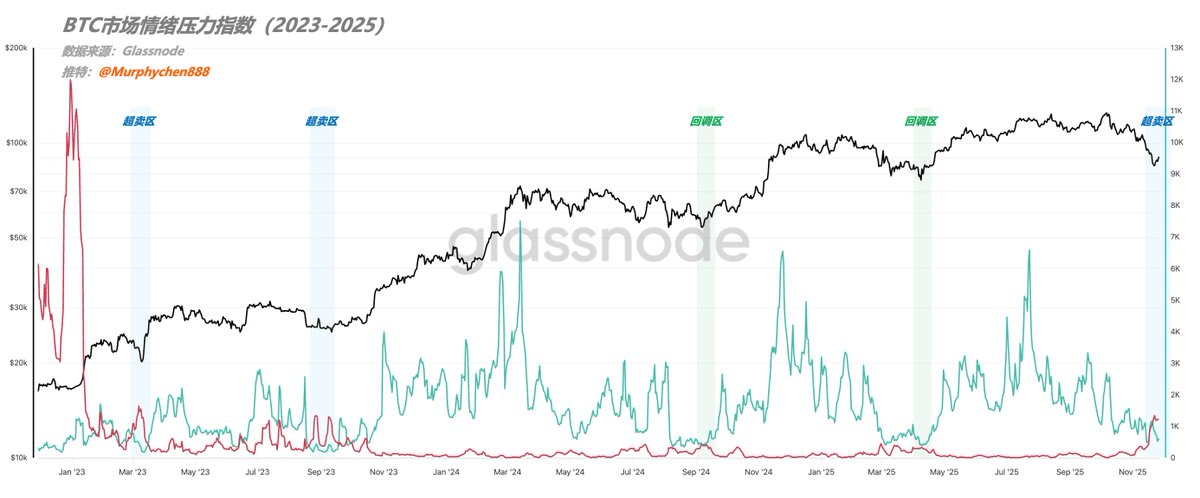
After a long deep bear period, BTC's market confidence has not yet recovered, and emotions have become extremely unstable. Therefore, at the beginning of the transition from bear to bull, SPI inversions are likely to occur; for example, in this cycle, they appeared in March and September 2023 (as seen in the blue shadow area in Figure 1).
If the extreme selling zone at the beginning of the bull market is the position where cross-cycle traders fully invest, then the mid-term pullback zone (green shadow area) is the time when trend traders should significantly allocate. Because at this time, after experiencing a round of strong trend, the moderate return of the price allows the market's long-short emotions to return to balance.
Currently, we see that the SPI inversion has occurred again; it is clear that this is no longer the beginning of the bull market, so it can only be classified as an extreme selling zone in the mid to late stages.
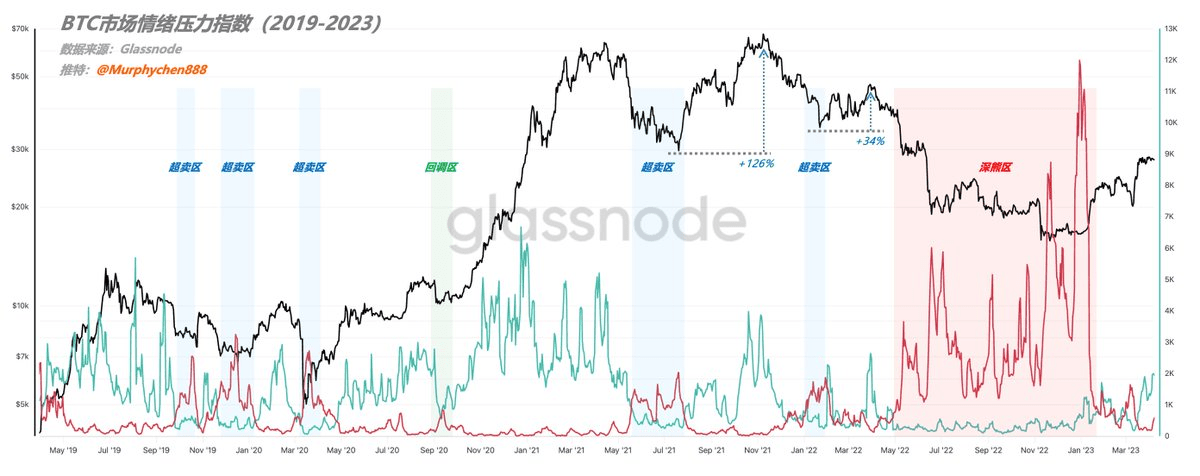
Historical data proves that extreme selling in the mid to late stages is more likely to lead the market into a deep bear zone. Once the market's psychological threshold is broken, if unexpected sudden events (black swans) are added, under the continuous blow to confidence, it will enter a death spiral — the more panic, the more selling; the more selling, the more decline; the more decline, the more panic...
However, extreme selling in the mid to late stages does not mean it will immediately transition into a deep bear zone. On the contrary, because emotions are compressed to the extreme, a strong rebound may follow. For example, after the extreme selling from May to July 2022, BTC price rebounded by 126%; after the extreme selling in January 2022, BTC price rebounded by 34% (Figure 2).
Subsequently, due to macro factors such as the Federal Reserve's release of interest rate hike tightening expectations, along with the impact of major events like Luna's exposure, BTC quickly fell into a deep bear zone.
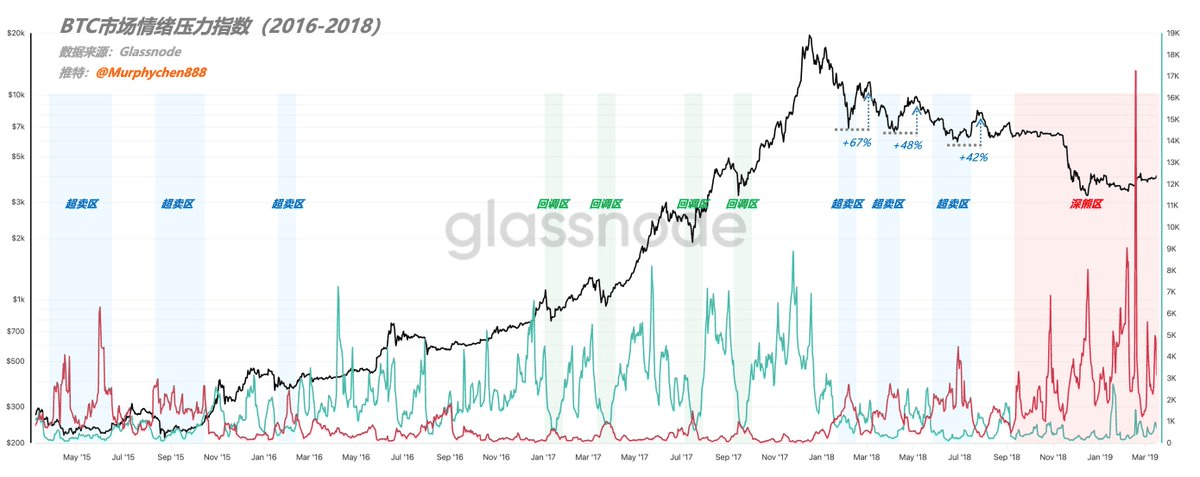
The situation was almost the same during the 2016-2018 cycle. Due to BTC's smaller market capitalization and lower institutional participation at the time, volatility was greater. It can be seen that the occurrence of extreme selling zones and pullback zones was significantly more than in the last two cycles.
At the tail end of the bull-bear transition, there were three noticeable SPI inversion structures, but each time was followed by a strong rebound of over 40%.
-----------------------------------------
In summary, we can draw the following conclusions:
1. The pullback of BTC in October-November this time is emotionally different from that in August-September 2024 and March-April 2025. From the SPI perspective, the first two instances only brought the long-short emotions back to balance, while this time it resulted in an inversion.
2. Entering an extreme selling zone means that market emotions are in extreme panic, which is a serious blow to confidence in the bull market and can trigger deeper adjustments. Therefore, in the previous pullback zones and the early bull extreme selling zones, we could go all in, but now we cannot; risk prevention must be the primary consideration.
3. In extreme panic, we should remain calm instead. From historical data, if there are no consecutive negative impacts after extreme selling, it will not immediately enter a deep bear zone; instead, it may lead to a rebound.
4. Essentially, both extreme selling zones and deep bear zones are SPI inversions, but the latter is more severe and persistent. It does not rule out that this cycle may be different from previous ones; perhaps this time the SPI inversion has already completed the process of 'walking bear'.

