
After more than 10 years of trading cryptocurrencies, 2025 marks the 10th year of my professional trading career. I currently have a stable monthly income in the seven figures, and an annual income in the eight figures, all relying on this trading strategy, with a win rate as high as 90%.
A method I personally tested: Last year, in less than a year, I turned an initial capital of 300,000 into nearly 82,000,000.
If you plan to invest in the cryptocurrency market, please take a few minutes to read my answer word for word, as it may save your life and a family.
The thousands of originally happy families ultimately become broken due to the pursuit of an unattainable dream of making a fortune in cryptocurrency. I believe the reason I can continue on this trading path is that I have been dedicated to learning, not only understanding the fundamentals but also analyzing news and studying technical indicators. #加密市场反弹
And the formation of a self-stabilizing profitable trading system!

Today we will begin to delve into the study of reversal patterns. This article is primarily theoretical, and practical case studies will follow.
For some novice friends, they may prioritize practical experience while neglecting theory, which I believe is incorrect. Theory is the foundation of all trading; it helps us understand and feel the logic behind price movements. If the foundation is not solid, it will be very difficult, if not impossible, to integrate knowledge.
Conditions for reversal
Let us first consider a question: Under what circumstances does a clear trend reverse?
There are 3 conditions; the first 2 are necessary, and the 3rd is non-essential.
1. Sufficient trend-following strength has exited the market or is no longer entering, indicating insufficient trend energy.
2. Sufficient strong counter-trend strength must emerge for a major trend's end and reversal to occur.
3. Failure of trend breakthroughs
Necessary conditions
Here, 'trend strength' and 'counter-trend strength' refer to the main capital; only funds of this magnitude can actually affect the market.
At the end of the bull market, most main players have long stopped buying, and the market is filled with retail investors frantically entering at high prices. Although some people continue to buy at this time, the strength of retail investors cannot drive true trend movements, often leading to a climax reversal that traps everyone.
When a clear trend forms, there must be strong capital continuously pushing behind it. Since the main players have exerted such great effort to push a trend movement through favorable conditions, the trend-following side will naturally push the trend to its limits before considering stopping and exiting. If the strength of the trend-following side is insufficient, but there is no strong counter-trend strength entering, or if only counter-trend strength enters while the trend-following side does not give up resistance, it is likely that the market will not welcome a reversal but enter an oscillation range, where the long and short main players will re-engage in a battle to determine the future direction.
Non-essential conditions
Many trend reversals stem from failures of trend breakthroughs. When the price has undergone a pullback consolidation pattern, then breaks through in the trend direction but fails, it indicates insufficient trend energy. The commonly referred to breakdown reversal, breakout reversal, or ultimate shakeout can all be understood as failures of trend breakthroughs.
One of the most important skills for a trader is the ability to accurately judge whether a breakout can successfully lead to a new trend or will ultimately fail and result in a reversal. This breakout is not limited to horizontal levels but may also be channel lines or other support and resistance structures.
Let us review the early content of the entire tutorial series. We previously used the Bitcoin daily chart as an example to demonstrate the deformed reversals caused by consecutive failures of breakthroughs. Here, I will mark it again and explain it once more.
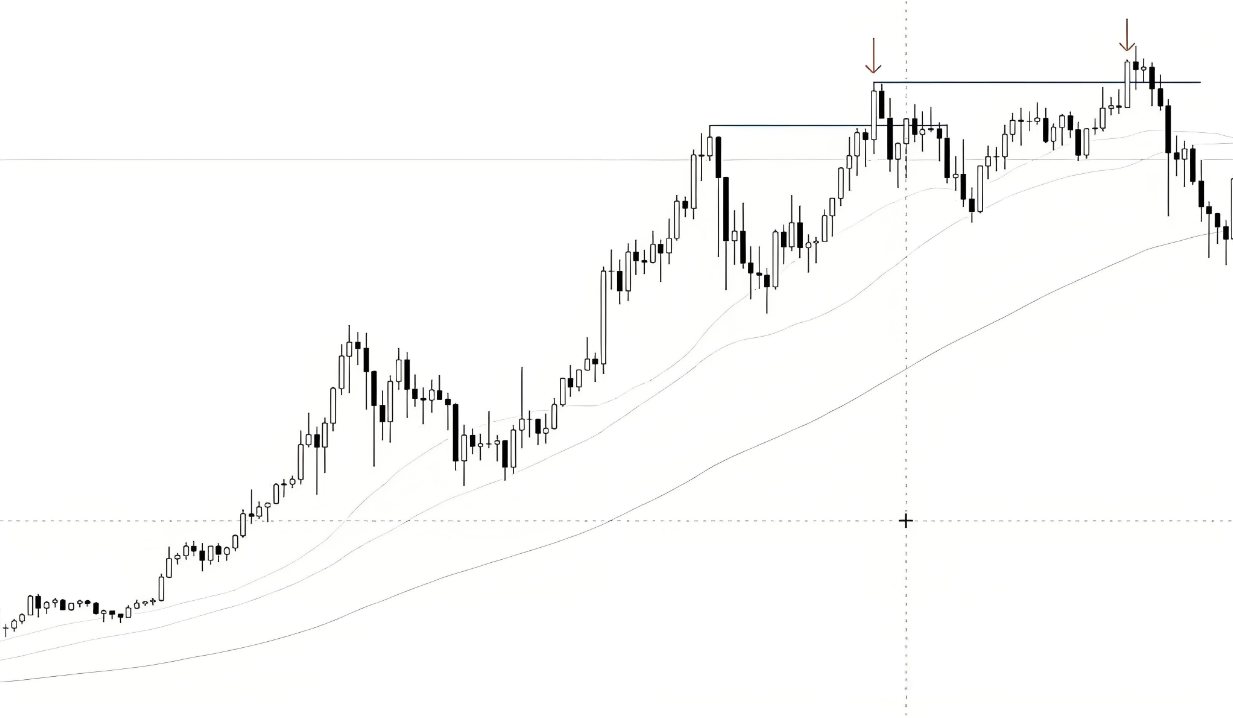
We observe that when the bullish trend of Bitcoin comes to an end, each breakout towards the trend direction after a pullback lacks new bullish follow-through strength; these breakouts are all failures. These two consecutive bullish trend breakthroughs failing ultimately led to a wedge reversal.
The situation is similar in Bitcoin's decline to 30,000.
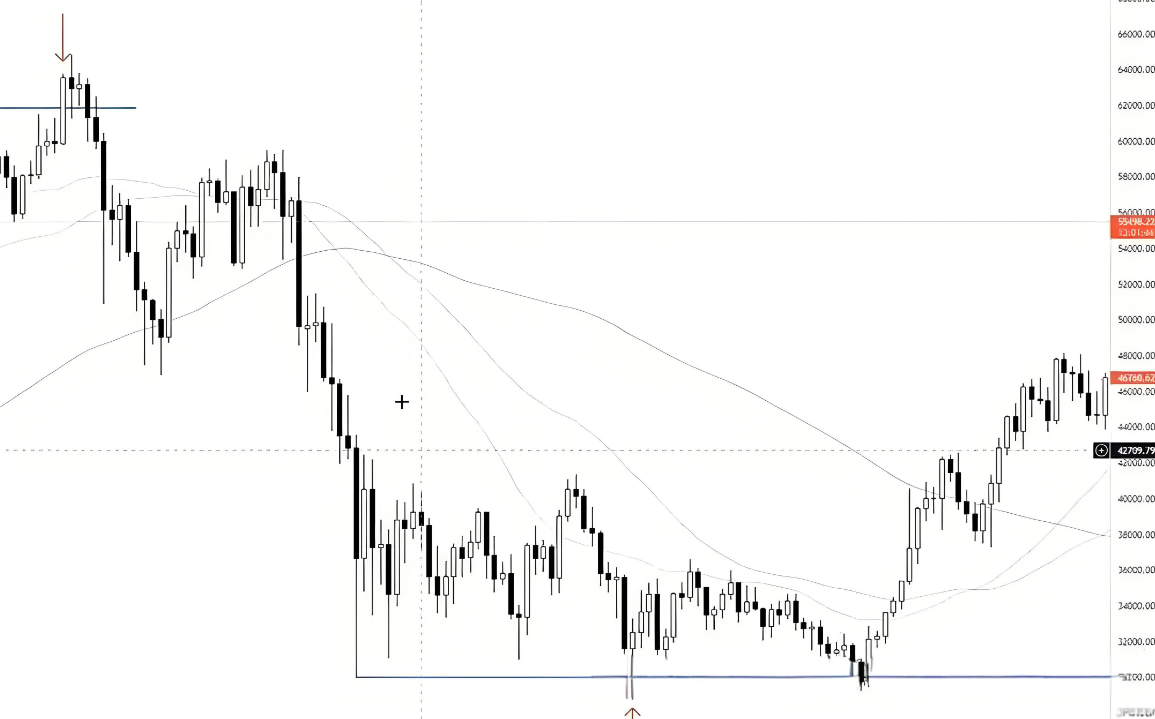
We will look at the situation of this decline from the perspective of the 4-hour level.
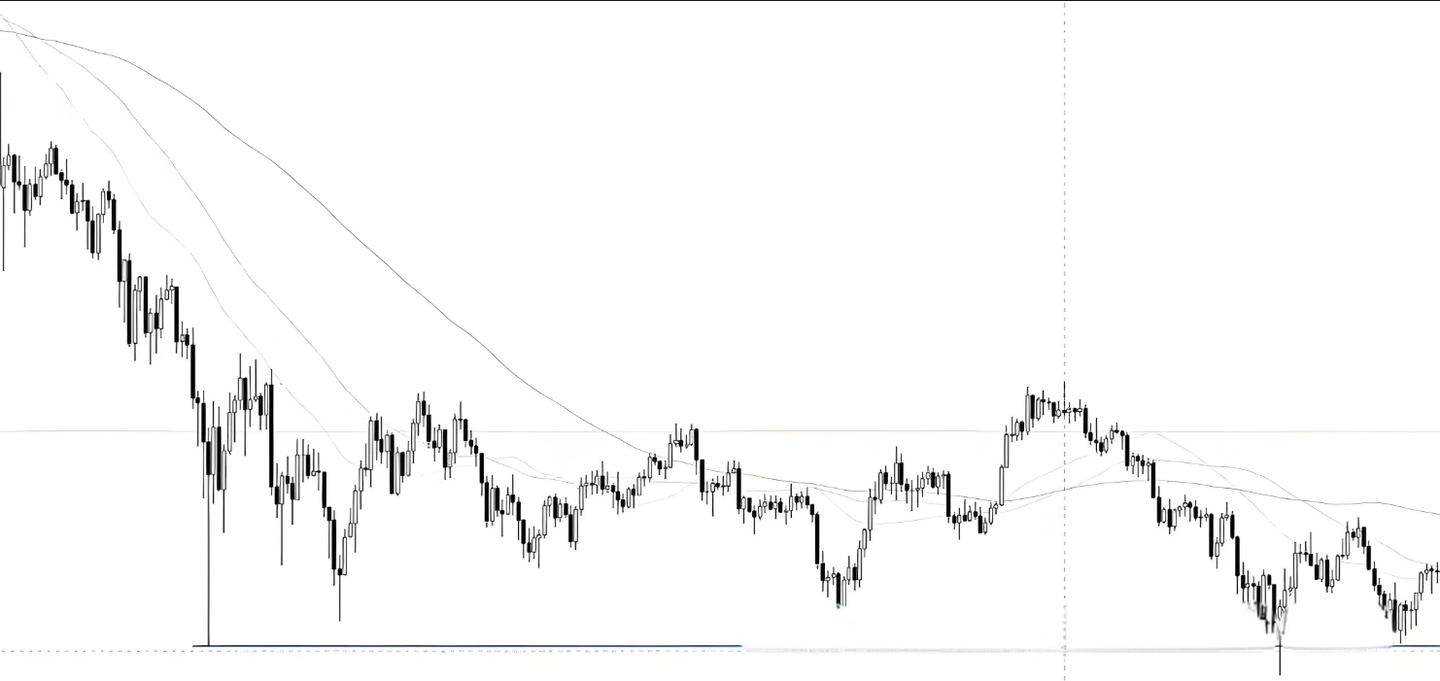
In this time frame, the decline from the peak has formed a bearish trend. We can observe that the end of this bearish trend was also triggered by a false breakout of a bearish trend. The bearish false breakout shows a lack of bearish energy, ultimately leading to a bearish reversal.
The essence of many reversal patterns is that they are formed due to failures of trend breakthroughs.
Support and resistance levels
Trend reversals across various time frames usually occur at support and resistance levels. This is because both technical analysis traders and algorithmic traders view these support or resistance ranges as signals for profit-taking. Many traders even engage in reverse trading at these critical areas.
Fundamental traders will also pay attention to key support and resistance levels on the chart, viewing these areas as value ranges and may engage in reverse trading within these ranges. Additionally, algorithmic traders specializing in value trading also emphasize these areas.
Regardless of the standards used for measurement, important support and resistance levels are always crucial in the market. Whenever an important price level appears, the entire market can see it, regardless of their trading logic or tools.
In the daily reversal case of Bitcoin, the 60,000 level and the 30,000 level represent significant support and resistance areas in the market.
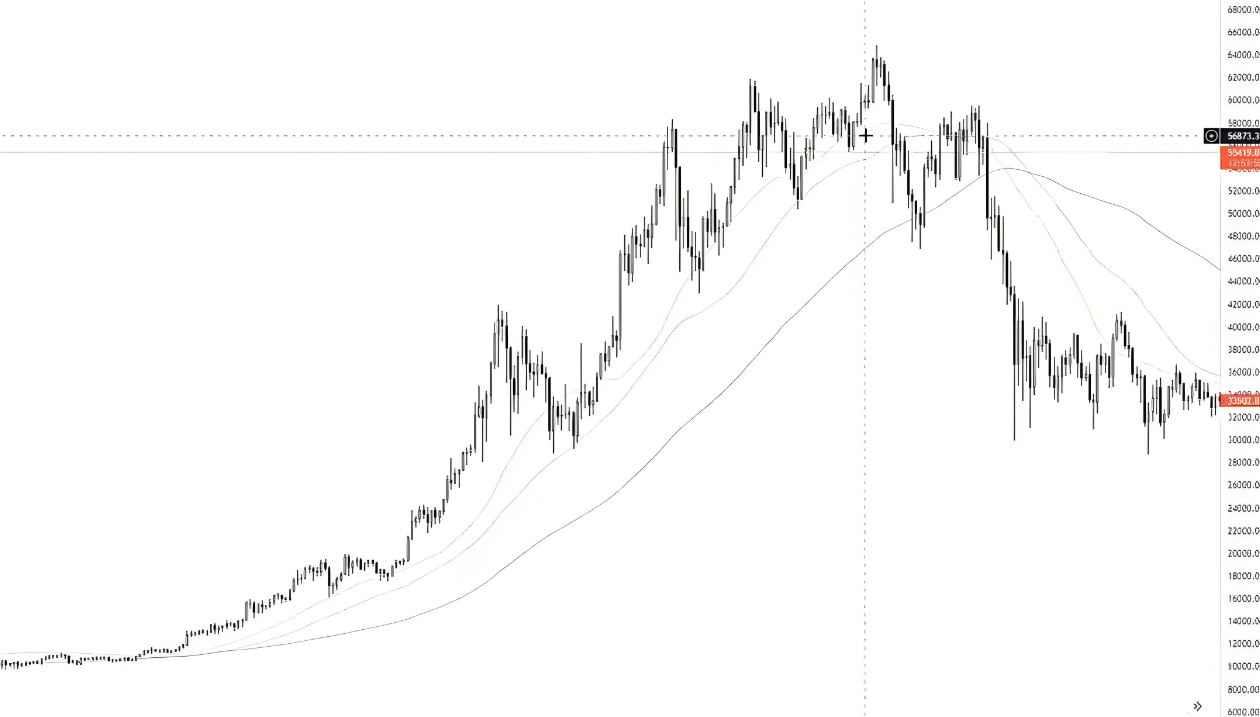
The importance of these two price levels is as follows:
Psychological target level
60,000 psychological target level: For investors, 60,000 may be a psychologically important price level. For example, early investors who entered at 10,000, 20,000, or 30,000 may consider 60,000 a natural target or the 'peak' of the price, thus exerting significant selling pressure.
30,000 psychological support level: Similarly, 30,000, as an important level for a 50% pullback, is also a psychological support level that many investors pay attention to, which may lead to renewed buying interest and thus a reversal.
Technical target levels
60,000 technical target level: Common technical analysis tools such as the AB=CD pattern and Fibonacci extension may indicate that 60,000 is a technical target level. In technical analysis, these tools are often used to predict trend targets, and when multiple tools yield similar targets, it further enhances the importance of that level.
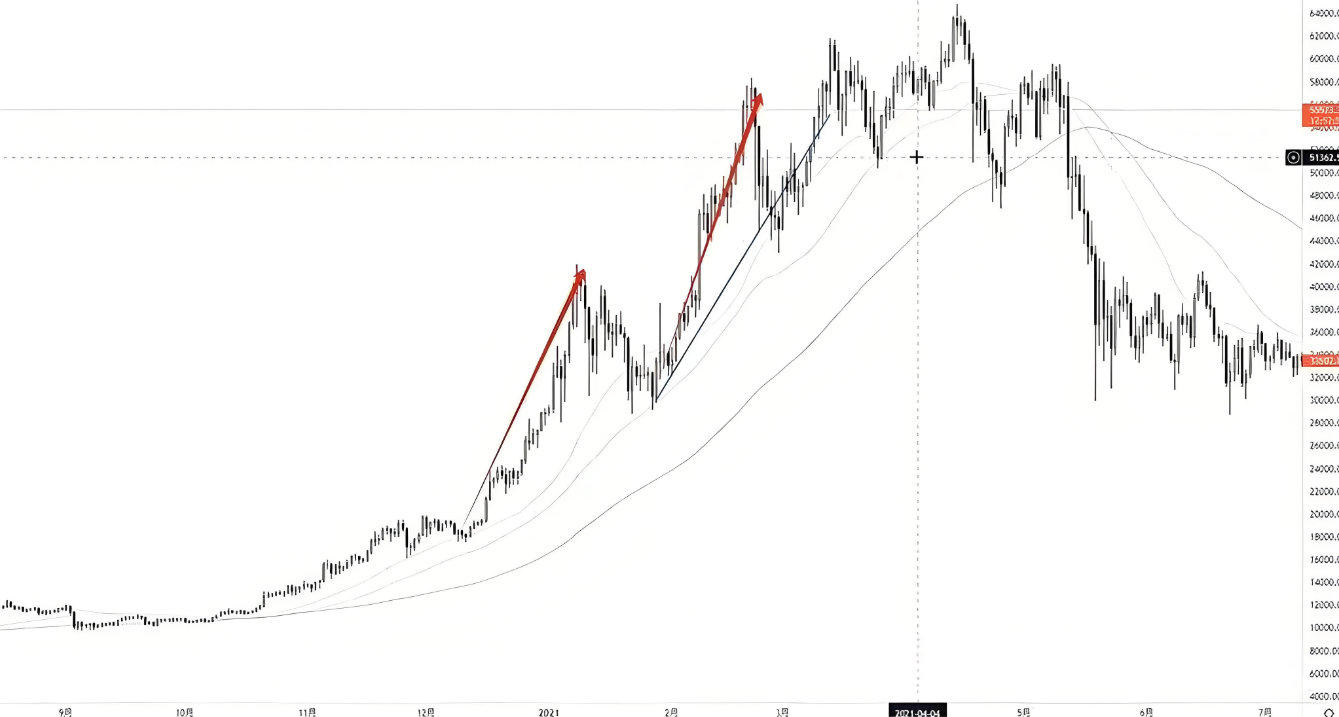
30,000 technical support level: 30,000 may be viewed as the starting point of a major upward wave, which is the beginning of the upward trend from that level. This makes 30,000 a key support level, and many traders and algorithms may regard it as a reference for buying signals.
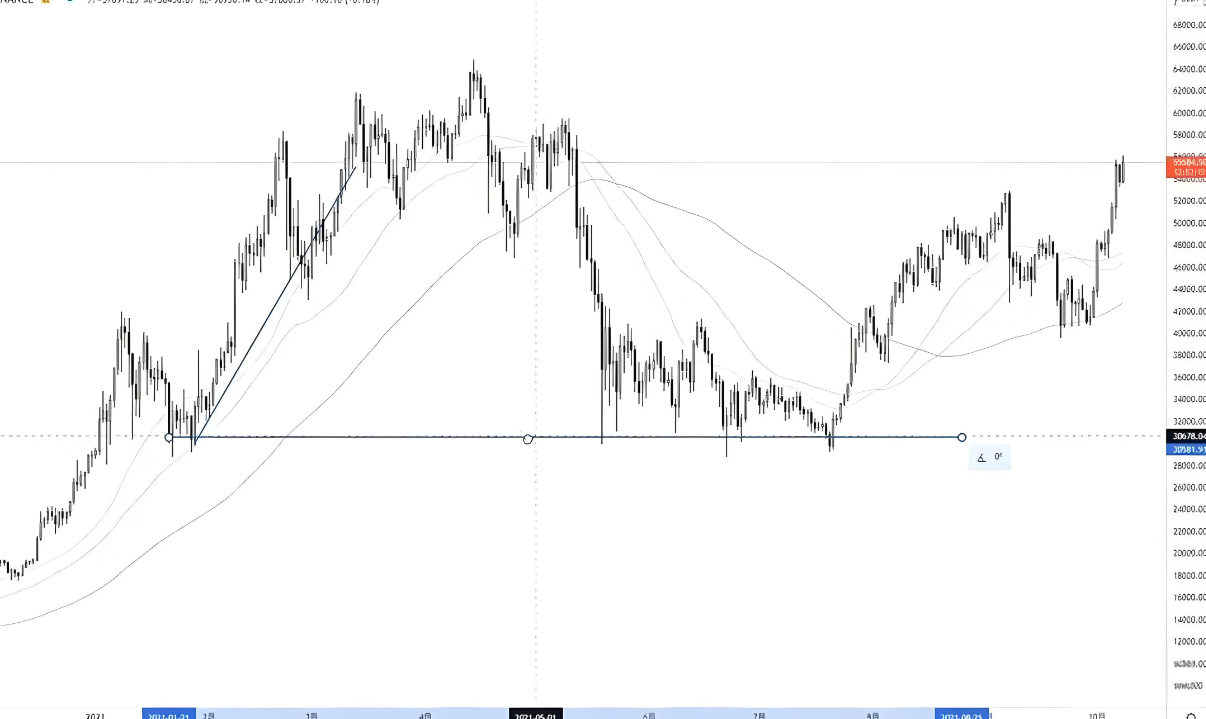
In actual trading, different participants use different analysis methods and tools, but these key support and resistance levels often receive widespread attention. Therefore, most people in the market can see these important price levels, leading to trend reversals often occurring at these key locations. Understanding these reversal zones and the logic behind them helps better grasp market movements and make corresponding trading decisions.
Price inertia; most reversals will fail.
A successful trend reversal can turn a bullish market into a bearish market or a bearish market into a bullish market.
However, the most important point is that most attempts at trend reversal will ultimately be in vain.
Market movements have inertia and tend to maintain their current state of motion without easily changing. This means that in a trend market, there is no real 'trend reversal pattern.' In such market environments, all patterns are continuation patterns, i.e., consolidation patterns. Occasionally, a certain continuation pattern may fail, manifesting as a depletion of trend strength.
Many technical analysts define these failed continuation patterns as reversal patterns; however, in most cases, these patterns do not lead to actual price reversals.
Here we continue with the double tops and bottoms and head and shoulders top and bottom reversal patterns as examples, which are often encountered by many novices when starting out.
In actual trading, most double tops and bottoms, head and shoulders tops and bottoms often do not bring about a reversal but rather a trading range. Indeed, many trend reversals will exhibit these reversal patterns, but this does not mean that the market will definitely reverse as soon as these patterns appear. This logic does not hold.
Just as professional basketball players tend to be taller, it does not mean that just being tall can make one a professional basketball player. Many other factors, such as athletic ability and training status, must also be considered. Similarly, market reversals depend not only on the appearance of patterns but also on other market factors.
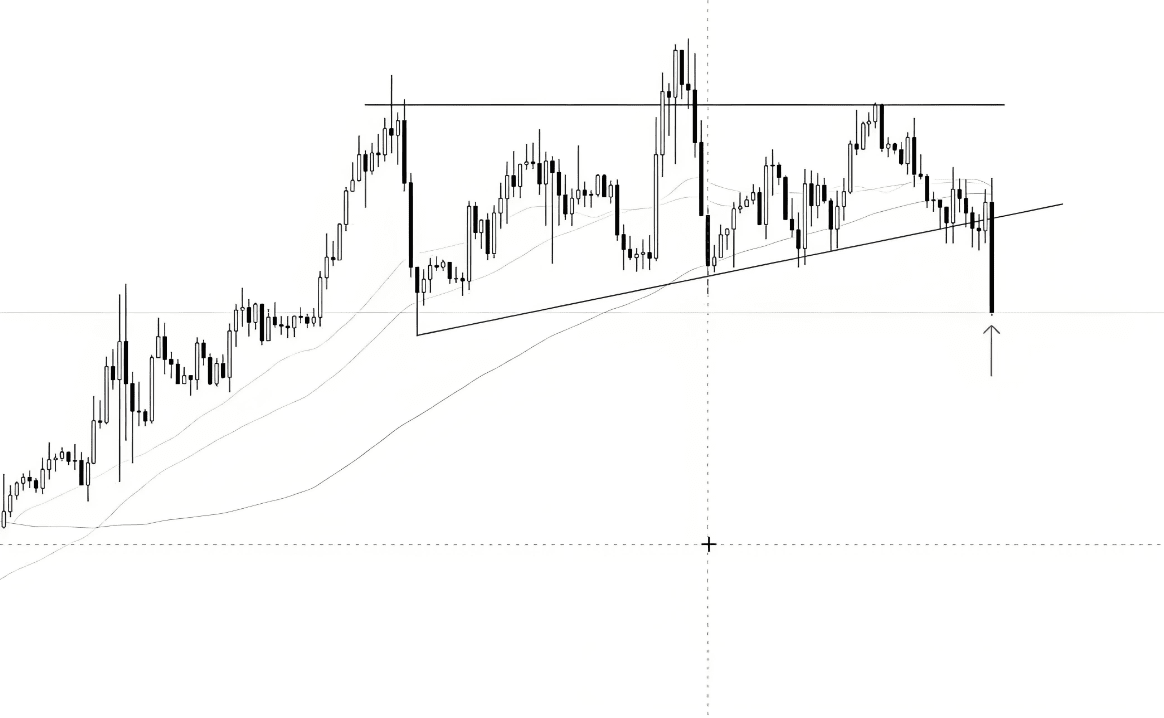
We see the head and shoulders top pattern in the chart, which is a fairly standard case. The shoulders, head, and neckline are all very clear. The large bearish candlestick here has clearly broken through the neckline of the head and shoulders top pattern, which should be a textbook entry point.

However, even though the head and shoulders pattern has been established, the subsequent market did not reverse but instead entered a wide trading range, becoming a continuation pattern.
A wave of trend is like a giant ship, requiring immense strength and time to change direction. Before one side's main capital controls the market, an increase in two-way trading volume is usually needed; this phenomenon of long and short contention manifests as oscillation markets. Therefore, most so-called reversal patterns actually represent oscillation ranges. Since reversal patterns have an 80% probability of failing, the probability of a continuation breakthrough in the range is high.
Sometimes, such consolidation ranges may experience counter-trend breakthroughs or quickly fail after a trend breakthrough, resulting in price reversals. In these cases, most traders will label these oscillation ranges as reversal patterns.
For example, double tops and bottoms, head and shoulders tops and bottoms, or terminal flags, many patterns capable of triggering counter-trend movements may actually just lead to a period of oscillation, and then the market is likely to return to the original trend. In this case, the reversal pattern is merely a consolidation pattern within the trend.
Trading principles for reversals
When conducting counter-trend trading, there is a very important principle:
You absolutely cannot consider counter-trend trading before important trend lines are broken. Only when a strong signal candlestick appears can counter-trend trading be executed. You need evidence that the opposing side is strong enough to seize and control the market opportunity.
Even so, you should still prioritize seeking opportunities for trend-following trades. Because after the first wave of counter-trend, the market will likely test the previous trend extremes, attempting to return to the original trend. Only in very rare cases will the breakthrough of the trend line be accompanied by very strong momentum, and the test of the previous trend extremes will be minimal, allowing for a continuation of counter-trend fluctuations.
Let's look at a case. The market previously experienced a very clear upward trend. I have marked the main upward trend line. You should not consider shorting until this important trend line is broken.
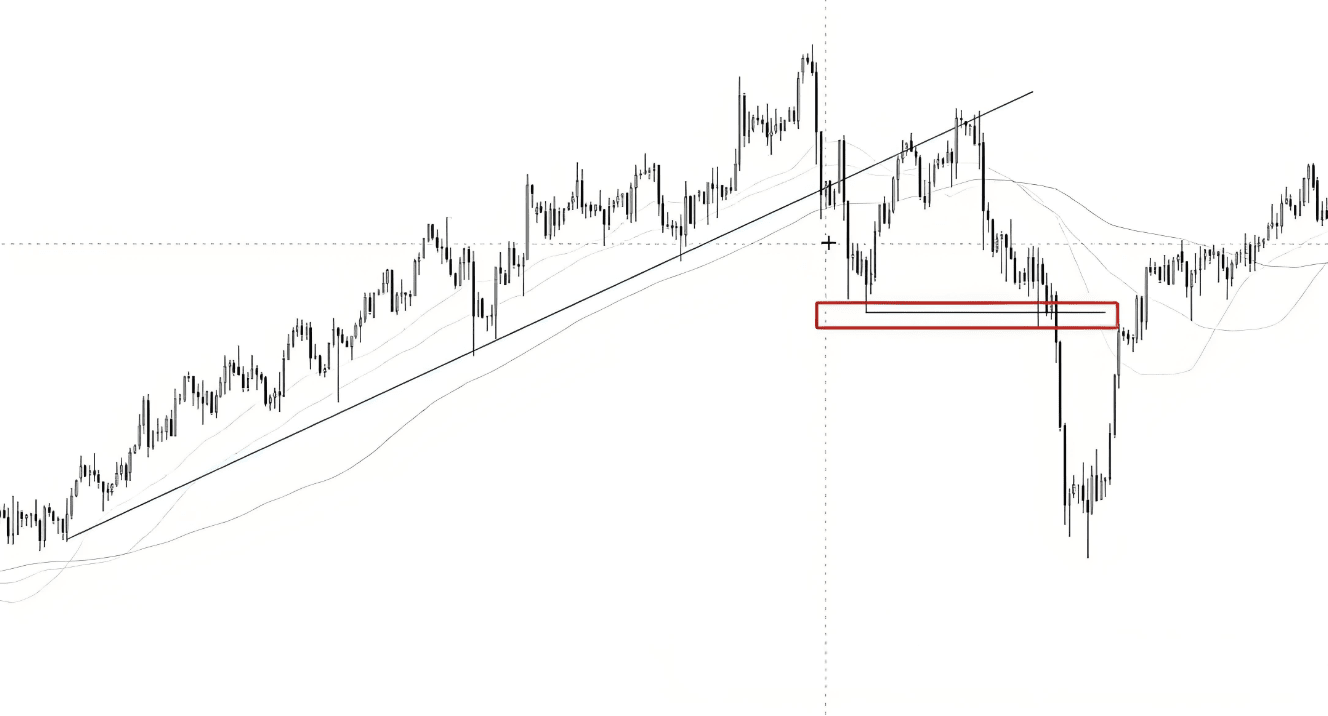
Although the price has experienced a significant breakthrough of this upward trend line, it still underwent a test of the previous trend extremes, namely a rebound upward. In most cases, reversal patterns will experience a test of the previous trend extremes. Therefore, we do not participate in shorting at the first reversal point.
When the upward trend line is broken, directly engaging in a short position often leads to being trapped. Only in very rare situations will a breakthrough directly trigger a counter-trend and not retest, or the retest will be very small.
So, why do most reversal patterns or important trend line breakthroughs accompany tests of previous trend extremes?
Because only when the price fails twice near the previous trend area, that is, when both challenges are unsuccessful, will the market attempt to make a counter-breakthrough.
Here are three conditions:
1. Breakthrough of the major trend line.
2. Failure to test previous trend extremes.
3. Occurrence of counter-trend breakthroughs.
The first two conditions only prove the lack of bullish strength, while the last counter-trend breakthrough indicates that the opposing side has dominated the market. We can see the horizontal line of the previous swing low; once marked, when this swing low is broken, it indicates that the opposing side has truly dominated the market.
Oscillation ranges are a form of trend reversal.
We generally consider a reversal to mean a shift from a bull market to a bear market or from a bear market to a bull market. However, the behavior of oscillation ranges can also be regarded as the opposite of trend behavior.
If a range breaks through into a trending market, or if a trending market turns into a range, this can also be considered a form of market reversal.
Trend pullbacks can manifest as small oscillation ranges or as a small-scale trend in the opposite direction of the larger trend, which is what we commonly refer to as a pullback wave. When the pullback ends, the small-scale trend will reverse and return to the original main trend.
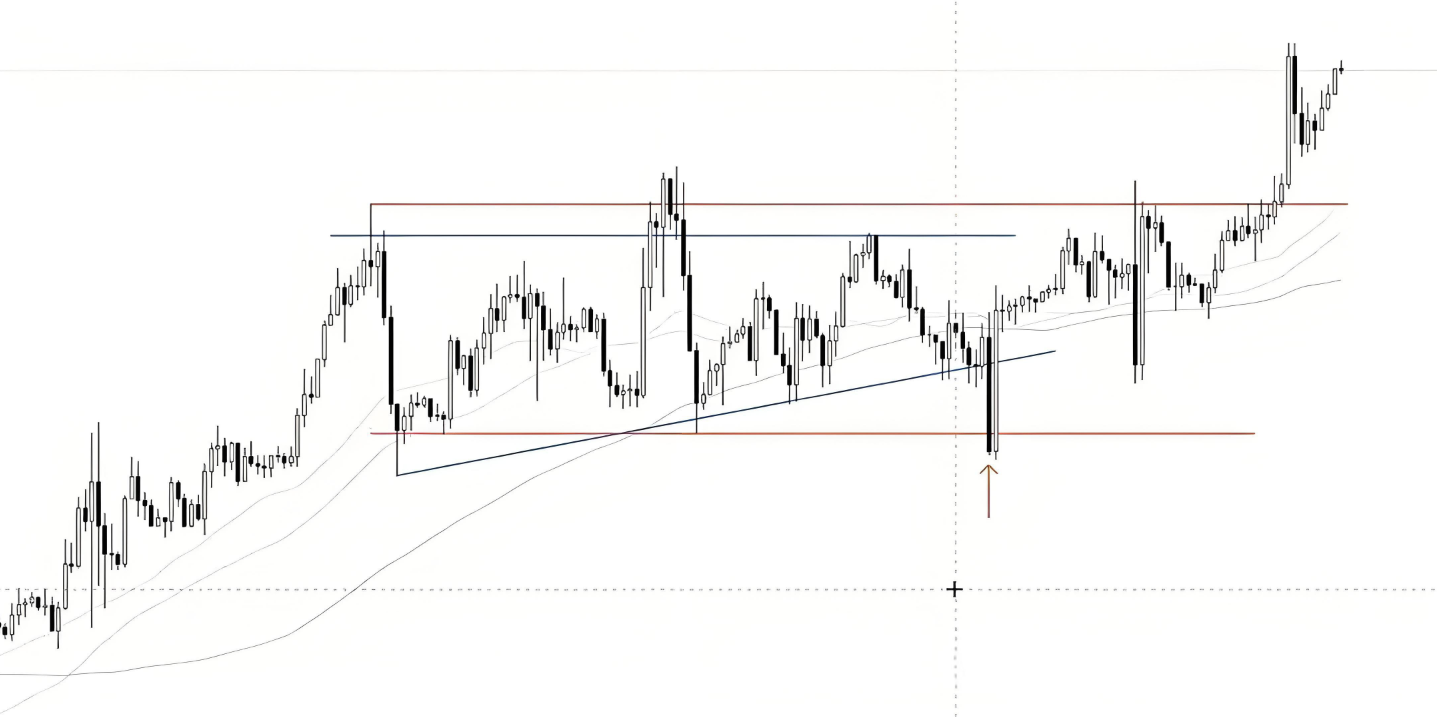
Most trend reversals are actually trend pullbacks on larger time frames.
Look at this case in the chart; it is an hour chart at the arrow point, and it is a reversal pattern.
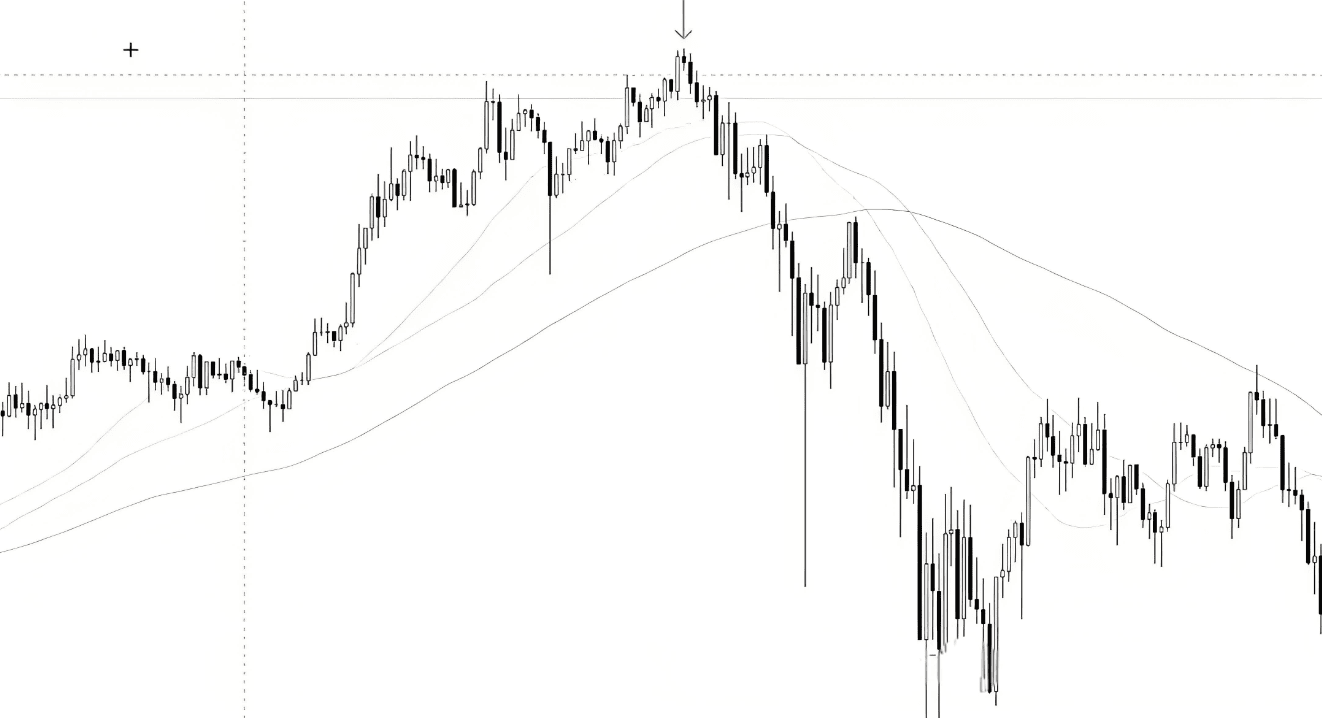
However, when we switch to the daily chart, we can see that in the larger cycle, this small cycle's reversal is merely a pullback.
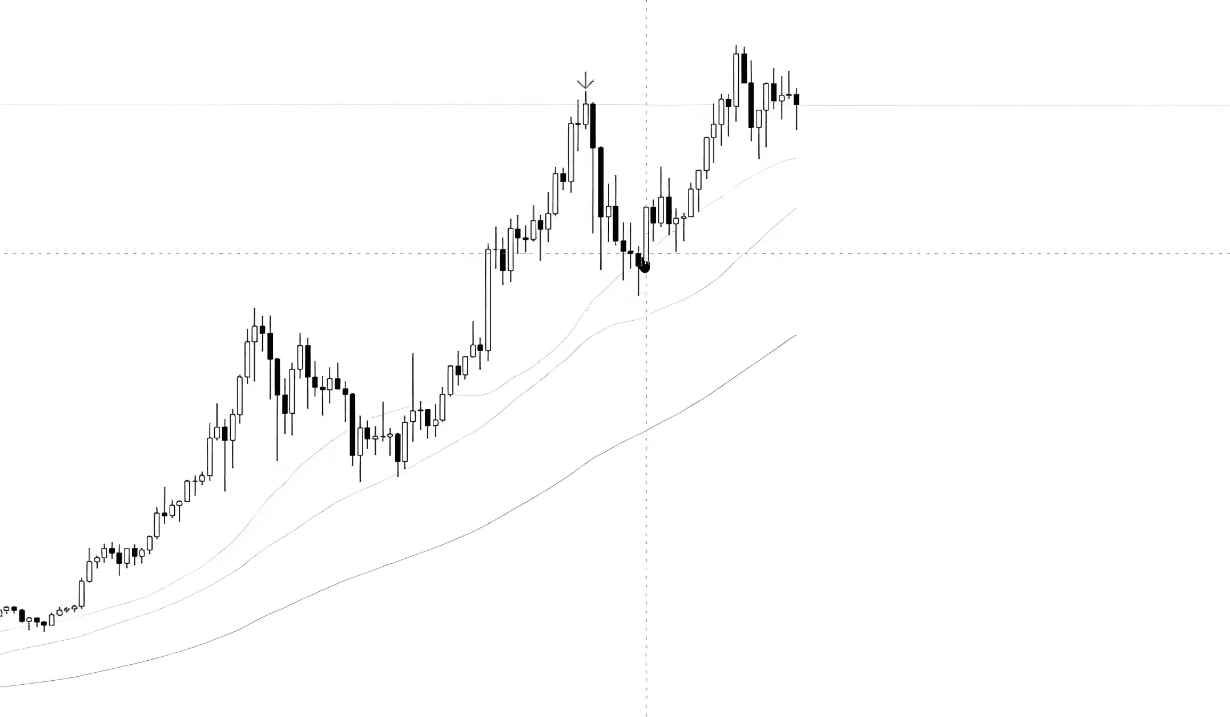
Most attempts at trend reversal result not in a strong counter-trend but in range oscillation.
Traders can never know in advance whether the current reversal will lead to a new counter-trend market. Because entering a reversal that leads to a range oscillation often looks the same as entering a reversal that leads to a new trend in the first ten candlesticks.
We will use this case of the Bitcoin daily wedge three-push reversal for explanation.
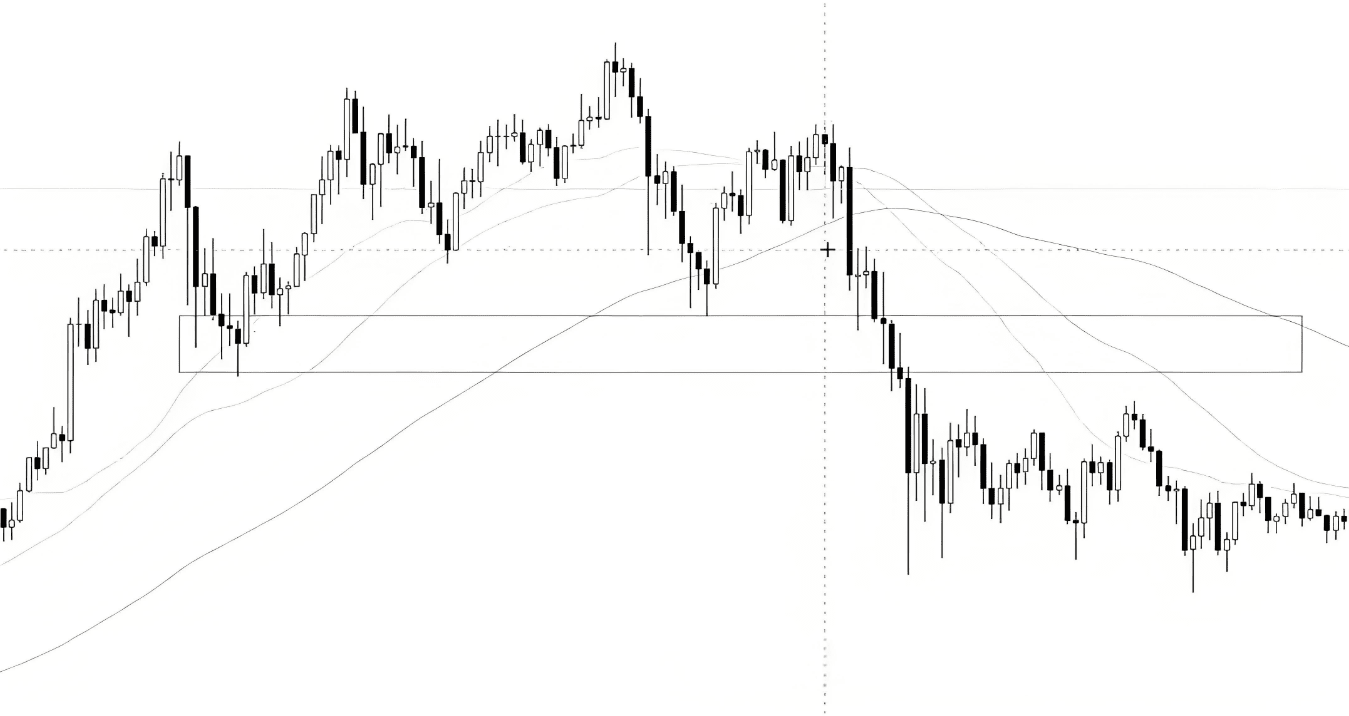
Only when the price breaks down below the wave level at the point of the wedge, i.e., the horizontal level marked in the chart, do we know that this reversal pattern has been established.

If the market finds support at this level and creates a horizontal range, this movement is completely acceptable.
Before the price causes a counter-trend breakthrough, we do not know whether this counter-trend breakthrough will be successful.
Will it lead to a new counter-trend, or will it merely create a horizontal range? Only after the market has operated for a long time can we judge whether this reversal has led to a new trend or merely transitioned into an oscillation range.
It is difficult to achieve both a favorable risk-reward ratio and win rate.
Most trades with very high risk-reward ratios reflect a low win rate at the beginning.
If you short at this wedge three-push reversal, where is the best entry point? Right after the third push breaks upward, the price pauses and forms an engulfing pattern. When this engulfing pattern breaks downward, it is a good opportunity to enter short.
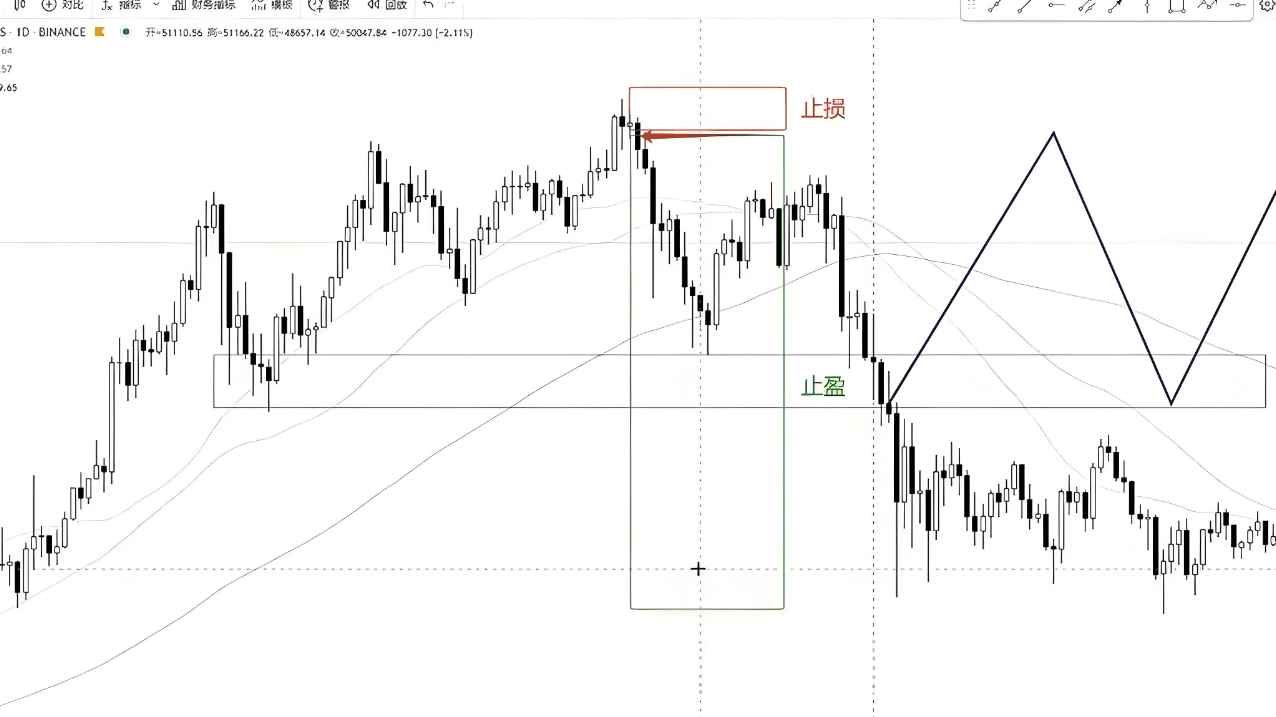
Your stop-loss space is very narrow, about 4,000 USD, while the profit space, or the expected profit after believing this reversal pattern will hold, is close to 30,000 USD. This means a risk-reward ratio of 7.5:1, but the win rate is very low. Why is that?
As we mentioned earlier, you cannot determine whether this reversal pattern is successful or failed before the price truly breaks through the opposite trend. Therefore, the uncertainty in the initial entry position is significant, and the win rate is very low. However, when the price successfully breaks through the previous swing low, this reversal trade will be confirmed by the market.
However, when the market confirms the establishment of the reversal pattern and re-enters, you will find that the remaining profit space is already very narrow. That is to say, as the trend becomes clearer, the success rate of trading indeed increases, but the remaining profit space gradually decreases, leading to a diminishing risk-reward ratio.
Cognitive biases in trading
Whether the reversal evolves into a new round of strong counter-trend or merely turns into several large counter-trend waves, the method of trading reversals remains the same.
If a reversal pattern quickly leads to a counter-trend breakout, traders can gain substantial profits from the new trend. For example, the counter-trend breakout in the above case was successful, and in this situation, the risk-reward ratio is very high, and the profit space is also substantial.
However, even if the market is merely consolidating sideways, forming a large oscillation range, traders can still profit by trading within this range. For us traders, we do what the market provides us. There is no need to pray that the market must operate according to a particular thought; this is a common misconception among many traders—they hope the market develops according to their expectations, otherwise, they do not know how to act. This line of thinking is incorrect.
As traders, we need to adapt to the market; regardless of the market conditions, we must make corresponding trading decisions based on the actual situation.
Summary of reversal types
Finally, let's briefly review several common reversal behavior patterns in the market.
1. Major trend reversal
The first is a major trend reversal, a term originating from the Abu book. In the market, major trend reversals are very common patterns; the common double tops and bottoms and head and shoulders tops and bottoms belong to variants of major trend reversals. Taking the case in the chart as an example:
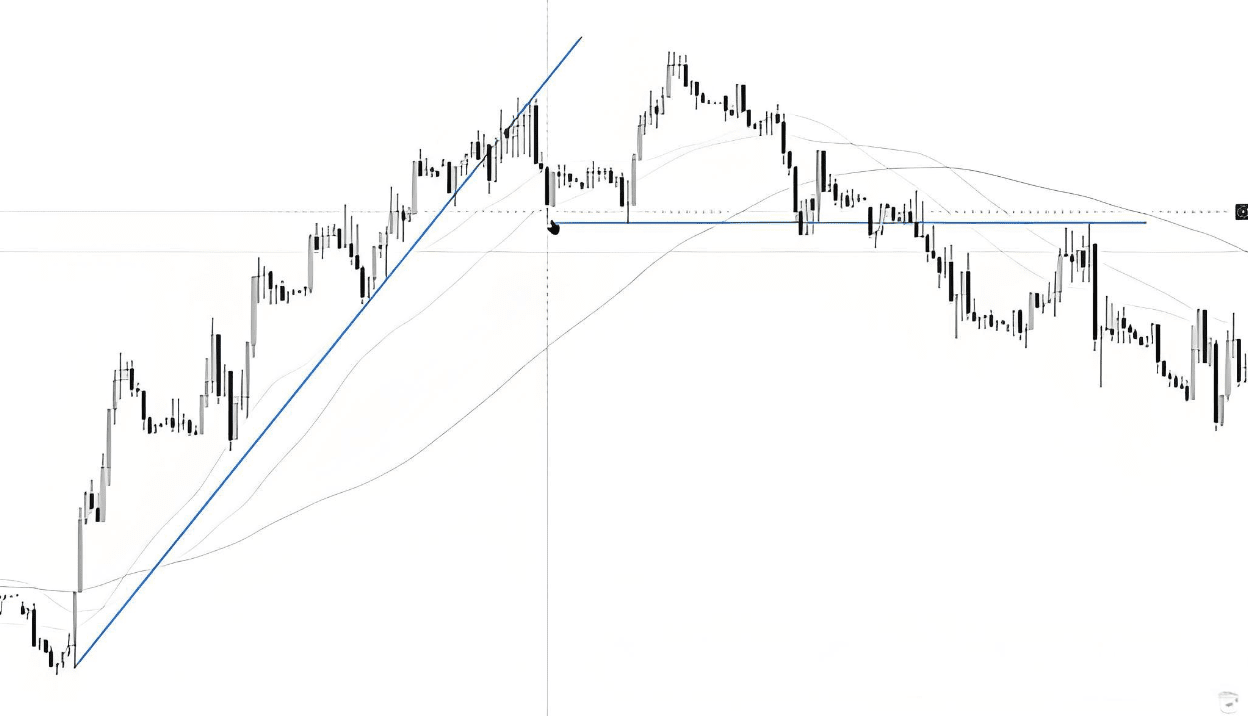
1. Significant breakthroughs of important trend lines: First, the chart shows an upward trend line, where the market experiences a significant breakthrough of this trend line.

2. Testing of original trend extremes: In the chart, we see that the market tested the highs of the upward trend.
This test can be above, parallel to, or below the previous high; the important thing is whether the strength in the original trend direction can be observed to weaken from this test. For example, in this upward trend:
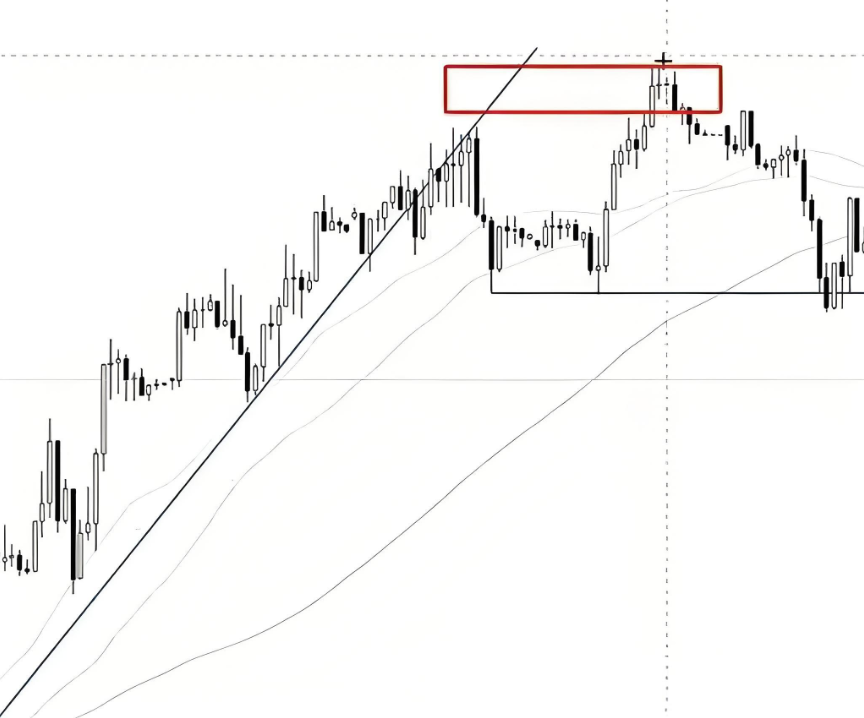
If the original trend extreme is broken and then reverses, it still indicates insufficient trend strength, because even if the extreme is broken, it has not maintained a new trend, and the price will retreat, as shown in the chart.
If the test is parallel to the previous high, it also indicates that the original trend direction is weak, as it cannot create a new high.
If the test fails to reach the previous high, it indicates that the original trend direction is weak, as the high points have decreased.
Counter-trend breakthrough
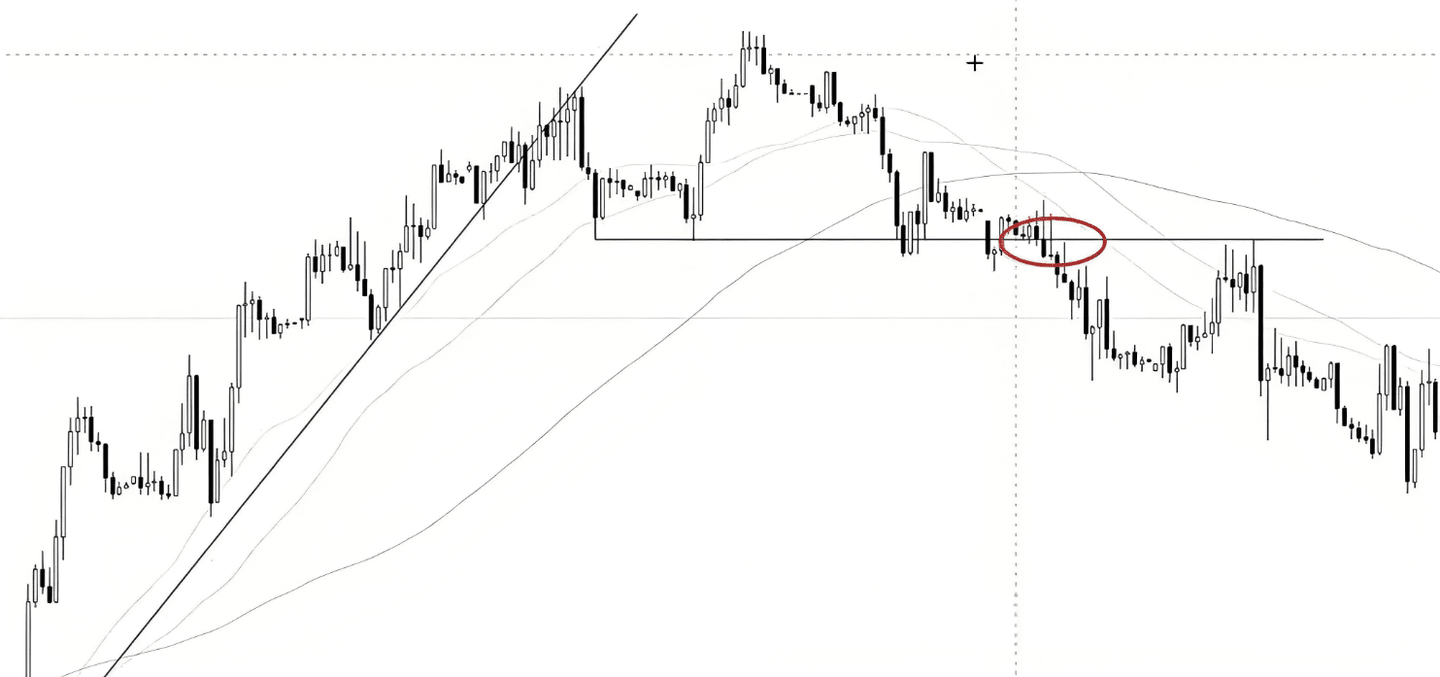
The market is controlled by bears. In the chart, we see a counter-trend breakout; the bears control the market, signaling the beginning of a reversal.
Double tops and bottoms, head and shoulders tops and bottoms
The case in the above chart is actually a double top and bottom reversal pattern; it is a mode of major trend reversal, forming double tops and bottoms through testing previous trend extremes. In subsequent cases, I will detail the specific applications of these common reversal patterns. Additionally, in the case in the chart, if the price does not directly break below the horizontal level but instead receives support and rises again, a false breakout of the previous trend extremes and reversal occurs, forming a head and shoulders pattern. The right shoulder part is the second entry point after the failed breakout; this pattern is another mode of major trend reversal.

2. Climax reversal
The second reversal behavior pattern is the climax reversal, which is very common in cryptocurrency trading and the stock market. To be precise, it tends to occur easily in all commodity markets.
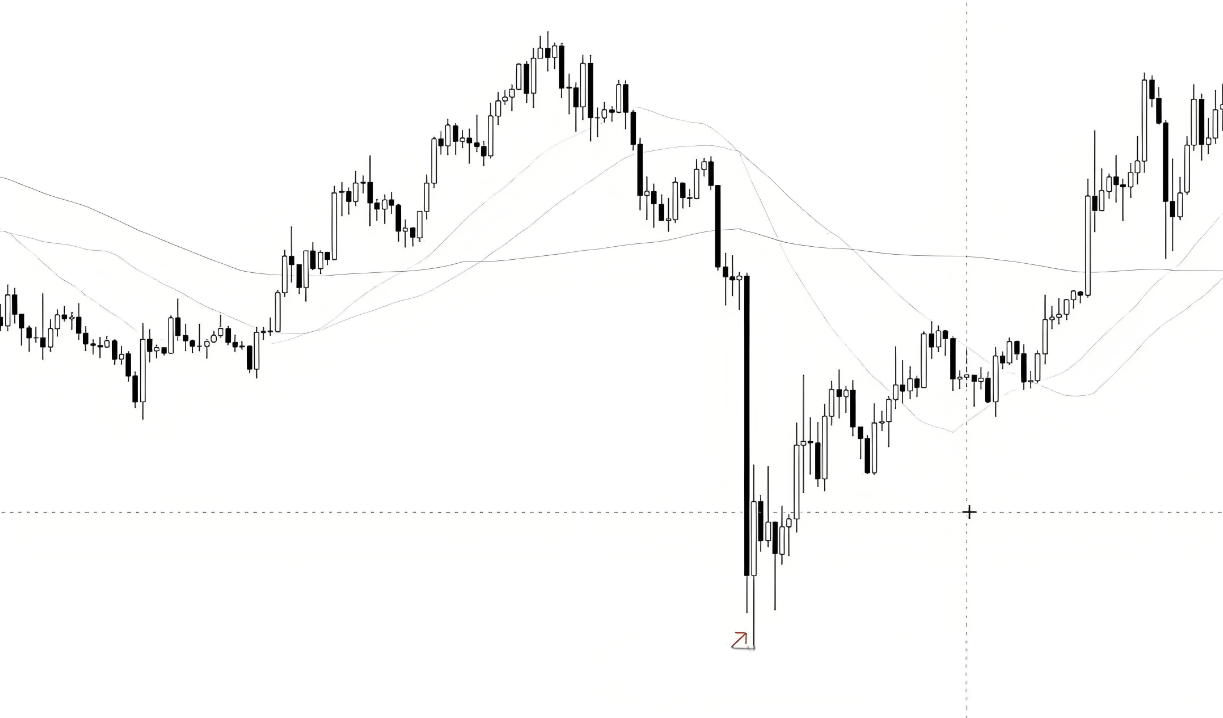
The climax reversal features extreme releases of market sentiment, usually manifested as extreme fear or extreme greed. The following are the main characteristics of climax reversals:
1. Lack of testing of trend extremes: Climax reversals usually do not effectively test the original trend. For example, the chart shows the case from March 12, 2020, a very famous day in the cryptocurrency circle. We see this extremely long bearish candlestick, which may have been caused by the collapse of the financial market. This extreme panic reversal did not test the original trend.
2. Climax reversal at the end of a bull market: Climax reversals are particularly likely to occur at the end of a bull market. Especially in cryptocurrency trading, many traders will frantically buy when they see long bullish candlesticks towards the end of a bull market, even selling their houses to chase the rise. Often, these extremely long bullish candlesticks are actually signals of a rapid market reversal. Because at this point, greedy participants enter the market en masse, and buying enthusiasm peaks. When all buying pressure is exhausted, the market lacks new buying support, and selling pressure begins to dominate, naturally leading to price declines.
The core of the climax reversal lies in the extreme release of market sentiment, which often leads to sharp price fluctuations in the short term. This phenomenon is especially likely to occur at the peak of a bull market.
3. Three-push wedge reversal
The third reversal behavior pattern is the three-push wedge reversal. This pattern is relatively simple to understand; it often manifests as a climax in the trend direction.
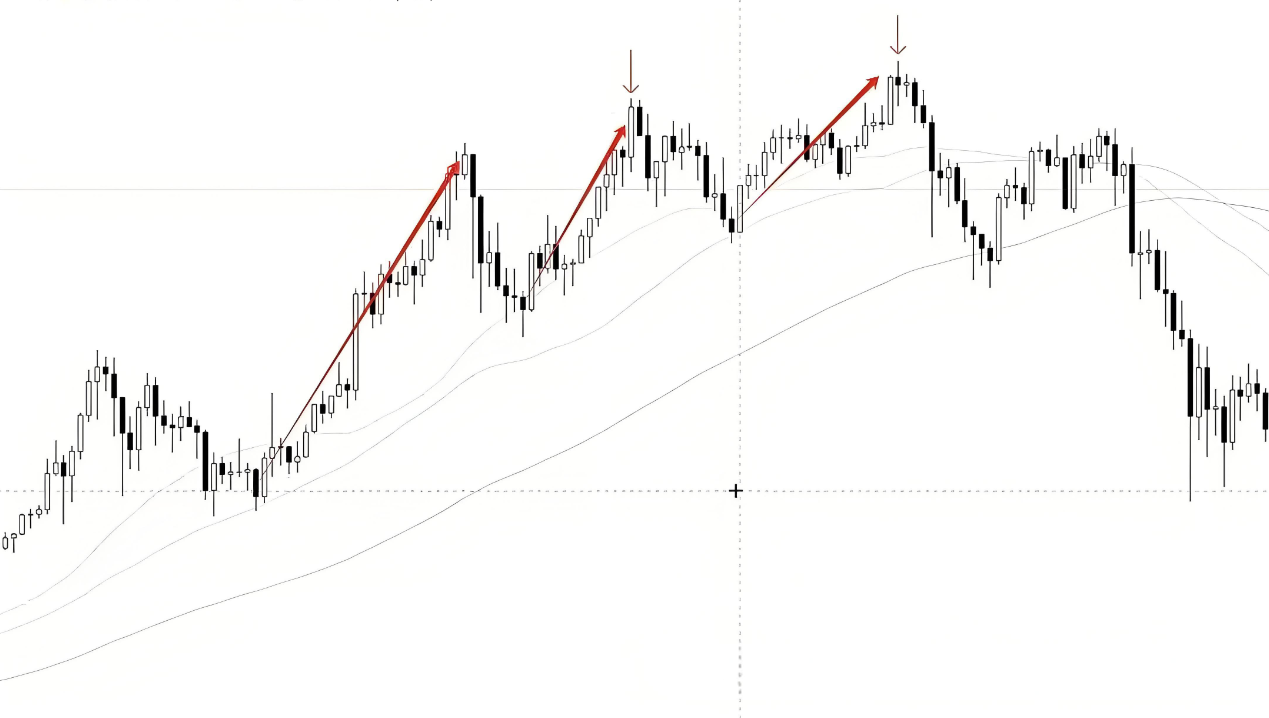
In a bull market, this reversal often manifests as an upward scorpion structure; the following is a specific explanation:
1. Performance of wedge reversals: Taking Bitcoin as an example, wedge reversals can be seen as a climax performance in a bull market. We can observe that after experiencing normal upward movements, when pullbacks occur, there are false breakthroughs in the trend direction. This false breakthrough indicates that the bullish strength is temporarily insufficient, and the market needs to undergo a long adjustment period to accumulate strength before breaking through again.
2. Market behavior after false breakouts: In this case, the market after a false breakout did not undergo a deep pullback but rather quickly exhibited new buying strength. Many of these buying forces are irrational and quickly lead to another new breakout. However, this breakthrough is also a failure.
3. Continuous failed breakthroughs: If the market experiences two failed breakthroughs in the trend direction and then shows a counter-trend breakthrough, it is very unfavorable for the trend. This indicates that the bullish strength in the market has been completely exhausted, and the market may enter an adjustment or reversal phase.
The core of the three-push scorpion reversal lies in the continuous false breakthroughs and failed breakout signals, which usually indicate a strong adjustment or reversal in the market.
4. Terminal flag
The terminal flag reversal is a relatively common but difficult-to-master reversal pattern in the market.
Although it is relatively difficult to master, understanding its existence can help traders remain calm when encountering such patterns. The following is a detailed explanation of terminal flag reversals:
Pullback in a downtrend: Previously, there was a clear downtrend. After this downtrend, a two-part pullback occurred (marked by the red arrows), which usually manifests as the market testing the previous low.
Trend downward: After this pullback pattern, the bearish direction continues to push the market downward. However, this decline did not last long, and the price exhibited a false breakout of the previous low. This false breakout usually indicates insufficient momentum at this level, and the market quickly returns to previous levels.
This adjustment period (marked by the red arrow) signifies the final segment of the downward trend. The terminal flag pattern here manifests as a market adjustment before the final segment of decline, forming a flag-like structure.
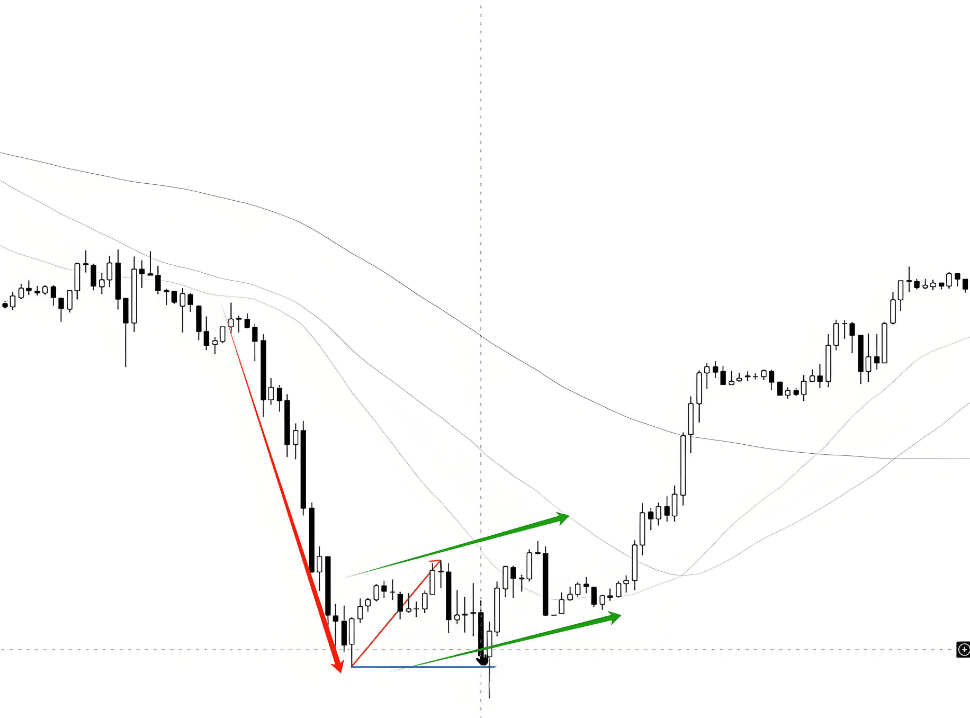
Although the terminal flag reversal appears very clear during replay, errors can easily occur in actual trading. Market behavior may not be as clear in practice as it is in theory.
In real-time operations, terminal flags can form sudden surges without warning.
Understanding the existence of terminal flag reversals can help traders remain calm when encountering such patterns. Even if one cannot accurately trade this pattern, maintaining awareness of the market's movement state is very important.
In summary, terminal flag reversal is a complex but important market behavior pattern; understanding its characteristics and behaviors can help traders remain composed when facing similar situations.
The above is the trading experience shared by Yan An today. Many times, you lose many opportunities to profit due to your doubts; if you do not dare to try boldly, to engage, to understand, how can you know the pros and cons? You only know how to proceed once you take the first step. A warm cup of tea, a word of advice, I am both a teacher and your talkative friend.
Fate is a matter of chance, while understanding is a matter of separation. I firmly believe that fate will ultimately bring us together across a thousand miles, while separation is a matter of destiny. The journey of investment is long, and temporary gains and losses are just the tip of the iceberg. Remember that even the wisest may have miscalculations, while the black may have some gains. Regardless of emotions, time will not stop for you. Pick up your worries and stand back up to move forward.
The martial arts secrets have been shared with you; whether you can become famous in the martial world depends on yourself.
These methods should definitely be saved, reviewed multiple times, and if you find them useful, feel free to share them with more cryptocurrency traders around you. Follow me for more valuable insights into the cryptocurrency world. Having experienced the rain, I am willing to shelter the inexperienced! Follow me, and let us walk together on the path of cryptocurrency!
