

The world's largest asset management company, BlackRock, has once again transferred $135 million worth of Ethereum to the cryptocurrency exchange Coinbase.
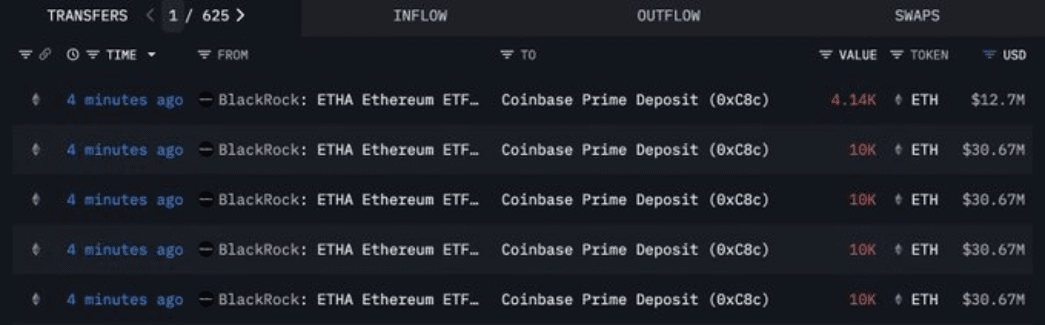
In the past week, the most closely watched event in the cryptocurrency market has been the frequent movements of on-chain whales. According to blockchain data monitoring, on December 3, 2025, the world's largest asset management company BlackRock deposited 44140 Ethereum into Coinbase Prime, valued at approximately $135.36 million.
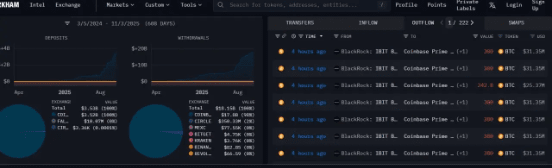
Just a month ago, the same operation has been performed multiple times. On November 4, BlackRock transferred over $290 million worth of Bitcoin and Ethereum to Coinbase; on November 17, the company again transferred approximately $470 million worth of Bitcoin and $176 million worth of Ethereum. The first two transfers coincided with a sharp decline and liquidity tightening in the cryptocurrency market, and their actions were seen by the market as reinforcing bearish signals, exacerbating market volatility.
 1. Core Event
● This transfer event itself is quite clear. According to information from multiple blockchain data monitoring platforms, BlackRock deposited 44,140 Ethereum into Coinbase Prime on December 3.
● Based on the market price at the time of the transaction, this asset was valued at approximately $135 million. The transfer action was captured through on-chain monitoring and quickly spread in the crypto community and financial media.
 2. Market Interpretation
● The market's first reaction to such large transfers is often concern. Traditional logic suggests that transferring large amounts of cryptocurrency from private wallets to exchanges is usually done in preparation for selling or trading, which can bring direct selling pressure to the market.
● Especially when the transferor is a financial giant like BlackRock, its movements are seen as a barometer of institutional sentiment. Many traders are beginning to closely monitor changes in the depth of market order books and the bid-ask spread to anticipate potential price fluctuations.
● However, deeper analysis reveals another possibility. Evgeny Gaevoy, founder of market-making giant Wintermute, pointed out that such transfers are actually a "highly lagging indicator."
3. Underlying Mechanism
● The general market panic may stem from an incomplete understanding of the ETF operating mechanism. BlackRock's on-chain transfers are actually part of the settlement process in its standard operating procedures for spot Bitcoin ETFs (IBIT) and spot Ethereum ETFs (ETHA).
● When there is a net outflow of funds from the ETF, market makers will buy shares from ETF sellers and submit redemption requests to BlackRock, converting ETF shares into actual Bitcoin or Ethereum. This process typically involves a one-day delay.
● The key point is that the real market selling pressure does not occur when large transfers are visible on-chain, but rather when market makers sell in the external market to hedge risks. This means that when retail investors see large on-chain transfers, the related selling pressure may have already been absorbed by the market a day prior.
4. Pattern Analysis
A review of recent data reveals that BlackRock's large cryptocurrency inflows to Coinbase have formed a pattern.
● High transfer frequency and large scale, with significant transfers occurring almost weekly. BlackRock has made at least four significant asset inflows in the past month, each amounting to hundreds of millions of dollars.
● Both ETH and BTC were moved in large quantities, but ETH was more prominent. Multiple records indicate that the number of ETH transfers was quite substantial, often reaching tens of thousands, while BTC also maintained a stable large liquidity.
● The operational behavior shows characteristics of "bulk + periodicity". The transfer intervals are generally around 7-10 days, with amounts being relatively concentrated, indicating that this is more likely a form of "normal rebalancing" or institutional-level fund management processes, rather than isolated temporary events. This has a significant impact on market sentiment but has not resulted in a consistent bearish trend.
Although large inflows to exchanges are typically viewed as potential selling pressure, recent events have not directly corresponded to obvious sell-offs; instead, they appear to be routine asset flows of ETFs or custody positions.
Here are the main transfer records from the past month:
1. December 3: Inflow of 44,140 ETH, approximately $135 million.
2. November 24: Inflow of 2,822 BTC + 36,283 ETH, approximately $345 million.
3. November 17: Another large inflow of BTC and ETH, with a total value of approximately $646 million.
4. November 4: Inflow of 1,742.8 BTC + 22,681 ETH, approximately $293 million.
 5. Market Viewpoints
● In response to BlackRock's frequent large transfers, crypto market analysts have split into different camps. Some traders firmly believe this is a strong bearish signal, indicating that institutions may be reducing their positions or preparing to sell.
● However, another viewpoint suggests that this is precisely a sign of the cryptocurrency market maturing and being accepted by the traditional financial system. The participation of institutions like BlackRock has brought unprecedented liquidity and legitimacy to the market. This perspective believes that the long-term involvement of institutional investors will transform cryptocurrencies from marginal speculative assets into allocatable mainstream asset classes.
● Analysis from the crypto data analytics platform CryptoQuant indicates that since 2023, the number of retail investors holding small amounts of Bitcoin has declined, while the influence of institutional investors has been steadily increasing.
● This shift is closely related to changes in the US regulatory environment, particularly the approval of spot Bitcoin ETFs, which allows institutional investors to invest in crypto assets without directly interacting with exchanges.
6. Investment Perspective
● For ordinary investors, understanding the large on-chain transfers by institutions like BlackRock requires moving beyond surface phenomena. As market analysts have pointed out, these transfer data should ideally be analyzed in conjunction with the daily ETF fund inflow and outflow data.
● When seeing large on-chain transfers, investors should first check the fund flow of relevant ETF products on the previous trading day, rather than immediately interpreting it as an additional bearish signal.
● This analytical approach can help investors avoid unnecessary panic and accurately grasp the real dynamics of the market. In today's increasingly institutionalized crypto market, understanding the intersection of traditional financial operating logic and the characteristics of the cryptocurrency market will become an important basis for investment decisions.
● The actions of financial giants on the blockchain are certainly eye-catching, but mature investors have begun to learn to see through these superficial appearances to find the real pulse of the market.
As Bitcoin fell 4.5% during the transfer period, dropping below $104,000, Ethereum also dropped 5.5%, trading below $3,390, and the market is digesting this information in its own way.
Recently, BlackRock CEO Larry Fink openly admitted that his past stance against Bitcoin was wrong and stated that the company is "actively embracing Bitcoin"; this giant managing $10 trillion in assets is clearly continuing its crypto narrative.
Join our community to discuss and become stronger together!
Official Telegram community: https://t.me/aicoincn
AiCoin Chinese Twitter: https://x.com/AiCoinzh
OKX Welfare Group: https://aicoin.com/link/chat?cid=l61eM4owQ
Binance Welfare Group: https://aicoin.com/link/chat?cid=ynr7d1P6Z

