
In today's rapidly evolving Web3 world, while technological innovation is receiving much attention, the governance of infrastructure and economic models often determine whether the ecosystem can develop sustainably in the long term. Smart contracts and decentralized protocols provide automation and transparency, but in the absence of effective governance and reasonable incentives, ecosystems can easily become unbalanced. The core value of APRO Oracle lies not only in providing reliable on-chain data but also in building an ecosystem capable of supporting complex applications and long-term development through a sound governance mechanism and economic model.
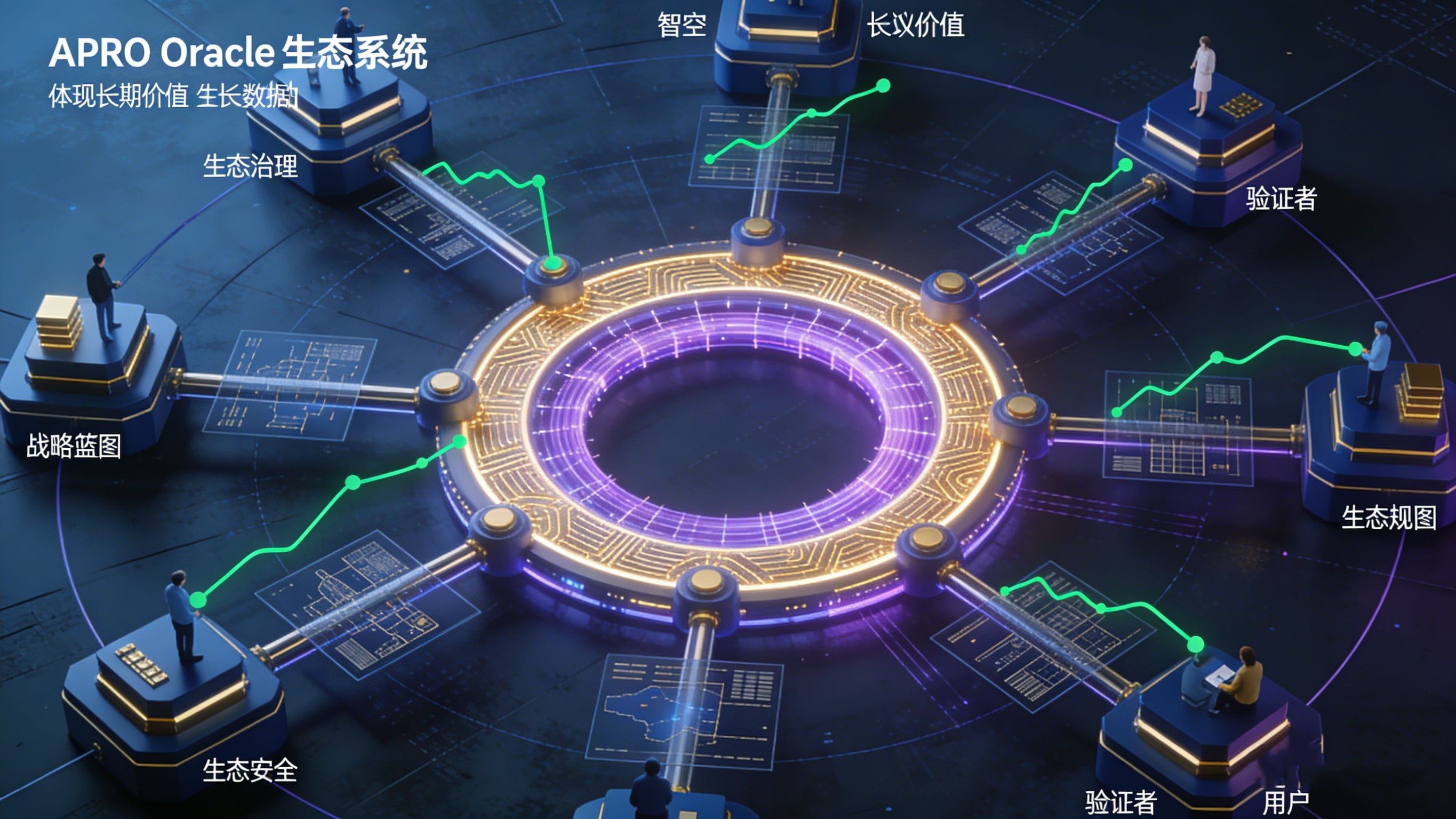
Ecological governance is the cornerstone of the stable operation of the APRO network. In a decentralized environment, nodes, developers, and token holders together constitute the participants in the ecosystem. APRO ensures that every network decision reflects the interests of all parties through a community co-governance model, maintaining fairness and transparency. Node operators bear the responsibility of data collection and verification, receiving rewards through token incentives while also facing penalties for violations. This design ensures the reliability of data services and maintains the balance of the ecosystem, allowing the entire network to remain stable even in the face of external shocks and market fluctuations.
The long-term economic model is the core means by which APRO constructs value sustainability. APRO has designed a reasonable token incentive mechanism that not only motivates node operators to provide high-quality data services but also allows ecosystem participants to gain benefits from contribution and governance. This incentive mechanism combined with decentralized governance gives the ecosystem self-repair capabilities. As more nodes and projects connect, network effects gradually become apparent, and every new contribution will strengthen the stability and value of the entire ecosystem. This model makes APRO not just a set of technical tools but also a carrier of long-term value in the Web3 world.
APRO's economic model and governance system also support cross-chain and real asset mapping. The realization of real asset mapping and multi-chain applications requires highly reliable and transparent data foundations, as well as network rules that can adapt to complex economic behaviors. APRO ensures that on-chain applications can obtain trustworthy information through decentralized data nodes and AI-driven data verification mechanisms, while providing economic incentives and community governance to ensure the continuous stability of data services. This design allows Web3 projects to safely conduct cross-chain transactions, asset tokenization, and automatic execution of smart contracts, promoting the diversified development of the ecosystem.
APRO's ecological governance is not limited to the technical level but also includes community participation and institutional building. Node operators, developers, and ordinary users can influence the direction of network development by participating in governance, proposing suggestions, and voting on decisions. The community governance mechanism allows the network to quickly respond to market changes and ecological needs, forming a self-optimizing capability. Meanwhile, transparent governance processes and rules reduce potential risks, enabling ecosystem participants to innovate and trade in a fair and safe environment. This governance model establishes long-term value and resilience for the APRO network, making it an indispensable infrastructure in the Web3 world.
In the design of economic incentives, APRO fully considers the operational costs of nodes, data quality, and the long-term development needs of the network. Nodes earn token rewards by providing data services while must comply with network rules to ensure the accuracy and timeliness of data. Violating or providing low-quality data nodes will be punished, and the combination of token incentives and punishment mechanisms forms a positive feedback loop. This economic design not only ensures the quality of data services but also enhances the stability of the network, allowing the ecosystem to remain efficient and sustainable in the long run.
The manifestation of long-term value also lies in APRO's bridging capability between real assets and on-chain ecosystems. As real asset mapping and cross-chain applications develop, the reliability of data and the sustainability of economic models determine the stability of the entire ecosystem. APRO provides decentralized, transparent, and auditable data services while maintaining network order through token economics and governance mechanisms, allowing on-chain assets to truly reflect real market value and providing fundamental guarantees for financial innovation. The stability and trustworthiness of the infrastructure are prerequisites for the long-term development of the ecosystem, and APRO's governance and economic design are at the core of this prerequisite.
APRO's ecological governance and long-term economic model also provide developers with greater freedom of innovation. Developers do not need to worry about data reliability issues or lack of economic incentives and can devote more energy to decentralized applications, smart contract strategies, and cross-chain innovations. Modular data interfaces and multi-source verification mechanisms allow developers to easily access the data they need and innovate while ensuring safety and reliability. This ecological environment not only enhances development efficiency but also strengthens the scalability and long-term competitiveness of Web3 projects.
The combination of community participation and economic incentives gives APRO a strong self-repair capability. When facing external attacks, market fluctuations, or node anomalies, the network can quickly adjust through consensus mechanisms and economic incentives. The collaborative participation of nodes, developers, and users allows the ecosystem to maintain resilience in complex environments and achieve long-term value accumulation. This design not only ensures the stable operation of the network but also provides a reliable data foundation and institutional guarantees for the Web3 world, allowing the entire ecosystem to continue developing healthily.
In the future, APRO will continue to optimize and innovate in ecological governance and economic models. As cross-chain applications and real asset mapping continue to expand, the network needs to handle more complex data and higher transaction volumes. APRO's decentralized node network, economic incentive mechanisms, and community governance will ensure that the network remains stable and efficient even under high load and multi-chain environments. At the same time, APRO will continuously improve the data verification mechanisms to enhance data reliability and availability, providing solid data support for developers and users.
APRO's strategic layout not only focuses on technological innovation but also emphasizes the long-term sustainability of the ecosystem. It builds a complete ecological foundation through governance mechanisms, economic models, community participation, and data services, enabling Web3 projects to operate safely, users to participate with confidence, and developers to innovate freely. This systemic design makes APRO an indispensable infrastructure in the Web3 world, providing guarantees for the long-term development and value accumulation of the ecosystem.
Follow APRO, and you are following the future and sustainable development of the Web3 ecosystem. Through a complete governance structure, reasonable economic incentives, and decentralized data services, APRO provides a stable, trustworthy, and efficient infrastructure for the Web3 world, enabling the entire ecosystem to maintain resilience and innovation in complex environments. Whether it is on-chain finance, cross-chain applications, tokenization of real assets, or AI-driven smart contracts, APRO could become a core support, providing irreplaceable guarantees for the long-term development and value accumulation of the ecosystem.
The existence of APRO Oracle reminds us that the future of Web3 is not only about technological iterations and short-term gains but also about building a long-term, stable, and trustworthy ecosystem. Through ecological governance and economic models, APRO injects resilience and value into the Web3 world, allowing the entire ecosystem to continue to develop healthily in complex environments and achieve true long-term value.

