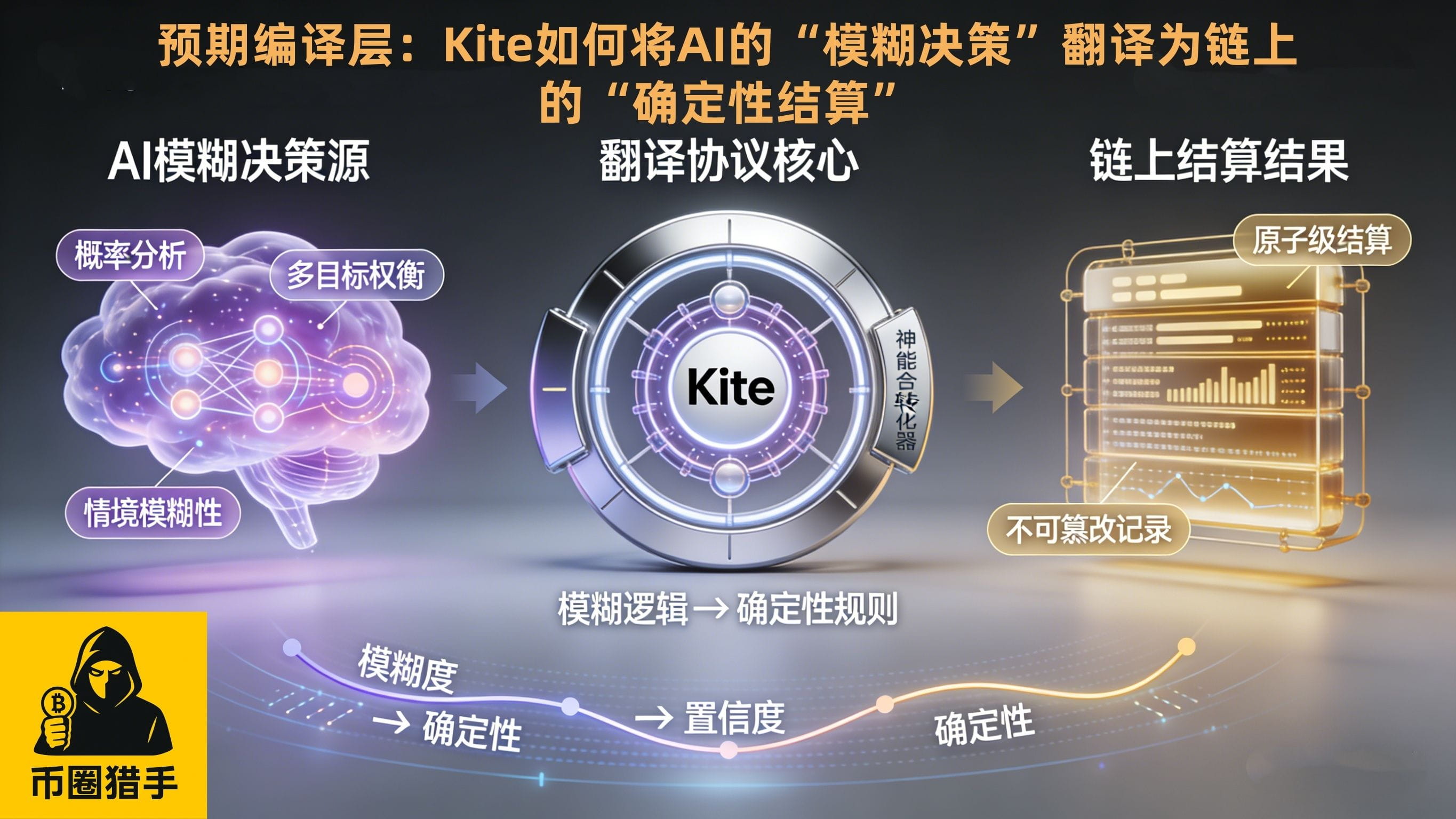
In the halls of traditional finance, all sacred contracts are built on an iron law: the absolute certainty of 'if-then' logic. If the value of collateral falls below a threshold, then liquidation is triggered; if the option's expiration price is higher than the strike price, then the price difference is paid. The blockchain, as a 'deterministic machine', perfectly executes such contracts. However, when we turn our gaze to the AI agent economy, a fundamental contradiction explodes: the essence of AI decision-making is 'probabilistic', while blockchain settlement requires 'certainty'. An AI trading agent's 'decision' might be: 'Based on current market sentiment (73% positive), there is a 68% probability that ETH will rise in the next 10 minutes, recommending a 70% position buy.' This is filled with 'possibility', 'probability', and 'confidence', creating a vague expectation that cannot directly serve as the basis for on-chain settlement, payments, or risk management. The current so-called 'AI + DeFi' mostly just allows AI to provide signals, leaving the final, definitive 'button' to humans—this completely castrates the autonomy of AI.
What Kite AI is building is an 'expected compilation layer' bridging probabilistic AI and deterministic blockchain. Its core function is not to enable AI to trade faster, but to compile, verify, and encapsulate AI's inherent, vague, probabilistic 'intentions' and 'expectations' into 'deterministic commitment packages' that the blockchain can natively understand and execute through a rule engine (programmable governance) and consensus mechanism (PoAI). The average daily 1.01 million interactions among agents in its network essentially complete 1.01 million compilations and executions from 'vague expectations' to 'deterministic settlements'. Understanding Kite means understanding how it solves the 'last mile' problem of AI economy on-chain—not data transmission, but the bridging of 'decision logic' and 'settlement logic'.
First compilation phase: From 'probability cloud' to 'causal constraint' (programmable governance layer)
AI's thinking is like a probability cloud, impossible to touch directly. Kite's first step is to impose verifiable 'causal constraint frameworks' on this cloud.
Input: Non-deterministic decision tendencies generated internally by AI agents (e.g., 'want to purchase data A, budget approximately between 0.1-0.5 USDC').
Compilation process: Developers pre-write 'causal constraint rules' for agents in smart contracts. For example: 'Allow purchases of data, but must be from certified data market modules, and single expenditure cannot exceed 0.3 USDC, with daily total not exceeding 10 USDC.'
Output: A strictly bounded, verifiable set of action instructions. The AI's vague intentions are 'compiled' into a list of clear atomic operations permitted to execute under specific conditions. This bridges the gap between 'what AI wants to do' and 'what it is allowed to do', framing uncertain intentions within a defined rule grid.
Second compilation phase: From 'unilateral claims' to 'multilateral consensus' (PoAI verification layer)
The decisions of a single AI (even after constraints) can still go wrong. Kite's PoAI consensus takes on the role of the 'expected verification compiler'.
Input: Specific action requests made by agents within the constraint framework (e.g., 'Pay 0.25 USDC to purchase dataset Y from data market X for completing prediction task Z').
Compilation process: Validator nodes in the network do not directly trust the agent's 'claims', but may instead:
Re-computation verification: Some nodes run similar tasks themselves to verify whether purchasing that data is reasonable and necessary for task Z.
Result cross-checking: For prediction-type tasks, aggregate and rationality check the prediction results of multiple agents.
Reputation consensus: Combine the historical reputation (passport records) of the requesting agent to weigh the rationality of this request.
Output: A 'verified expectation' endorsed by decentralized network consensus. This process elevates individual, potentially noisy or biased decisions to a relatively reliable 'social consensus expectation' validated by collective wisdom. PoAI transforms subjective 'I think it should be done' into objective 'network verification passed, can execute'.
Third compilation phase: From 'verified expectation' to 'deterministic settlement' (payment and execution layer)
Verified expectations need to be transformed into irreversible facts on-chain. Kite's payment layer (x402) is the final 'settlement compiler'.
Input: Action instructions verified by the PoAI network ('Pay 0.25 USDC to market X for data Y').
Compilation process: The system initiates the atomic settlement process. Through near-zero gas fees and sub-second confirmations for stablecoin payments, it completes the fund transfer and grants data access permissions within 1 second. A key innovation is 'conditional payment': payment instructions can be bound to data delivery proofs, achieving deterministic transactions of 'data in hand, money only deducted afterwards'.
Output: A deterministic settlement event permanently recorded and immutable on-chain. The AI agent's vague 'information acquisition demand' is transformed through three layers of compilation into a clear, auditable on-chain transaction record.
Modular ecosystem: Professional 'expectation compilation workshops'
Over 100 vertical modules, such as data markets, computing power leasing, and prediction platforms, essentially function as different fields' 'professional expectation compilation workshops'. Each workshop has pre-set optimized and standardized 'compilation rules' (transaction templates, dispute resolution mechanisms). When AI agents enter a specific workshop, they connect to a pre-tuned compilation pipeline, significantly reducing the cost of translating complex intentions into on-chain actions.
Data verification: The 'throughput' and 'stability' of the compiler
To evaluate the performance of a compiler, look at its throughput and error rate.
Compilation throughput: An average of 1.01 million interactions per day is the number of tasks this 'expected compiler' can stably handle. 17.8 million passports represent the number of 'information sources' connected to the compiler.
Compilation stability and reliability: Maintaining 99.9% availability during the market fluctuations of Q4 2025, proving that even when input information (market data) is extremely chaotic and noisy, the compiler itself (network consensus and payment layer) operates stably and reliably, without 'crashing' or 'garbled output'.
Compilation output quality: Near-zero latency payments and 1-second finality represent the speed and quality of compilation results (settlements). The lower the latency, the shorter the closed loop from AI forming intentions to realizing value, thus the higher the efficiency.
Essentially complementary to Bittensor: 'Generator' and 'Compiler'
In the value chain of AI on-chain, the two occupy distinctly different but necessary positions:
Bittensor (TAO) is the 'advanced expectation generator': It focuses on producing higher quality, more powerful 'probability clouds' (AI models), optimizing the 'raw materials' of the compiler.
Kite (KITE) is the 'universal expectation compiler': It focuses on efficiently, reliably, and securely compiling various qualities and types of 'probability clouds' (AI decisions) into deterministic code executable on-chain. It does not produce ideas; it produces feasibility proofs and execution frameworks for ideas.
The generator determines the depth of thought, while the compiler determines whether that thought can change the world. Investing in KITE is investing in the underlying toolchain for 'monetizing ideas'.
$KITE's value logic: the licensing of 'compilation rights' and the collection of 'settlement taxes'
In the expected compilation system built by Kite, $KITE is the core element that drives this system.
Certificate of compiled resource usage: Calling complex verification logic (PoAI), using advanced programmable constraint templates, gaining priority in expectation processing in popular modules may all require consuming or pledging $KITE in the future.
Medium of charging for compilation services: For every successful 'expectation compilation-settlement' service, the system may charge a small fee. Massive microtransactions (averaging 1.01 million daily) will aggregate into considerable cash flow, supporting the value of $KITE.
Governance rights of compilation rules: $KITE holders decide which new 'syntax' (asset types, constraint models) the compiler supports and how to optimize the 'compilation algorithms' (consensus parameters). This is control over the evolution direction of the AI economy's 'programming language'.
Thus, the value capture of $KITE originates from the total 'compilation demand' needed to realize AI decisions on-chain as deterministic actions in the future. Its value growth is proportional to the scale of the on-chain AI agent economy and the complexity of its decisions.
Hunter's perspective: Betting on the underlying translation protocol of 'AI intention chainification'
The explosion of the internet began with the HTML/HTTP protocol translating human 'information intentions' into machine-presentable web pages. The rise of blockchain stems from smart contracts translating human 'business logic intentions' into automatically executable code.
Currently, we are on the brink of an explosion in the next translation layer: translating AI's 'decision-making and collaboration intentions' into on-chain verifiable and executable deterministic actions. This is a key step to unlock autonomous AI economy.
Kite AI, with its full-stack three-layer compilation architecture (constraints, verification, settlement), is striving to become the standard protocol for this emerging translation layer. It does not produce the smartest AI, but it provides all smart AIs with the 'language' and 'syntax' necessary to transform their intelligence into on-chain reality.
Therefore, investing in $KITE is a bet on a more forward-looking dimension: betting that future on-chain economic activities will be driven by the autonomous decisions of massive AI agents, which must undergo credible transformation through a 'expected compilation layer' similar to Kite before impacting reality (completing payments, transferring assets). Whoever defines these transformation rules controls the 'value gateway' of the AI economic era.
When future AI agents sign a contract on-chain, they are essentially saying: 'Based on my internal probability calculations (AI model), and verified as compliant and feasible under Kite protocol constraints, I commit to execute the following deterministic actions...' At that moment, $KITE, as the underlying compilation protocol's equity certificate, its value is firmly tied to this new human-machine contract civilization.
I am a hunter in the crypto world, seeking those translators and architects who are building communication bridges between two intelligent species amidst the language barriers of code and algorithms.