

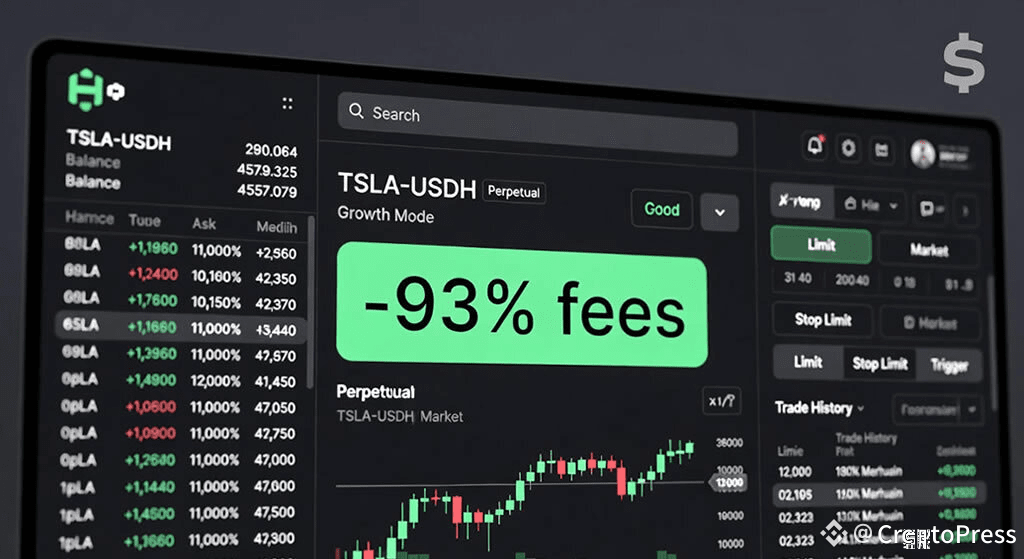
Imagine scrolling through your trading app, spotting a perpetual futures contract for Tesla stock or Nvidia shares—not on a traditional Wall Street platform, but right there on a blockchain, with fees so low they feel like a glitch. That’s the promise Hyperliquid is chasing with its latest upgrades. As decentralized finance (DeFi) heats up, platforms like Hyperliquid are making high-stakes trading accessible to anyone with a wallet, not just institutional whales. But high costs were holding back the party. Enter HIP-3 and its new “Growth Mode”—a smart fix that’s already sparking billions in volume.
In simple terms, Hyperliquid is a Layer 1 blockchain and decentralized exchange (DEX) built for perpetual futures, or “perps.” These are derivative contracts letting traders bet on asset prices without owning the underlying item, like crypto or stocks, with no expiration date. HIP-3 lets everyday builders create these markets permissionlessly, but early versions were pricey, scaring off traders. Growth Mode, launched in late November 2025, slashes those fees by 90% or more to kickstart activity. It’s a classic DeFi move: lower barriers, boost liquidity, and watch the ecosystem grow. Let’s break it down step by step, like explaining a new recipe to a friend who’s never cooked.
Growth Mode slashes fees by 90% or more to kickstart activity.
HIP-3 Simple Explanation
Here is a simple explanation of the situation with Hyperliquid’s HIP-3 and the new Growth Mode:
The Goal: More Markets, More Assets
Hyperliquid is a major decentralized exchange (DEX) for perpetual futures (perps). Perps let you bet on the future price of an asset.
HIP-3 is a recent update that allows almost anyone (who stakes a large amount of $HYPE tokens, currently 500,000 $HYPE, worth around $19.3 million) to launch their own perpetual futures market on the Hyperliquid platform.
The Big Idea: This opens the door for trading a much wider variety of assets beyond typical crypto, such as tokenized stocks (like TSLA-USDH or NVDA), commodities, or even indices (like the TradeXYZ NVDA perpetual contract).
 The Problem: High Costs Stalled Growth
HIP-3 markets were initially designed with higher trading fees than Hyperliquid’s standard markets to ensure the new market creators (called “deployers” or “builders”) and the protocol both earned revenue.
The Result: These higher fees made the new markets “expensive to trade,” which discouraged traders from using them. This led to low liquidity (not enough supply/demand) and light trading activity on the new, innovative markets.
 The Solution: Growth Mode’s Fee Cut
Growth Mode is a new feature for HIP-3 markets that directly addresses the cost issue.
How it Works: It drastically cuts the all-in trading fees for new perp markets by at least 90%.
For example, standard taker fees (before discounts) might be around 0.045%, but with Growth Mode, they can drop to a range of 0.0045%–0.009%.
For top-tier traders with maximum discounts, the fee can go even lower, potentially to 0.00144%–0.00288%.
The Goal: By making trading much cheaper, Growth Mode gives users a stronger incentive to trade on these new markets, helping them attract more traders and build up liquidity.
This allows the new HIP-3 markets (like those listing stocks) to finally compete on cost with other platforms.
Key Statistics from the Text
HYPE Staking Requirement for HIP-3: 500,000 HYPE tokens (approx. $19.3 million USD).
Fee Reduction: At least 90% for new markets in Growth Mode.
Hyperliquid Total Value Locked (TVL): Around $4.5 billion.
Hyperliquid Trading Volume (Last 30 Days): $264 billion.
Hyperliquid Trading Volume (Last 24 Hours): About $9.5 billion (holding 3rd place on the day).
Top HIP-3 Protocol (TradeXYZ) 24-Hour Volume: $200 million.
Top HIP-3 Protocol (TradeXYZ) Open Interest (OI): $103 million (new all-time high).
Top Perp DEX by Trading Volume Today: Aster with just over $11.5 billion.
Real-World Wins and the Bigger Perps Boom
Growth Mode isn’t theory; it’s delivering. TradeXYZ, top HIP-3 protocol by volume, crossed $200M daily amid Nvidia hype—proof decentralized perps can handle earnings-season frenzy. HIP-3’s total volume? Over $5B in weeks, with $3M daily fees for Hyperliquid. That’s real demand for on-chain stocks, echoing how dYdX pioneered crypto perps but now Hyperliquid eyes TradFi’s lunch.
The mania extends chain-wide: Aster’s token hit $1.9B cap post-launch, Lighter topped volumes in November. Hyperliquid’s $264B 30-day volume (as of late November) underscores the shift—traders want speed, low costs, and composability (mixing perps with lending, like Felix’s USDH margins).
Risks and Challenges: Not All Smooth Sailing
No DeFi upgrade is perfect. Growth Mode trades short-term revenue for long-term volume—Hyperliquid sacrifices 90% of HIP-3 fees, pressuring $HYPE buybacks amid unlocks (9.92M tokens, ~$320M, hit November 29, with $11.9B vesting over 24 months). $HYPE dipped 6% post-launch to under $40, reflecting supply jitters.
Why This Fuels Crypto’s Future
Growth Mode positions Hyperliquid as DeFi’s innovation lab, blending crypto’s openness with TradFi’s depth. Expect more wild assets: tokenized yields, FX, even niche indices. As volumes climb (HIP-3 staking data will be key), it could flip market share from CEXs, especially in emerging markets hungry for borderless tools.
For beginners: Start small on Hyperliquid’s testnet to grasp perps. Intermediates, eye HIP-3 launches for alpha—stake $HYPE if you’re bullish, or trade low-fee equities for diversification. Risks like leverage amplify losses, so use stop-losses and never bet the farm.
In a world of fleeting trends, upgrades like this remind us DeFi’s power: democratizing tools once reserved for suits. Hyperliquid isn’t just fixing fees—it’s building the on-chain economy’s trading floor.
Key Takeaways:
HIP-3 empowers anyone to launch perps with a big $HYPE stake, expanding beyond crypto.
Growth Mode cuts fees 90%+ to ignite liquidity in new markets.
Early results: $5B+ HIP-3 volume, records in OI and fees.
Watch for $HYPE unlocks, but long-term, it’s a bet on DeFi derivatives.
Subscribe to Cryptopress.site for more breakdowns on DeFi innovations.
The post Hyperliquid’s Growth Mode: Making New Markets Cheaper appeared first on Cryptopress.

