

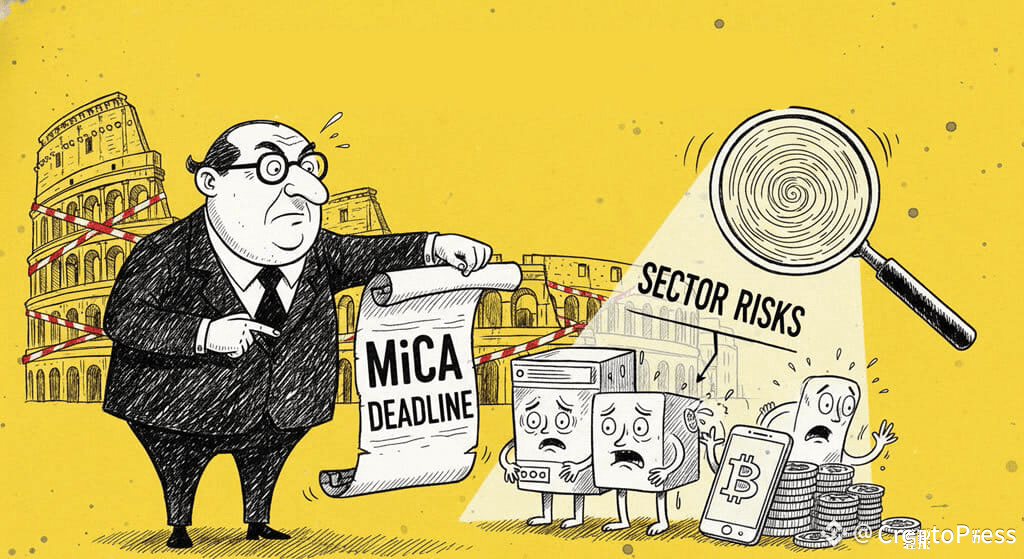
Consob mandates that VASPs apply for CASP authorization under MiCA by December 30, 2025, or cease operations in Italy.
Applying firms may continue services during review, up to June 30, 2026.
Italy’s Macroprudential Policy Committee has started an in-depth assessment of crypto risks to retail investors due to growing ties with traditional finance.
Italy’s financial regulator, Consob, has issued a critical reminder to cryptocurrency firms operating in the country, emphasizing the need to comply with the European Union’s Markets in Crypto-Assets (MiCA) regulation by the end of the year.
Under the transitional provisions, virtual asset service providers (VASPs) registered with Italy’s Organismo Agenti e Mediatori (OAM) can operate until December 30, 2025, but must submit applications to become crypto-asset service providers (CASPs) by that date to avoid shutdown, as detailed in Consob’s recent statement.
Firms that apply on time may continue serving customers while their applications are reviewed, with operations permitted until approval, rejection, or no later than June 30, 2026. Non-applicants must terminate contracts, return client assets, and communicate clear exit strategies to users.
This guidance follows Consob’s earlier communications, including a specific warning sent to unregistered VASPs on October 31, 2025.
In a related development, Italy’s Committee for Macroprudential Policies—comprising Consob, the Bank of Italy, and other authorities—convened on December 5, 2025, to address emerging vulnerabilities from crypto assets’ integration with the financial system.
“Diverging crypto regulation does create real risks,”
Ruchir Gupta
The committee highlighted concerns over regulatory fragmentation globally and the lack of visibility into risks, noting that about 75% of major Bitcoin (BTC) holders are U.S.-based, limiting eurozone oversight.
An in-depth review of retail investors’ direct and indirect exposure to crypto has been launched, driven by recent market surges and policy shifts, such as those in the U.S. following political changes.
Experts warn of potential systemic risks. Ruchir Gupta from Gyld Finance stated, “Diverging crypto regulation does create real risks,” pushing activities into less-supervised areas.
The moves signal Europe’s push for stricter supervision under MiCA, which could increase compliance costs but provide regulatory certainty for firms dealing in assets like Ethereum (ETH). While enhancing investor protection, this may lead to market consolidation as smaller players struggle to adapt.
Investors are advised to verify providers’ status via official registers to mitigate risks during this transition.
Disclaimer: This article is for informational purposes only and does not constitute advice of any kind. Readers should conduct their own research before making any decisions.
The post Italy Warns Crypto Firms of MiCA Deadline appeared first on Cryptopress.

